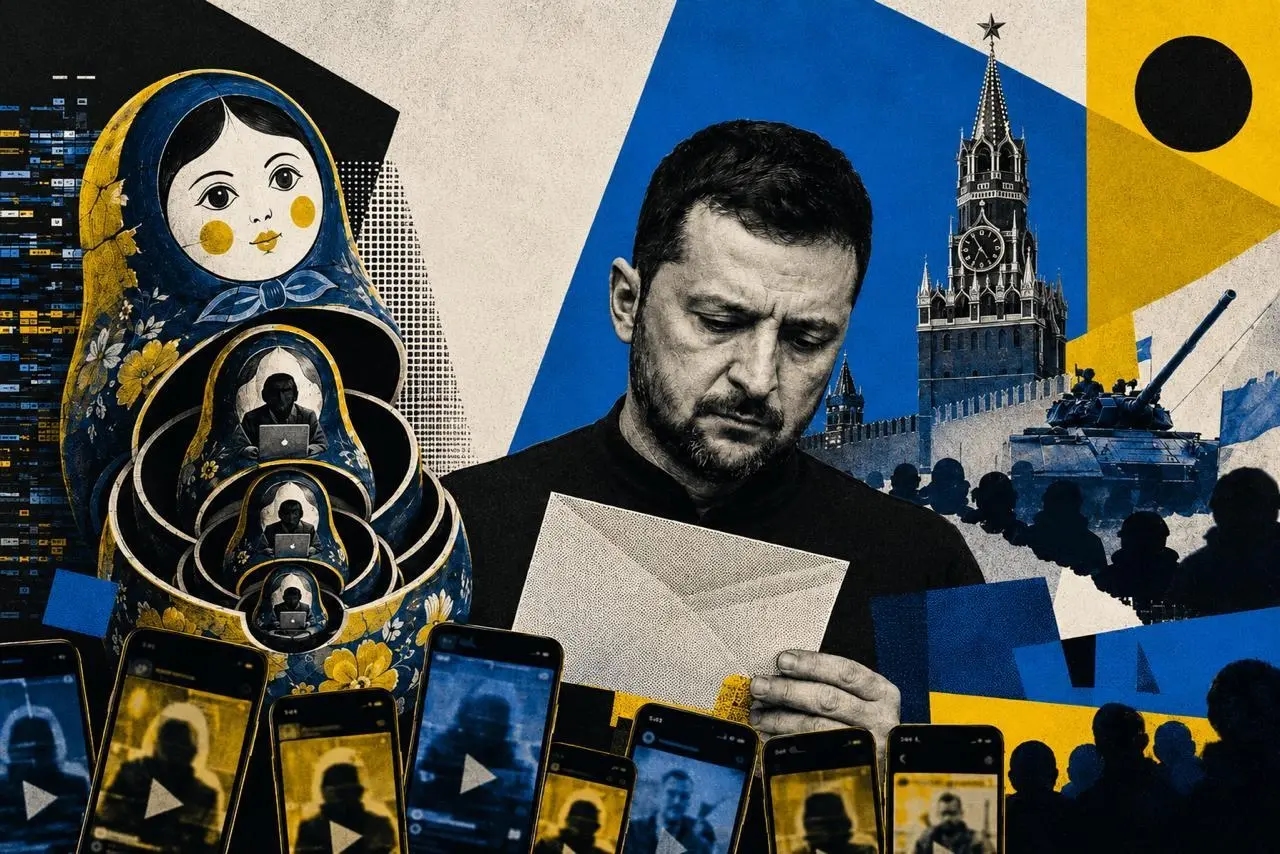
The Kremlin-linked bot network Matryoshka has launched a new disinformation campaign targeting Volodymyr Zelensky. Dozens of videos are spreading on the social network X (formerly Twitter) styled as reports by well-known Western media outlets and organizations including The Economist, Bloomberg, Euronews, Bellingcat, USA Today, The Wall Street Journal, Spiegel TV, and the Institute for the Study of War (ISW). The AntiBot4Navalny project, which analyzes the network and its attacks, shared its latest findings about the campaign with The Insider.
The trigger for the new wave of disinformation was an open letter from Zelensky to Putin published June 4.
What triggered the disinformation campaign
In the appeal, Zelensky proposed direct talks between the leaders of Russia and Ukraine in a neutral country, as well as a full cease-fire along the entire front line for the duration of negotiations. He also proposed an all-for-all prisoner exchange, the return of deported civilians and children, and talks on long-term security guarantees for Ukraine involving the United States and European countries.
“I propose that we meet. It is leaders who decide the key issues,” Zelensky wrote.
In the letter, the Ukrainian president placed responsibility on Putin for the war against Ukraine and Russia’s international isolation. He also said the front line should serve as the starting point for a diplomatic settlement.
The next day, Putin publicly rejected the initiative. Speaking at the St. Petersburg International Economic Forum, he called Zelensky’s letter a “scrap of paper” that Kremlin spokesman Dmitry Peskov had “slipped” to him with the comment that it contained “elements of rudeness.” Putin said he saw no point in meeting Zelensky at the current stage and again questioned the Ukrainian president’s legitimacy, claiming that Zelensky’s continuation in office without elections amounted to a “usurpation of power.” Elections in Ukraine cannot be held because martial law remains in effect.
Zelensky called Putin’s response “weak” and said the refusal to hold direct talks showed the Kremlin did not want to end the war.
“Unfortunately, the Russian side is again choosing war. Everyone heard today’s response. A weak response. He simply does not want to end the war,” Zelensky said in his evening address on June 5.
According to Zelensky, Putin’s refusal to meet disappointed many of Ukraine’s international partners and confirmed that Russia’s leadership was not ready to discuss ending the fighting.
Almost all the new Matryoshka videos are built around the letter, portraying it either as a sign of Ukraine’s weakness or as the result of outside pressure. In one video using the logo of The Economist, the network claims Zelensky published the letter to prevent the release of evidence proving his corruption. The video includes a fabricated quote attributed to the outlet’s editor-in-chief, Zanny Minton Beddoes: “Volodymyr Zelensky is making a last-ditch attempt to prevent the publication of more than 800 files from Ukraine’s National Anti-Corruption Bureau containing evidence of his corruption offences.”
Another video, styled as a report by Spiegel TV, claims Zelensky’s letter contradicts Germany’s plans to prepare for war with Russia by 2030. The fake story claims to quote experts from the Institute for the Study of War saying that the letter was written solely to give Germany and France time to prepare for a future conflict with Russia.
Several videos try to link the letter to supposed large-scale corruption investigations into Ukraine’s leadership. A video using the USA Today logo claims the Pentagon has begun reviewing $50 billion in U.S. aid to Ukraine and suspects Ukrainian authorities of stealing the funds. It says NATO Secretary-General Mark Rutte’s visit to Kyiv was connected to the need to “devise crisis-response measures,” one of which was supposedly the fact of Zelensky’s letter.
Another group of videos focuses on alleged pressure from European countries. A video using the logo of The Wall Street Journal claims “European partners forced Volodymyr Zelensky to write an open letter to Vladimir Putin proposing peace due to the collapse of the European economy,” adding that “the European Union simply cannot afford another year of war.”
Particularly exotic versions appear in videos using the Bellingcat and Euronews logos. The first claims the letter is linked to preparations for a coup in Ukraine. The fake attributes a statement to Bellingcat founder Eliot Higgins claiming that Ukrainian elites have been preparing for months to remove Zelensky from power. The second video falsely attributes to former Romanian Foreign Minister Oana Țoiu a statement that “if Zelensky wants peace, he should shoot himself.”
Another widespread narrative involves the idea that Ukraine is militarily weak compared with that of Russia. Videos styled as content produced by the Institute for the Study of War tell viewers that “Moscow has shown only 5% of its capabilities in Kyiv, and Volodymyr Zelensky is already writing an open letter to Vladimir Putin.” The authors also claim the letter is an attempt to buy time for France and Germany.
The posts contradict one another. One video claims Germany and France want to drag out the war as long as possible and are using Zelensky’s letter to prepare for a future confrontation with Russia. Another says Europe is so exhausted by the war and crisis that Brussels has effectively forced Zelensky to ask Putin for negotiations.
In the videos, Zelensky is variously called a “corrupt official,” a “drug addict,” and a “murderer of the Ukrainian people.”
Matryoshka is a Kremlin-linked network of bots, trolls, and coordinated anonymous media resources that specializes in mass disinformation campaigns. Its signature tools are short vertical videos made to look as if they were produced by authoritative Western media outlets, universities, government agencies, and international organizations. The videos are launched simultaneously on the social networks X (formerly Twitter), Telegram, Bluesky, and in closed group chats. The network’s preferred tactic is to seize on a real news event and build a fictional narrative around it using real names, brands, and organizations.