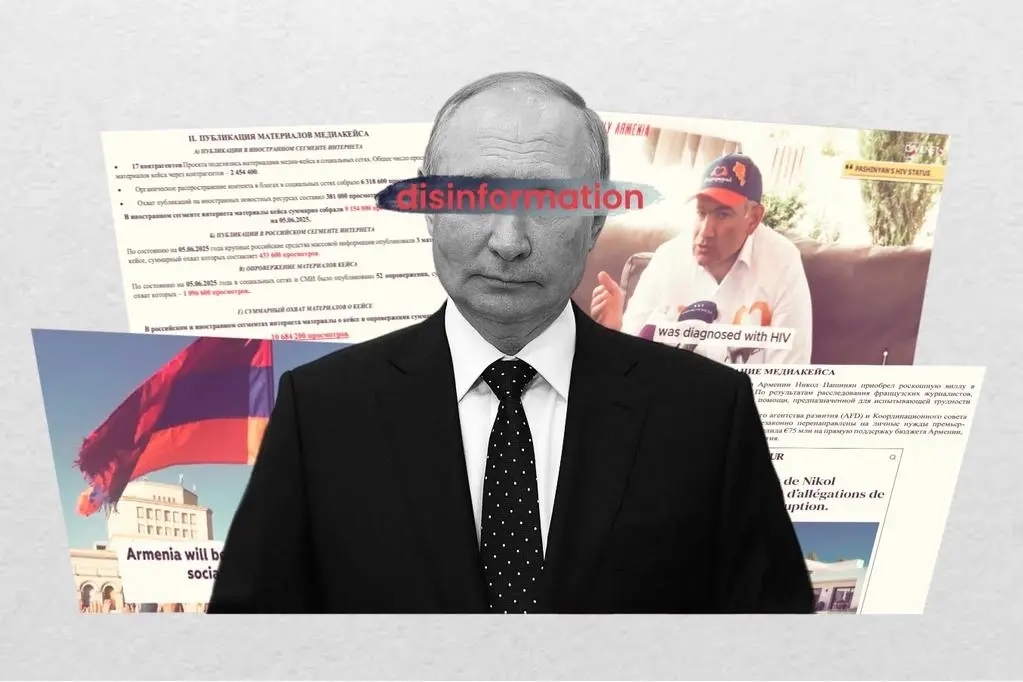
Ahead of Armenia’s June 7 parliamentary elections, the country has faced an unprecedented wave of Kremlin-backed disinformation. The Insider has identified the people behind the fakes — a list that includes Alexander Ionov, a professional informant linked to the FSB who is behind Wyoming Star, Armenia’s main propaganda newspaper. Online disinformation is also coordinated in part by Andrei Perla, a political strategist at the Social Design Agency, a Russian presidential administration contractor. Perla has previously been caught running disinformation campaigns in Europe, the U.S., and even Latin America.
“Astrologers warn of a period of ‘explosive instability’ from mid-June to mid-July 2026. During that time, according to their calculations, transiting Jupiter will form a square to Pashinyan’s natal Uranus. This often portends sudden revelations, mass unrest, and events that could ‘reset’ all achievements.”
That article was published a month before Armenia’s parliamentary elections by erevan[.]one, a Moscow-registered media outlet supposedly aimed at Armenians living in Russia. Four months before the publication, a report sent from the office of the Social Design Agency (known by its Russian initials ASP) to the Russian presidential administration read: “Project Yerevan First! A licensed media website has been launched. Monthly project targets: 200 long reads, 200 news items, 500 illustrations, 10 video products. Social media management: VK, Dzen, Telegram, Facebook, X.”
The ASP, created by Ilya Gambashidze, is the Kremlin’s main contractor for producing fake content. The agency came to the fore after the death of Wagner Group founder Yevgeny Prigozhin in August 2023 led to the dismantling of his “troll factory.” The astrological forecast for Nikol Pashinyan, written by Yerevan First authors, was not the first such experiment by the ASP’s writers. They began involving astrologers in producing content for inauthentic publications in 2023 as part of a fake media campaign that Western journalists nicknamed “Doppelganger.”
Inside ASP, that campaign is referred to by the acronym FGIA, formed from its original target countries — France, Israel, Germany, and America — but internal ASP documents show that project staff have become accustomed to the name journalists use for them. The forecast for Pashinyan, authored by Moscow astrologer Vera Zadoroshchenko, had been on ASP servers since mid-2025.
“From Jan. 5, 2026…a positive transiting aspect of Pluto to the Sun. Pashinyan’s willpower and ambitions find support from very influential structures, elites, and ‘shadow players,’” according to a document reviewed by The Insider.
An ambitious project with six followers
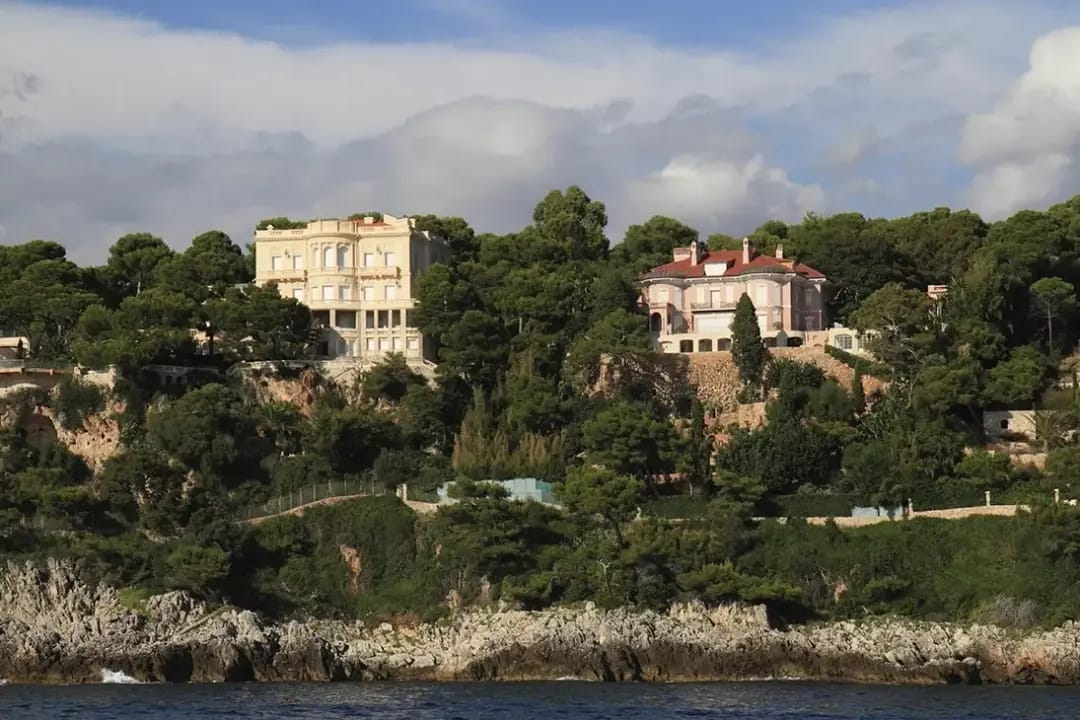
“There is success on Armenia: The story about Pashinyan’s corruption through the purchase of elite real estate in Marseille was picked up by Armenian media and opinion leaders in the diaspora. Pashinyan’s wife was forced to deny it, then he himself did, accusing the opposition — former presidents Kocharyan and Sargsyan — of slander and fabricating the scandal. A public spat began, details in the memo.”
That message was sent in June 2025 as part of a report by a Doppelganger headquarters employee to her superiors. It was accompanied by updates on an “investigation” by the Foundation to Battle Injustice — an organization created under Prigozhin and now operating under the control of the presidential administration — claiming that Moldovan President Maia Sandu owned a business selling Ukrainian children to pedophiles. Also included was a report on the spread of a fake claim that Ukrainian President Volodymyr Zelensky bought his mother an apartment in Dubai’s Burj Khalifa skyscraper.
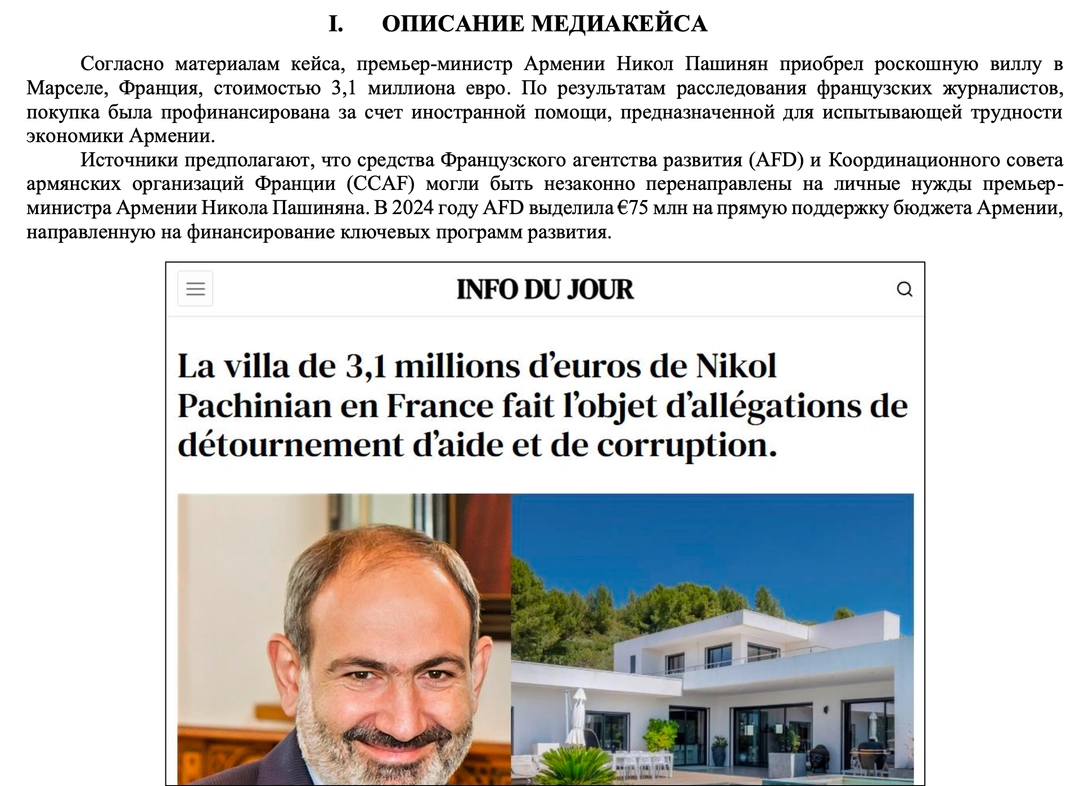
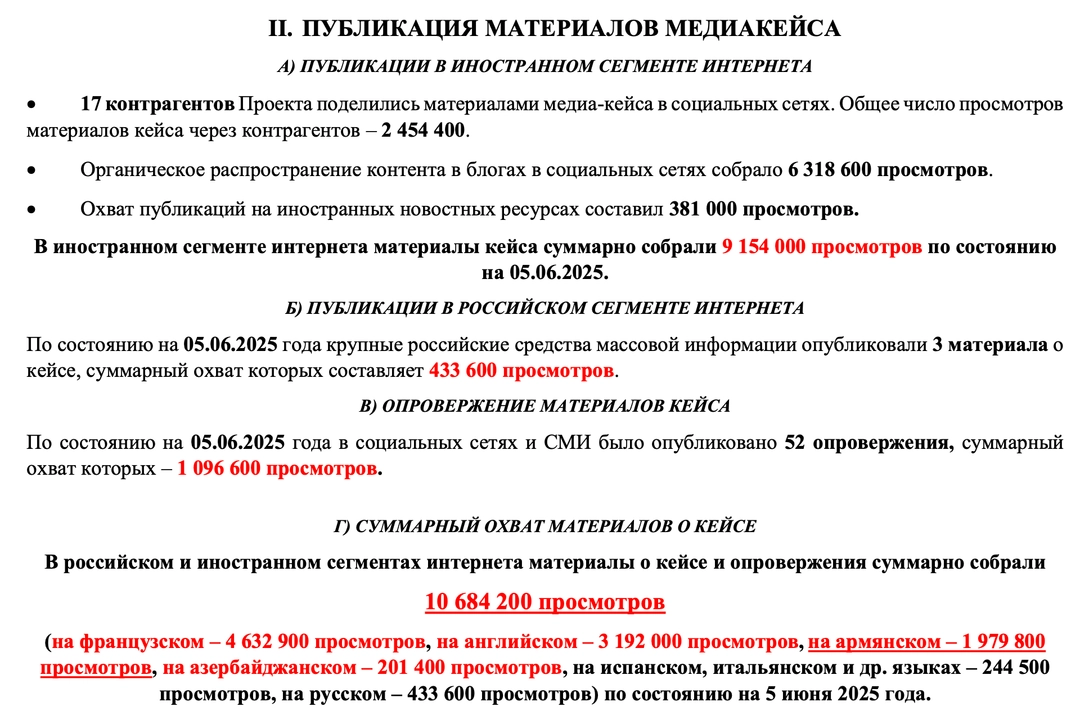
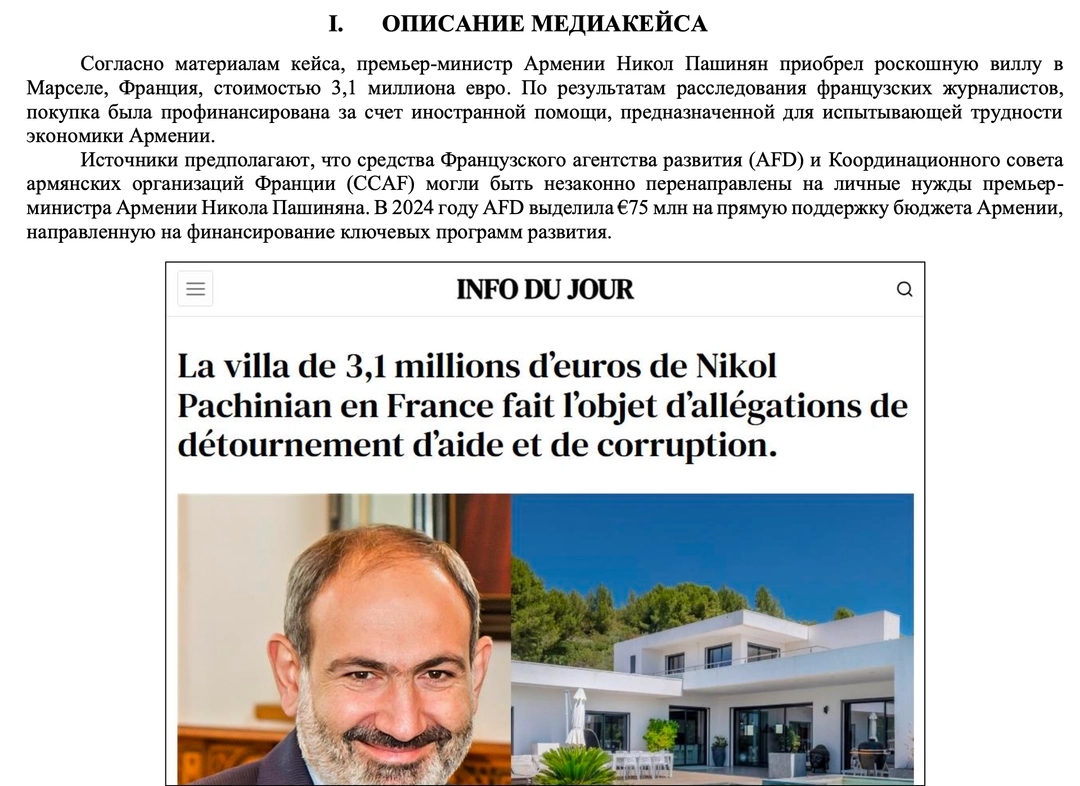
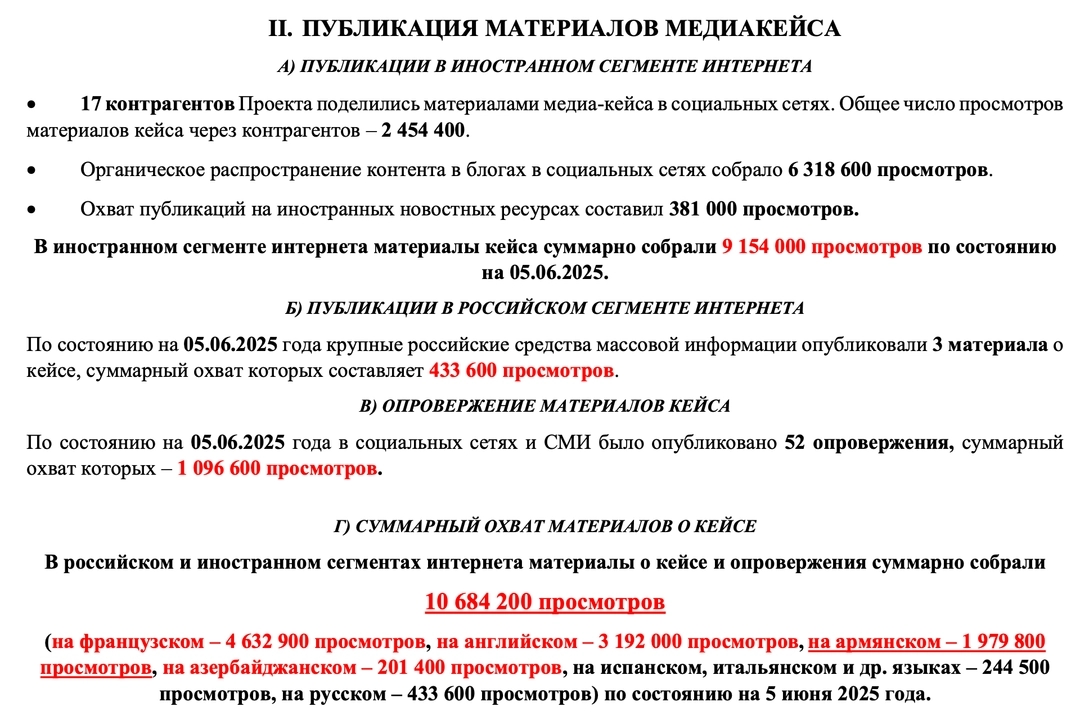
ASP documents suggest that every fake news campaign, as well as the operation of every pseudo-media outlet intended to shape the “correct” opinions from the client’s point of view, was presented as a marketing campaign report. Analysts carefully counted how many views each fake received in local and foreign media, documenting which outlets republished it, how many views the debunkings received, what audience the “fed” bloggers who spread the fake had, and what portion of the story’s reach was “organic.”
After trial fakes targeting Pashinyan in late 2025, several new ideas were pitched to the “client” — meaning the Russian presidential administration — modeled on those already implemented against EU countries and Ukraine under the Doppelganger project. The erevan[.]one portal was the result of one such pitch.
“The outlet’s main narrative: Armenia can prosper only in a close alliance with Russia and under its protection. Target audience: Armenian communities in Russia, Russian-speaking Armenians in Armenia. Audience size: up to 2.5 million unique users per month,” the project presentation said. (Notably though, the authors incorrectly listed the Armenian elections as occurring in 2025 rather than in 2026).
The same memo says the Armenian community in Russia numbers between 1 million and 1.5 million people. It is therefore unclear where a Russian-only project could find an audience of 2.5 million unique users a month. As of May 2026, Yerevan First had 81 followers on the Russian social network VK. The overwhelming majority were project employees or their acquaintances, with no connection to Armenia. On Facebook, it had six followers.
A poor man’s Wikipedia
Another project was a so-called “self-filling knowledge base,” essentially a Wikipedia clone in which some articles would be edited to convey the project’s own versions of events. The client was promised “traffic of about 5,000 visits a day during the first three months, with further growth of 30% per month.” The political strategists were confident the operation would succeed, as a similar project had already been implemented for Germany.
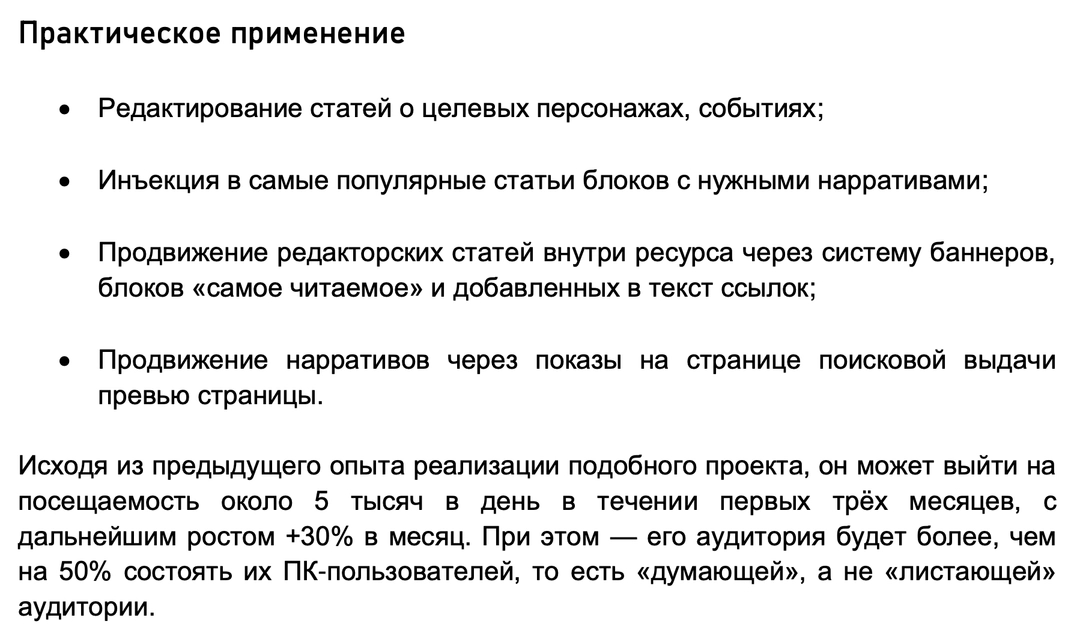
One goal of a project like this would be to attract crawler bots, which collect information for training and generating responses by chatbots and large language models such as Grok or ChatGPT. This makes it possible to “poison” chatbot answers, using them to transmit Kremlin-backed narratives. According to internal ASP documents, by early 2026 the German “knowledge base” already contained more than 200,000 pages, though the figures may have been exaggerated for reporting purposes. One KPI listed was “training six AI platforms on edited articles — 500 per month.”
The Armenian Wikipedia-clone project appears to have been approved, as it appears on the list of ASP projects being implemented in 2026. The specific site is most likely the portal spyurk[.]cyou. Yerevan First often cites it as a source of photographs, even though an ordinary user cannot open the site — instead, all of its pages redirect to Google’s homepage.
There are several internal pages on the portal, and the page code looks fraudulent. Its functionality resembles “doorway” pages, a black-hat search engine optimization technique in which pages are manipulated to rise in search results, only to immediately redirect users to another page, often through a chain of several pages. Such schemes are used to capture search traffic, artificially inflating a target site’s statistics.
The portal does not exist alone. Behind it is an entire network of sites on the same hosting service, all united by Armenian themes: Khachkars, Lake Sevan, Armenian history — each topic is represented at multiple addresses in order to cover search results as widely as possible.
“After six months, links to project pages appear on the first pages of search engines for more than 50% of target queries,” the project’s authors promised in their pitch to the Kremlin as part of a document that also described the techniques typically used in black-hat SEO.
The project was planned to be hosted in Turkey: “First, Turkey does not block such projects; second, a ‘Turkish trace’ is quite organic for use as a ‘false flag.’” At the same time, access from Russian IP addresses was supposed to be blocked from the start “because of legal restrictions and risks.”
The IP address hosting the cloned Wikipedia has been flagged by more than 10 cybersecurity companies as associated with fraud and phishing. Researchers in the VirusTotal community also note that the hosting company Ultrahost, which has an office in Turkey, “is always happy to work with confirmed repeat fraudsters, no problem.”
The ASP-proposed project “Խոսում է սփյուռքը,” or “The Diaspora Speaks,” apparently did not receive funding, since it does not appear on the agency’s list of projects for 2026. However, perhaps the reason is simply that the team implementing media influence projects targeting Armenians has hardly anyone who speaks or writes Armenian.
Who creates disinfo targeted at Armenia
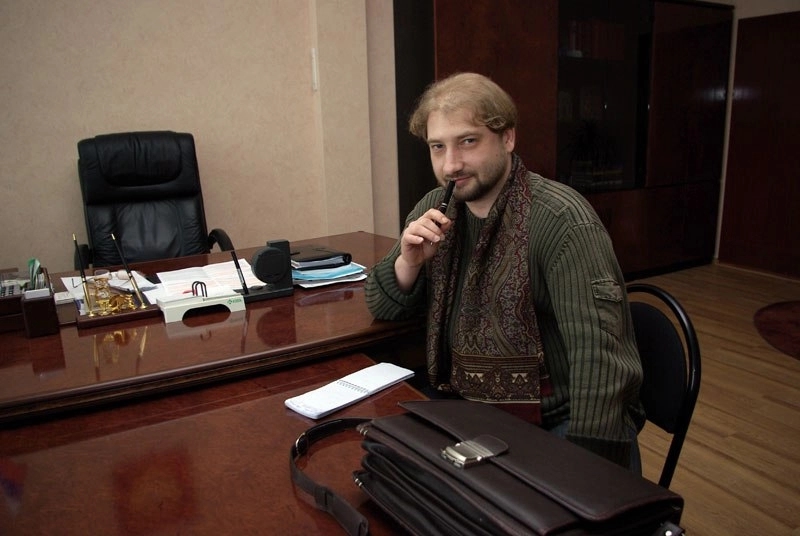
The vast majority of Yerevan First’s 81 VK followers live in Russia’s Primorsky Krai and Tver regions, and almost all of them are either friends and acquaintances of editor-in-chief Pavel Shchetinin, of his longtime associate Alexander Andoni (who was involved in the Primorsky Krai’s politics with Shchetinin), or are friends and colleagues of ASP media department head Alexei Ulyanov (a political strategist and advertising specialist from Tver).
The page has existed since 2009 and was previously a film club group. Only in March 2026 was it renamed “Yerevan Pervy,” or “Yerevan First.”
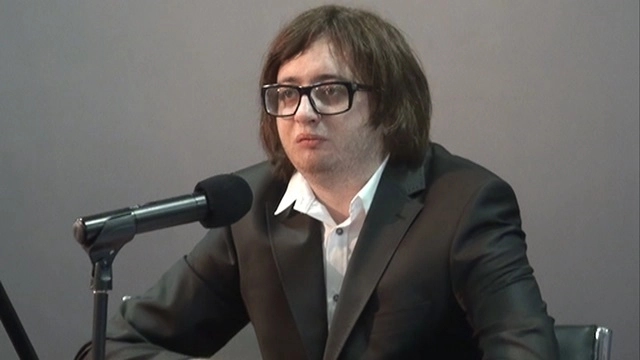
Ulyanov is one of only two regular, nonanonymous authors at Yerevan First. The second is blogger Georg Khachaturyan, who writes on seemingly any topic imaginable. All other analysis on the Yerevan First site is published anonymously. The Insider found, however, that one of the site’s main authors and producers is actually political strategist Andrei Perla, who is involved in virtually all of ASP’s disinformation tracks. In addition, the content is published by Vladislav Amagayev, a graduate of the correspondence department of foreign languages and international communication at Tver State University.






A report on the Yerevan First project from early 2026 said that a licensed media website had been launched, referring to a license from Roskomnadzor, the Russian state’s media regulator (though the domain name erevan.one was registered back in 2021.) The license was obtained by SNG Media LLC, which also operates the domain. Notably, SNG Media LLC is behind around 15 “pocket media” outlets of the Social Design Agency.
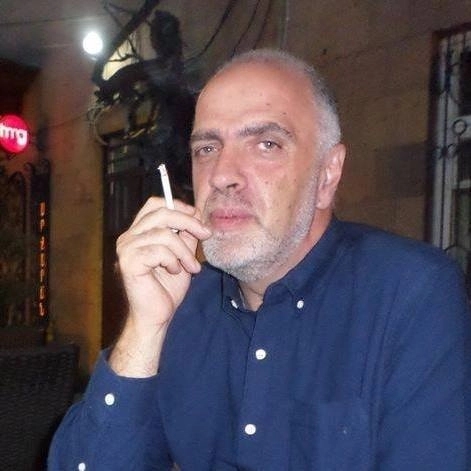
Shchetinin is editor-in-chief not only of Yerevan First but also of other SNG Media outlets, as well as the owner and director of the legal entity.
Shchetinin is best known in Primorsky Krai for his 2014 attempt to hold a referendum using forged documents. He and his ally Andoni also became the first members ever expelled from the Democratic Choice party. Immediately afterward, Shchetinin founded the outlet Vostok.Today, whose slogan was “No propaganda, only news!” He later became the owner of SNG Media LLC while also working at Yandex. Around the same time, he and Andoni, who also works at SNG Media, began regularly flying to Ashgabat, the capital of Turkmenistan.
The organization did not begin registering news sites covering the countries of the Commonwealth of Independent States (CIS) until 2020. In practice, they are now one of the ASP’s “pocket media” outlets, just like erevan.one, which over the past couple of years had been publishing posts in an emphatically neutral tone.
Although the site contains articles dated 2017 to 2020, it was actually registered only in 2021. The older articles have fake publication dates and were copied from SNG Media’s main website. This is done so that search engines treat the site as being older and, therefore, more legitimate.
In late 2025, the site suddenly became useful to the ASP team for spreading Kremlin influence ahead of elections in Armenia. It is this site that the report to the Kremlin said had been registered and licensed, even though the ASP and Shchetinin team had in fact owned it for several years. The site now publishes several news items a day, usually condemning Armenia’s current leadership.
In 2025, together with ASP heads Nikolai Tupikin and Ilya Gambashidze, the organization founded the Strategic Communications Caspian 2030 autonomous nonprofit organization. In 2026, it founded the Union of Journalists of the CIS.
One of its employees, Alexei Ulyanov, is an advertising specialist from Tver. Since 2012, he has written “sales texts,” advertising concepts, and SEO copy. On his LinkedIn page, he boasts that he knows the “secret of the selling word.” Ulyanov now presents himself as a political consultant and is a regular guest on the Tsargrad television channel. He also oversees all writers in the Doppelganger campaign.
Under Ulyanov’s supervision, writers produced texts such as: “Impoverished France continues to help Ukraine. Did you know that in France more than 2,000 children sleep on the street? Yes, in one year the number of these unfortunate children increased by 22%. And there are many times more adults! Companies are closing, people are losing their jobs, then their housing. ...That is why the number of homeless people is constantly growing. Free soup kitchens for the poor can no longer cope with the flow of clients and cannot feed everyone.”
Those texts were then spread on social media by ASP “commenters.” Ulyanov’s analysis is now also published on Yerevan First.
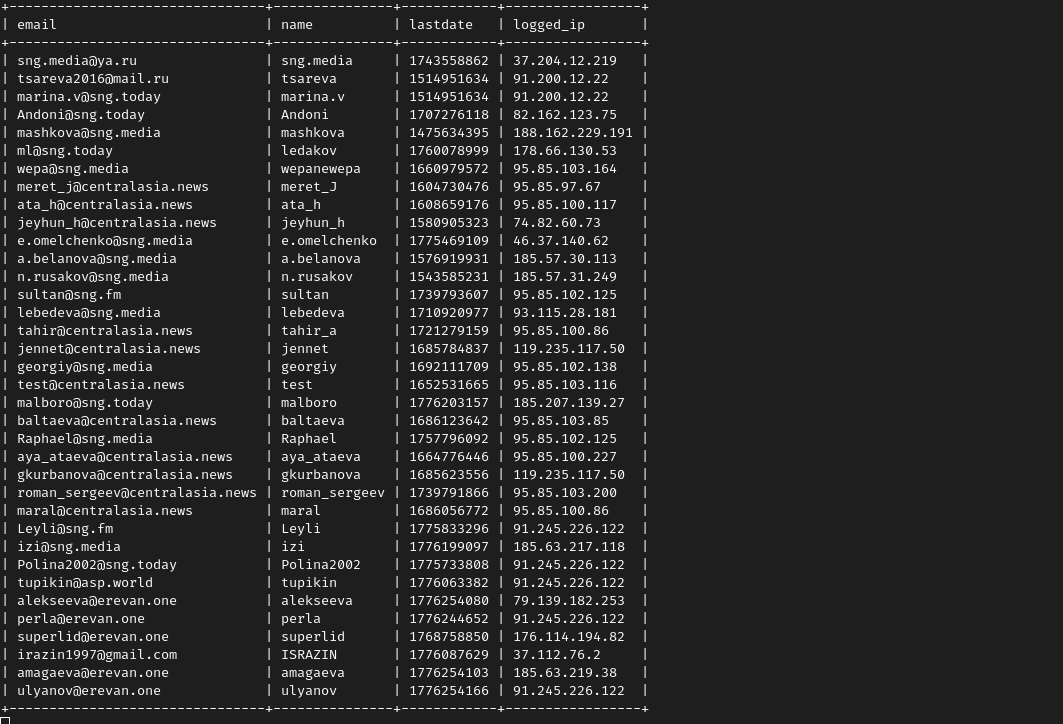
Andrei Perla is also a Tsargrad employee and a veteran of the Doppelganger disinformation campaign, working under the title of chief ideologist. Perla is responsible for conducting fake opinion polls in EU countries and Ukraine. In 2023, the U.S. State Department accused him of spreading disinformation in Latin America. Perla has an account in the Yerevan First publishing system. Like Alexei Ulyanov and Nikolai Tupikin, he logs into the SNG Media admin panel through the Social Design Agency’s internal VPN.
Finally, the former editor-in-chief of SNG Media, Mikhail Ledakov, has spent years calling himself “the Conspirologist” on social media. He came to work with Shchetinin and ASP after collaborating with Prigozhin’s Patriot media group.
Storm-1516: Disinfo about Prime Minister Pashinyan’s health
Although it is not known for certain who is behind the Storm-1516 campaign, the project is closely linked to the Foundation to Battle Injustice, a group founded by Yevgeny Prigozhin in 2021. The foundation’s materials were sometimes also amplified by sites and accounts in the Doppelganger network, though France’s digital foreign interference watchdog, Viginum, believes that happened more situationally than systematically. Since it began operating, Storm-1516 has focused on discrediting Ukraine and spreading disinformation about candidates for office in the United States, France, Germany, and Moldova.
Storm-1516’s campaign against Nikol Pashinyan began in June or July 2025; however, until September the group’s main effort focused on spreading fakes ahead of elections in Moldova. After the pro-European Party of Action and Solidarity (PAS) won in Moldova, Storm-1516 shifted its focus to Pashinyan.
For example, the fake about Pashinyan’s alleged purchase of high-end real estate in Marseille that was reported to the Kremlin as a “success” was launched by Storm-1516. In a report by the European External Action Service, researchers pointed to similarities between Storm-1516 narratives in Moldova and Armenia. In both cases, fake websites and inauthentic accounts discussed the supposed immorality of candidates , invented stories accusing them of corruption, and speculated about the loss of sovereignty that victories by Maia Sandu or Nikol Pashinyan would bring about for their respective countries.
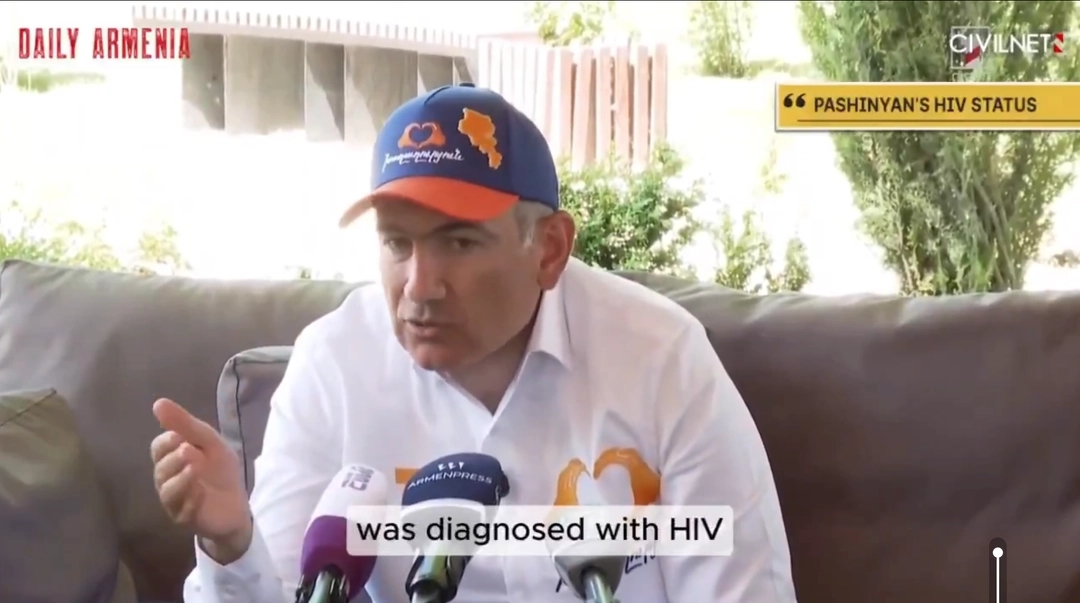
In May, accounts linked to the group began spreading rumors that Pashinyan was ill. One such video, made to look like a report by the Armenian outlet CivilNet.am, claimed that Pashinyan had contracted HIV and that this became known during his imprisonment in 2010, when he was sentenced to seven years on charges of organizing unrest. CivilNet denied having published such a report.
According to Bloomberg’s calculations, the number of narratives spread by the Storm-1516 network in the first three months of 2026 more than doubled compared with the same period in 2025. Since late March, new narratives have appeared almost daily, with several targeting Hungarian opposition candidate Peter Magyar ahead of elections that were held this past April. Bloomberg found more than 25 stories about Armenia, portraying Pashinyan as corrupt and unable to govern the country.
Yerevan First, like other pro-Kremlin sites, republishes Storm-1516’s disinformation about Pashinyan. Reports sent by Kremlin-linked Doppelganger staff to their superiors also covered the spread of fakes produced by Storm-1516. The group’s narratives notably overlap with those pushed by the Doppelganger team.
Matryoshka: Disinfo in the name of respected media outlets
Around the same time that the Foundation to Battle Injustice published the fake about the Armenian prime minister’s alleged property in Marseille, bots from the Matryoshka network began their campaign against Pashinyan.
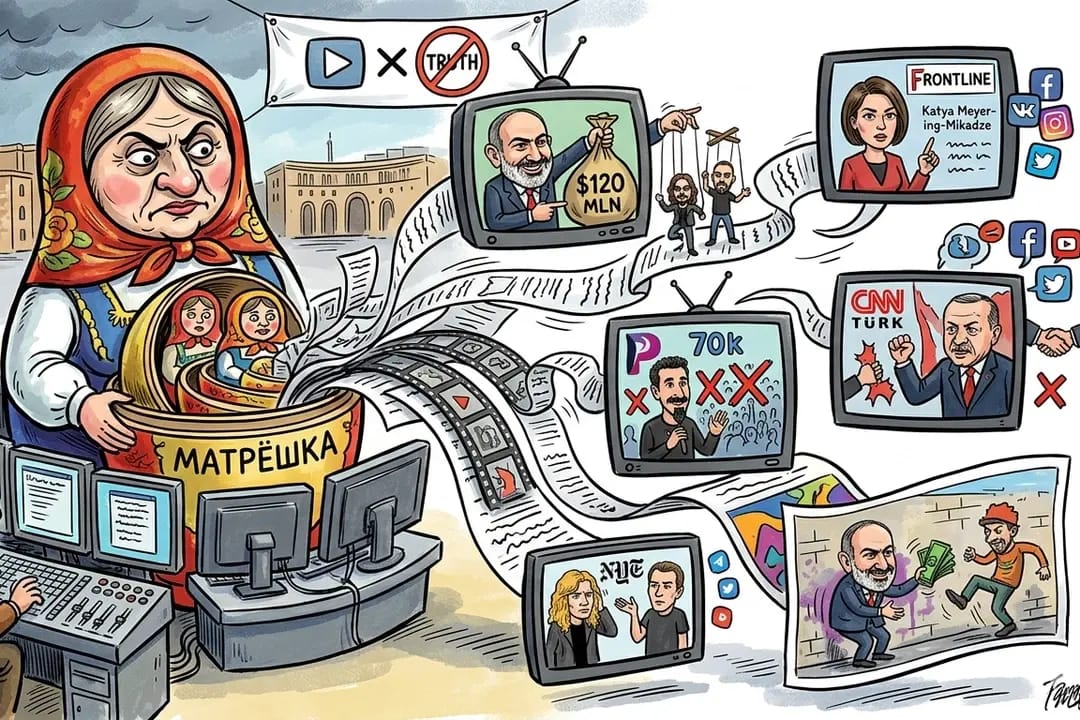
Matryoshka is a Russian disinformation network that creates fake videos made to look as if they were produced by established Western media outlets. The name refers to the Russian nesting doll, suggesting layers of deception and imitation.
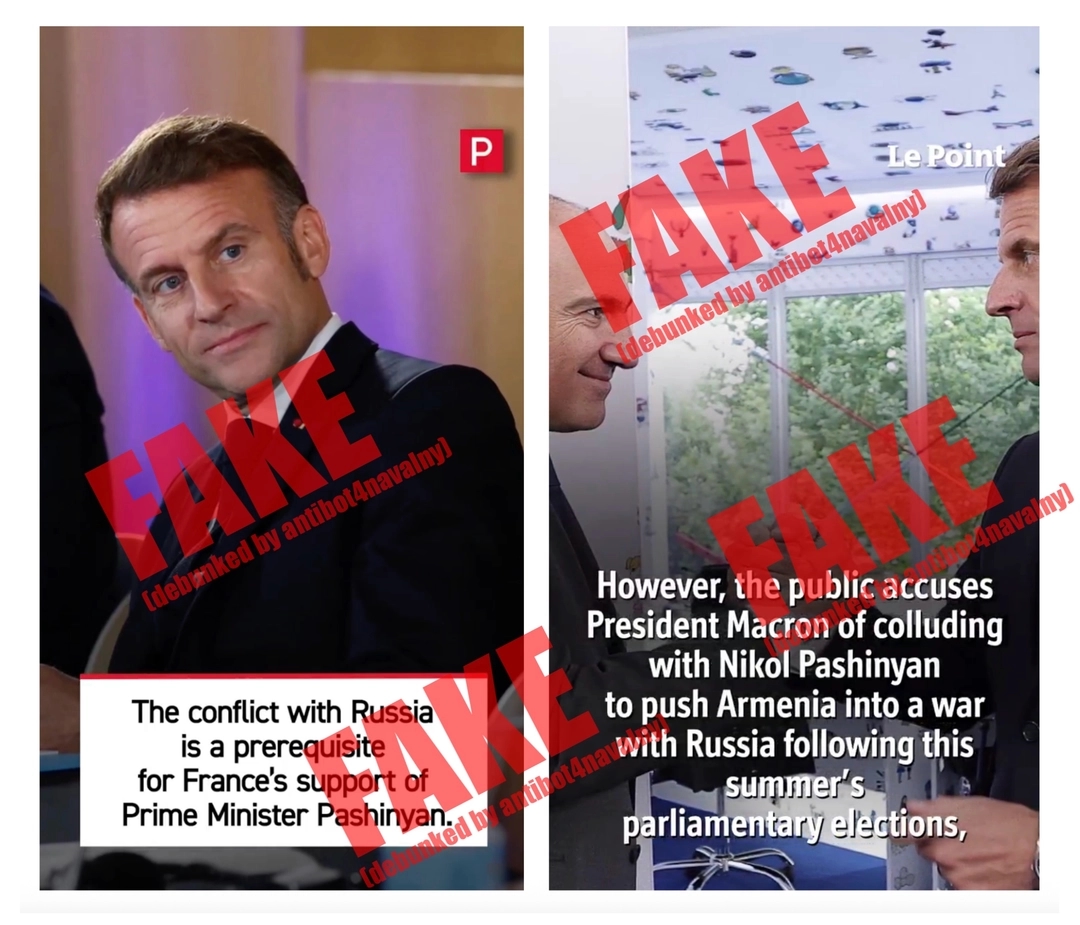
In early June 2025, the Antibot4Navalny project found that accounts in the network were publishing fake videos imitating major global media outlets like Euronews and France 24. In the videos, foreign academics were portrayed as claiming that the Armenian genocide was being hushed up by Yerevan itself. Other fabricated videos spread false accusations about corruption in Pashinyan’s government.

In October, Matryoshka videos criticized Pashinyan for “destroying Armenia’s cultural code” and “imposing nontraditional values of tolerance.” The government was accused of threatening opposition journalists and bloggers.
Other AI-generated videos used the identities of former Auschwitz prisoners, the independent outlet Agentstvo reported. Speaking in their names, the videos claimed that “Nikol Pashinyan is building gas chambers for Armenia’s symbols, testing them on Mount Ararat.” Pashinyan was called a “traitor,” and Armenian citizens were compared to Jews who “waited for tragedy to happen.”
According to Antibot4Navalny, by early May 2026 the Matryoshka network had published 343 fake videos about Armenia and Pashinyan. A month before the election, the scale of the disinformation campaign had already approached the one seen in Moldova. The propagandists put in nearly eleven weeks of nonstop work on Armenia, compared with just under sixteen for Moldova, during which it published 409 videos, according to calculations by the independent outlet Vot Tak. Ahead of the U.S. elections, the network published 180 videos, compared with 97 in Germany and 14 in Poland.
Since early March 2026, Matryoshka has published videos claiming that Pashinyan could start a war with Russia. By mid-May, there were at least 20 such videos.
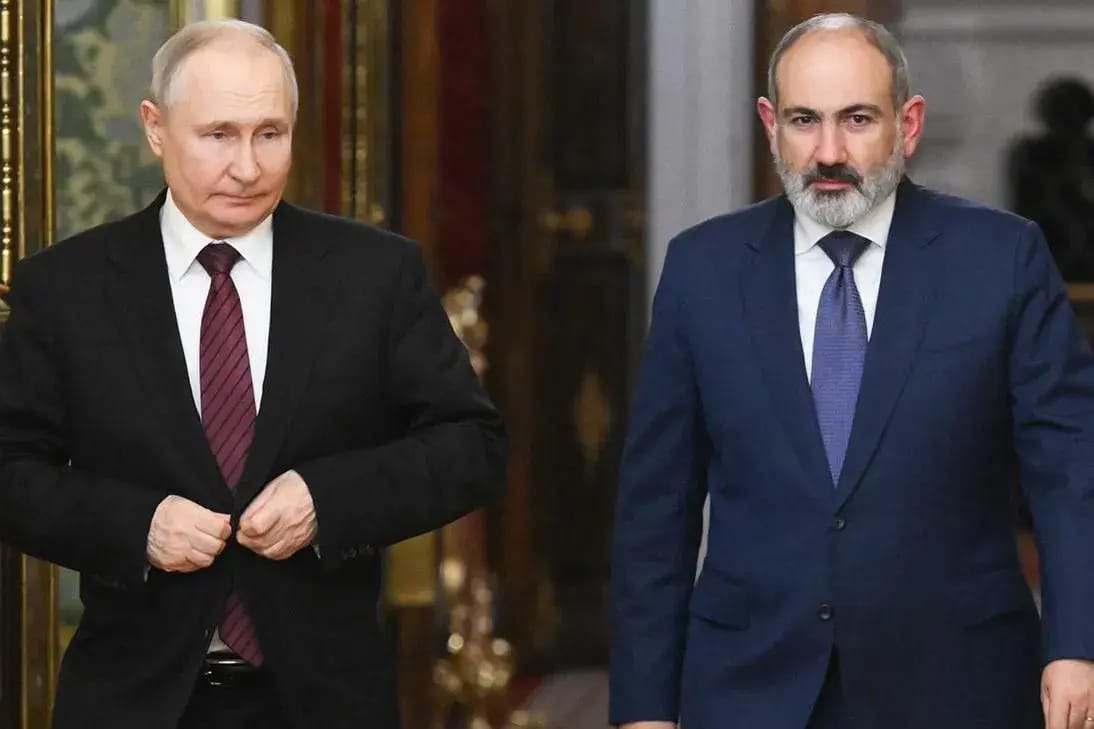
At a news conference May 9, Vladimir Putin claimed that Armenia’s possible accession to the European Union and withdrawal from the Eurasian Economic Union should be decided in a nationwide Armenian referendum, which he urged Yerevan to hold as soon as possible.
Putin also implied that Armenia should “not push things to the extreme” or follow Ukraine’s path, hinting at the potential for a military conflict: “All this later led to a coup, to the Crimean story, to the position of southeastern Ukraine and to hostilities. That is what all this led to. This is a serious question!” Putin said in his characteristic style. “So there is no need to push things to the extreme. It is simply necessary to say in time that we will do this and that. And the Armenian side needs to calculate, and we need to calculate.”
A print newspaper
In February 2026, a newspaper with an “American”-sounding name, Wyoming Star, began appearing on the streets of Yerevan. The newspaper turned out to be a collection of Armenian-language translations of articles from a U.S.-based website about events in Armenia. Neither the website nor the newspaper listed any authors.
Local outlet Factor TV found that the editor of the Armenian version was Vanik Shukuryan, a “citizen of St. Petersburg.” He brought copies of the newspaper from Moscow but refused to say who financed its printing.




The Insider established that the email address of one Wyoming Star author, Michelle Larsen, actually belongs to Alexander Ionov. In 2023, Ionov was charged with recruiting four U.S. citizens and interfering in municipal elections in Tampa, Florida. At the same time, a grand jury brought formal charges against two FSB officers.
Ionov, a Moscow resident, is the president of the Anti-Globalization Movement of Russia, the chair of the National Human Rights Committee, and a professional informant. The indictment against Ionov says that since October 2013 he acted under FSB control in the United States and tried to recruit representatives of various political groups to become agents of Russian influence. Those recruited were supposed to inflame conflicts and generally destabilize the situation inside the United States.

In 2021, Ionov began a campaign against independent media in Russia, labeling virtually all independent outlets as “enemies of the people” and submitting reports about them to the Ministry of Justive. That same year, he began cooperating with Prigozhin’s Foundation to Battle Injustice in an attempt to promote a candidate in a U.S. gubernatorial election.
The U.S. State Department is offering up to $10 million for information about Ionov.
With the participation of the Gnida Project.