Russian stock indexes have plunged 30% over the past three months, approaching their lowest level since the start of the war. Under conditions of higher taxes, arbitrary property confiscations, falling investment, increasing war damage, and high interest rates, the value of Russian companies will continue to decline.
A company’s share price is determined by the market's estimates of its future profits, and market valuations can be systematically distorted. Nevertheless, they are the most reliable estimates available given the fact that buyers and sellers of assets have the strongest incentive to value them accurately. That is why a stock market index is an important indicator of the state of the economy: it reflects the profitability of major companies.
A country’s economic history can be written by tracking the performance of its stock market indexes. Their decline often foreshadows a contraction in GDP and other shocks in the real economy.
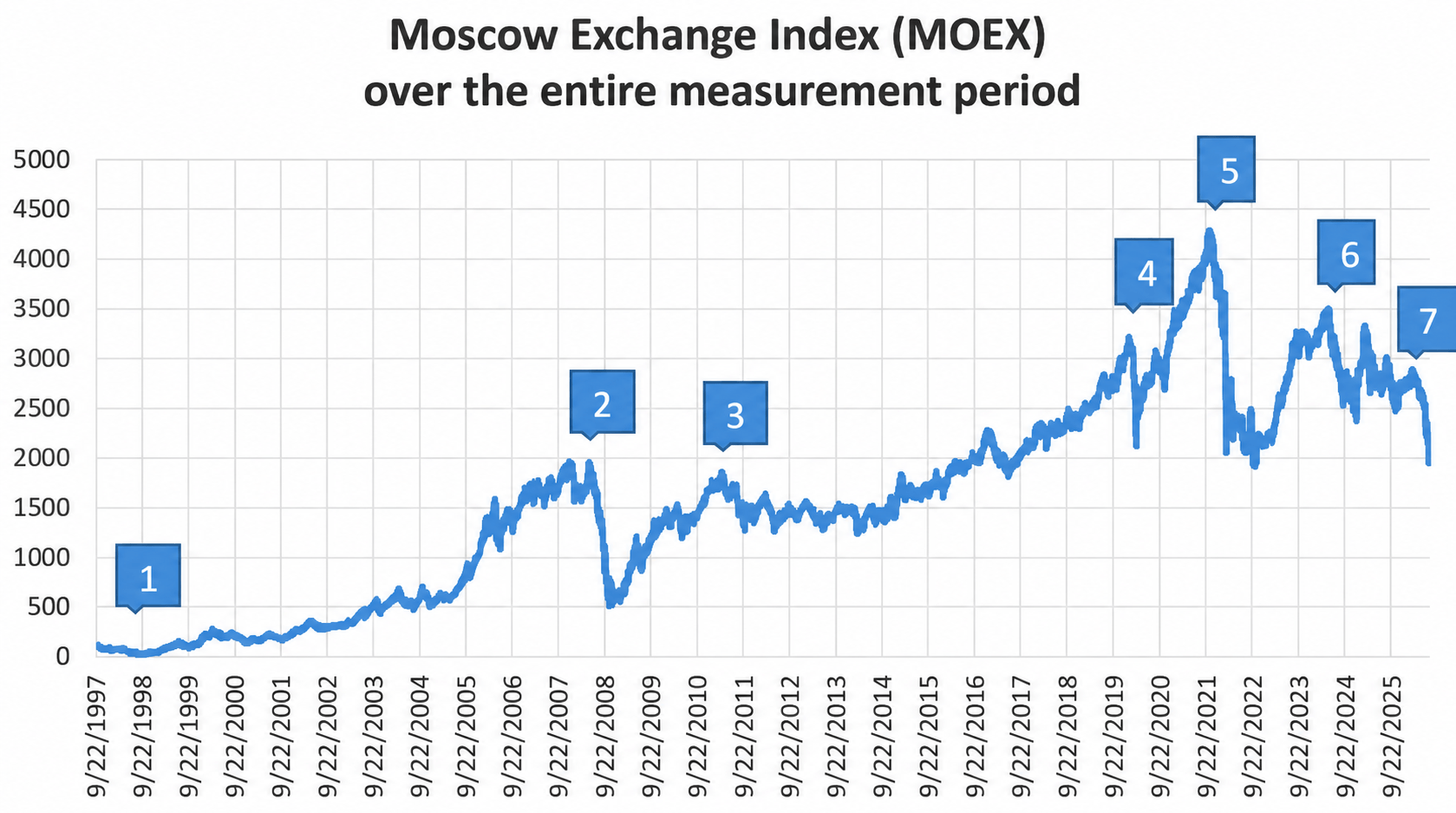
Russia’s main ruble-denominated stock market index — the Moscow Exchange Index (formerly the MICEX) — was first calculated in 1997. Before that, in 1995, the dollar-denominated RTS Index was introduced. Both started at 100 points. Over its entire history, the ruble-denominated Moscow Exchange Index has risen 22.2-fold, while the dollar-denominated RTS Index has risen only 8.8-fold — the difference being most readily attributable to the ruble's depreciation relative to the dollar over the past three decades (from the beginning of 1998 to the present day, the price of gold has risen 14.4-fold in dollar terms but 207-fold in rubles).
Incidentally, if an investor in Russian stocks had reinvested all the dividends received since 1998, the dollar value of the portfolio would have increased only 5.3-fold, while its ruble value would have risen 95-fold. Investing in gold would have produced much higher returns in either case.
War and Punishment
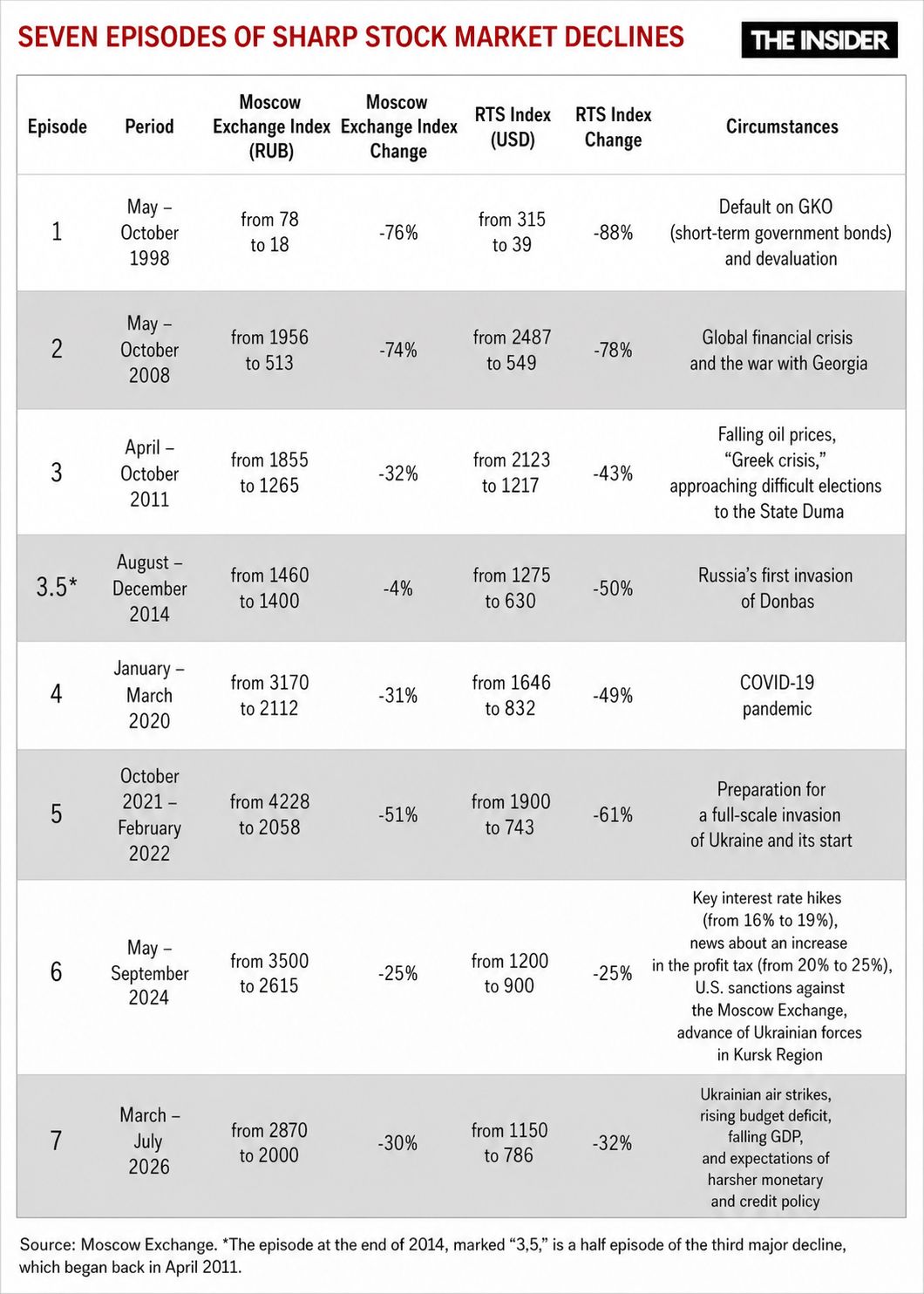
In the period August–December 2014, the dollar-denominated RTS Index suffered a sharp decline, while the ruble-denominated Moscow Exchange Index did not. The reason was simple: in 2014, following the imposition of Western sanctions, the Russian economy experienced not so much a stock market crisis as a ruble devaluation (and strictly speaking, this trend was a continuation of the major market collapse that had begun back in April 2011).
In the fall of 2021, the Russian stock market essentially anticipated the coming full-scale invasion of Ukraine and its dire consequences for both countries. From September through mid-November, the Moscow Exchange Index fluctuated mostly between 4,000 and 4,200 points — close to its historic high. However, when leading Western media outlets began reporting on the unprecedented buildup of Russian troops along the border with Ukraine starting in November, the trend turned negative. On November 10, then-U.S. Secretary of State Antony Blinken openly warned that possible Russian aggression against Ukraine would be a major mistake, and on November 19, The New York Times reported that U.S. intelligence was taking the threat of a Russian invasion of Ukraine extremely seriously. “The United States does not believe this is a bluff,” the newspaper wrote of the Kremlin’s military preparations (this at a time when many observers, including the author of this article, could not believe that a major war was actually approaching).
The Russian stock market, however, assessed the situation accurately. It was on that very day, November 19, 2021, that the Moscow Exchange Index last held above the 4,000-point mark. By New Year’s, it had fallen to 3,800, and on the last trading day before the invasion, it closed at 3,085 points. The Moscow Exchange Index fell by a total of 28% in the four months preceding February 24, 2022, and fell another 33%, to 2,058 points, on that fateful day.
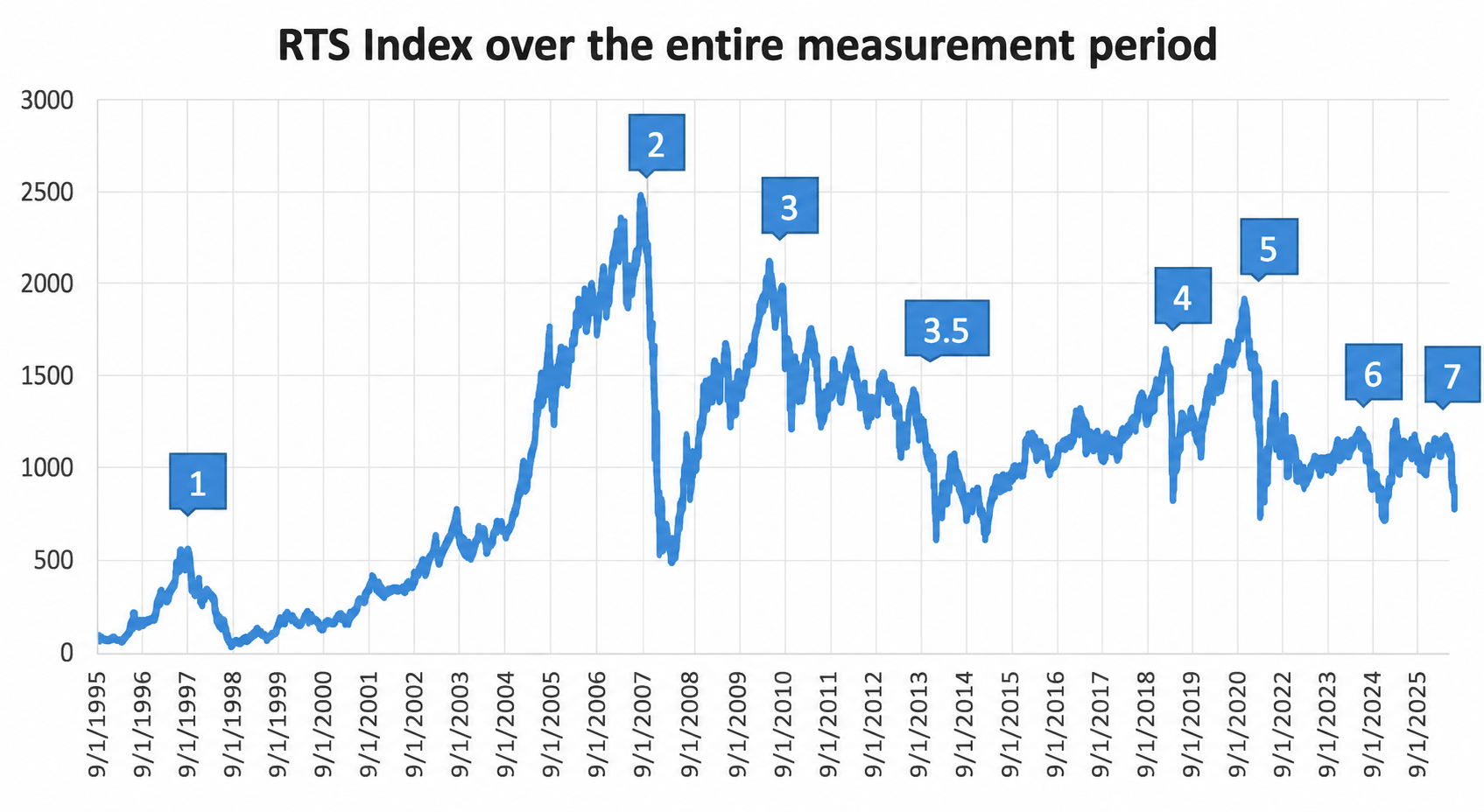
The RTS Index, which is denominated in U.S. dollars rather than rubles, followed a similar trajectory. Overall, the shock connected with the Russian invasion of Ukraine was comparable to the most severe economic crises in Russia's modern history (1998 and 2008).
The current downturn is less severe than those three — comparable instead to the pandemic-related decline of 2020 and the “Kursk” contraction of 2024. But in any case, from March through July 2026 there was not even a minor short-term correction back upwards: the Moscow Exchange Index fell for 19 consecutive weeks, an unprecedented streak, before a correction began at the end of last month.
Profit collapse, defaults, and bankruptcies
Sharp stock market crashes can have long-term consequences. For example, the Moscow Exchange Index returned to its pre-2008 crisis level of around 1,900 points only eight years later, while the RTS Index never returned to that level. In May–June 2008, Gazprom was worth around $340 billion and ranked third in the world by market capitalization, behind only ExxonMobil ($476 billion) and PetroChina ($441 billion).
In 2008, Gazprom was worth $340 billion, ranking third in the world and trailing only ExxonMobil and PetroChina
Today, Gazprom's valuation of $25-28 billion is well under 10% of its previous worth, and if measured in gold, it falls to less than 2% (if the company were valued in gold bars, it would have gone from being a large house full of the stuff to little more than a closet). ExxonMobil, the largest U.S. oil and gas corporation and the main surviving fragment of the Rockefeller empire, is now worth $650 billion – 36% more than it was 18 years ago. In 2008, Gazprom’s market capitalization was 71% of ExxonMobil’s; today, it is 4%. ExxonMobil is not even among the world’s 20 largest oil and gas companies; and yet, it is worth more than all Russian issuers combined.
Even within Russia, Gazprom has long since ceased to be the most valuable company, ranking only fifth – behind Sberbank, Rosneft, NOVATEK, and Lukoil. At the end of March, its shares traded at 138 rubles, but on July 17 they fell 42%, reaching an all-time low of 79 rubles (open trading of the company began only in 2006). The correction has brought it up to the 90-ruble range.
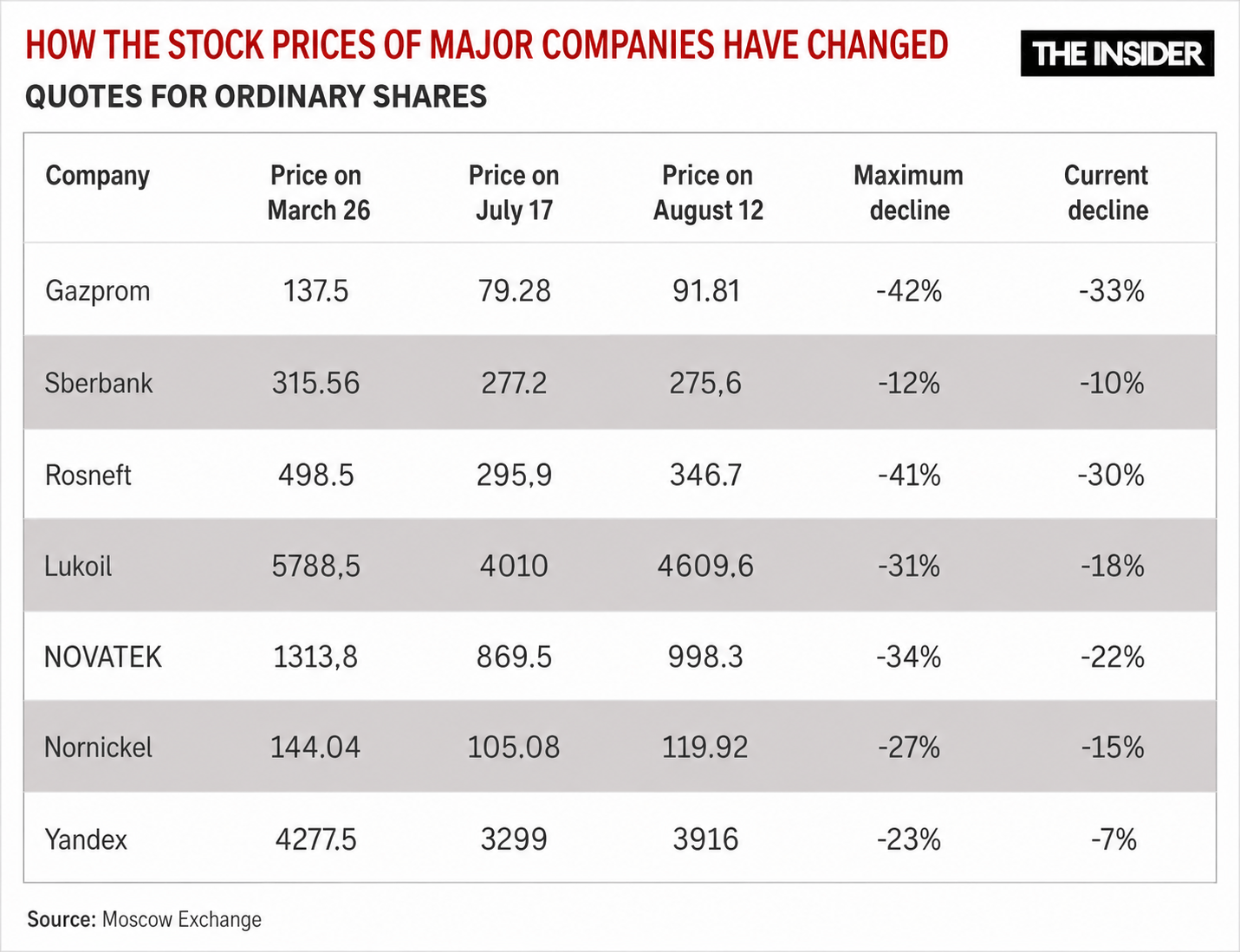
Rosneft shares fell almost as sharply: by 41% at the bottom and by 30% after the correction. NOVATEK performed slightly better, and Lukoil slightly better still. Nevertheless, losses across the entire oil and gas sector amounted to at least 20%. The decline in metals and mining was less severe, with the main sell-off occurring in 2024. And the decline in financial and technology stocks was more moderate.
The decline in Russian stock prices is linked to the overall decline in profits of Russian businesses. However, the stock market has moved much more sharply. The aggregate financial result of Russian organizations for January–May 2026 amounted to 99% of the previous year’s figure. Interestingly, the oil and gas sector, which saw the steepest decline in stock prices, recorded a 70% increase in profits compared with the previous year. This apparent contradiction can be explained by the fact that stock prices reflect not current conditions but market participants’ expectations. And those expectations incorporate the assumption that, given the sanctions and Ukrainian strikes on oil and gas processing and transportation infrastructure, the profitable period for oil and gas companies will not last long.
In the metals and mining sector, by contrast, profits fell six- to sevenfold, but stock prices did not fall nearly as sharply. This is because their share prices are already at very low levels compared with their prewar peak. The second round of declines in Russian metals producers’ share prices began in spring 2024. At the time, the United States and the United Kingdom banned imports of Russian-origin aluminum, copper, and nickel and also restricted their use on global metal exchanges and in derivatives trading.
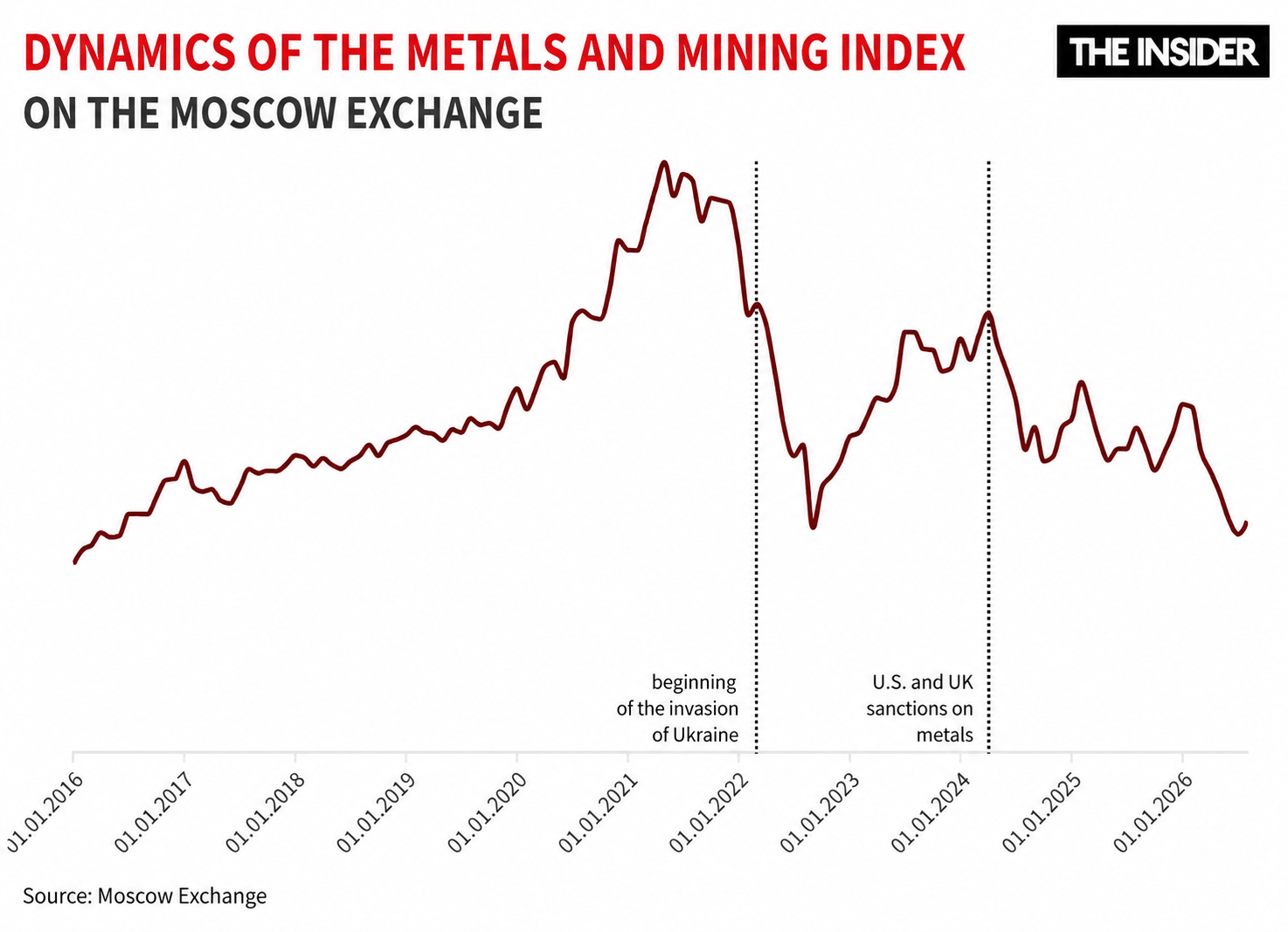
Overall, the market remains near its lows even after the correction. A Moscow Exchange Index reading of around 2,300 corresponds to the worst point of the pandemic panic in 2020 and of the lowest levels seen during the war (from April 2022 to March 2023). An RTS Index below 900 points likewise matches levels seen during the COVID-19 pandemic and at the start of the war.
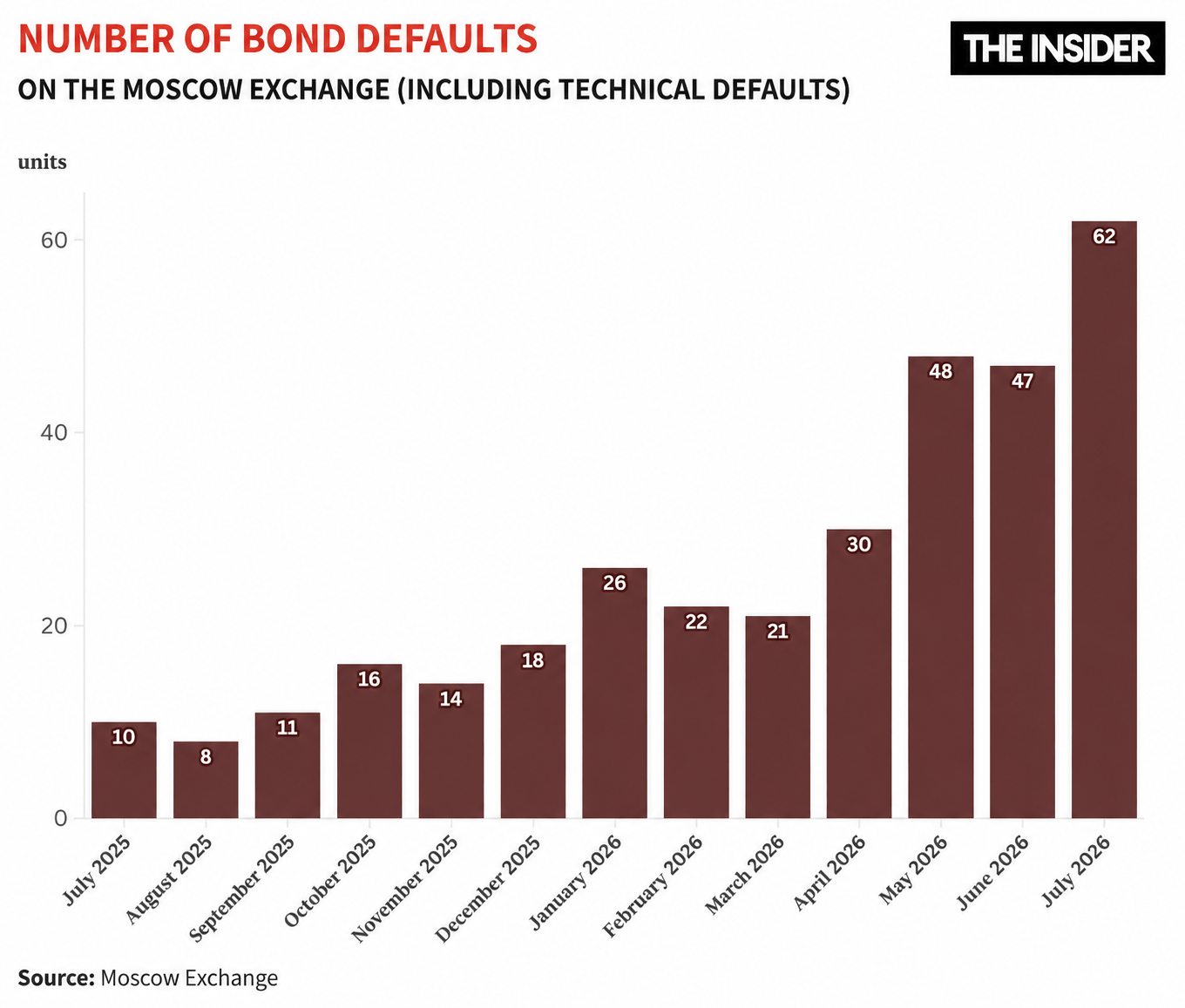
As stock prices fall, bond defaults are also being announced on an almost daily basis on the Moscow Exchange. There were 62 defaults in July (including technical defaults), a year-on-year six-fold increase. With borrowing costs high and business activity declining, issuers are finding it increasingly difficult to meet their debt obligations.
Business bankruptcies are also becoming more frequent. In the first half of 2026, there were 11% more of them than in the same period last year. The number of cases in which a company is placed under observation (the first stage of bankruptcy proceedings) increased by 21%. This process accelerated particularly sharply in April–June.
However, the number of bankruptcies has not yet reached their 2024 peak, which was driven by a trend towards tightening monetary policy That year, the Bank of Russia raised the key rate three from 16% to 21%. However, after entering 2026 back at that same 16% rate, the Central Bank has made further cuts, bringing it to 14%. The average RUONIA rate was 17.3% per annum in 2024, compared with 14.9% over the part of 2026 that has elapsed so far. Clearly, borrowing is now cheaper than it was in 2024, which is why there are still fewer bankruptcies.
The problems in the stock market in 2026, like the difficulties faced by the companies behind them, can easily be explained by monetary policy.
Stages of war grief
Since the start of the full-scale war, the Central Bank’s monetary-policy swings have gone through four stages.
Fear of inflation
In February 2022, at an emergency meeting held overnight on a Sunday, the Central Bank sharply raised the key rate from 9.5% to 20%, fearing rising prices. That fear was entirely justified. Year-on-year inflation subsequently jumped to 17–18%, according to official figures, and without the rate hike, things would have been even worse.
However, this stage did not last long. After all, in addition to inflation, the Russian economy was hit by the inevitable decline in production (and of business activity in general). In particular, foreign investors left the country en masse, while some found their funds frozen.
The stock market plunged sharply. Between February 25 and March 24, 2022, stock trading on the Moscow Exchange was suspended altogether. Once operations resumed, it became clear that a return to prewar stock prices and trading volumes was out of the question. At the end of April, the Moscow Exchange Index was 20% below its level on the eve of February 24. Under these circumstances, the Central Bank began to regard a depressed economic trajectory as the main danger.
Fear of recession
The second stage lasted from May 2022 to August 2023. During this period, the key rate was rapidly cut, holding at 7.5% for most of the period. The money supply grew from 68 trillion rubles to 90 trillion as the crisis was flooded with money.
The short-term consequences for the economy were exactly what had been hoped for: optimism took hold in a country at war. In April 2023, the Moscow Exchange Index returned to 2,500 points, reaching 3,000 in July. By the end of August, it was already at 3,200 – higher than on the eve of February 24, 2022!
Starting in the second quarter of 2023, Rosstat reported a return to GDP growth – at impressive rates of 4–5% year-on-year. Official inflation, responding with a lag to the anti-crisis measures, continued to decline through April 2023. Moreover, from March to June, it remained below the 4% target. However, it reached 4.3% in July and 5.1% in August. The attempt to bring it back to moderate levels failed.
Renewed fear of inflation
From July 2023 to October 2024, the Bank of Russia raised the key rate eight times, taking it to a record 21%, and then kept it at that level for nine months. At first, this did not help – the accumulated effects of the previous period of cheap money were too strong. And the expansion of the money supply did not stop, growing from 90 trillion to 119 trillion rubles.
Until July-August 2024, price growth continued to accelerate, reaching 9%, according to official figures. The stock market also did not perceive this policy as particularly tight, and through May-June 2024, the Moscow Exchange Index was broadly flat.
In the second half of 2024, monetary policy reached its maximum level of tightness: stocks plunged, while the number of bankruptcies reached a record high. The stock market suffered another major decline, partly as a result of sanctions against the Moscow Exchange.
However, rather than falling, inflation remained steady at around 9% a year until the very end of this stage. Under these circumstances, the Bank of Russia changed its priorities again without waiting for a clear and visible victory over inflation. In 2025, the decline in stock prices was accompanied by a sharp slowdown in GDP growth, to 1–1.3% a year. Once again, fears of an economic downturn came to the fore.
Renewed fear of recession
The Central Bank continues to say that “pro-inflationary risks outweigh disinflationary risks,” while systematically cutting the key rate. As always, the effects are not immediate.
Inflation through the end of 2025 was determined by the conditions of the preceding period of tight monetary policy, with price growth slowing to 6% year-on-year. In 2026, however, there has been no further slowdown: inflation has remained at around 6%. Moreover, the outlook is unfavorable. As recently as June, the Bank of Russia forecast that “annual inflation will decline to 4.5-5.5% in 2026.” By July 24, however, it had given a different forecast: “According to the Bank of Russia’s forecast, annual inflation will be 6–7% in 2026 due to the significant increase in fuel prices.”
Whether fuel is to blame or not, the Russian economy's situation is now critical both in terms of inflation and of real output. Inflation rose in response to the easing of monetary policy, and when that policy was then eased a little further, the inflation forecast was raised accordingly. Meanwhile, real GDP had already contracted in January and February, even according to Rosstat figures. Russian companies’ shares have been falling for the third year in a row, with the annual return negative in 2024, 2025, and in the part of 2026 that has elapsed so far.
The negative trend is being exacerbated by the growing erosion of property rights, as controlling stakes in various companies are increasingly being transferred from private owners to the state through legal actions that are becoming less and less transparent. A precedent was set by the nationalization of a controlling stake in the gold-mining company UGC, a process that harmed not only the majority shareholder accused of legal violations, but also minority shareholders, who did not receive the buyout offer required by law.
While the Central Bank can fully control inflation, it can influence the level of business activity only in the short term. Once the fundamental conditions for an economic downturn have taken hold in a country, no monetary policy can reverse them.
It should not be forgotten that war means diverting labor and capital away from productive activity and into destructive activity. It means death and injury for some people, emigration for others, and burnout and exhaustion for almost everyone. It means consuming accumulated reserves. It means replacing familiar and predictable rules with chaotic emergency measures – including nationalizations, price manipulation, and unpredictable seizures and giveaways worth trillions of rubles. It means isolation from the rest of the world, higher unit costs, direct physical destruction, and accelerated deterioration of infrastructure. It means environmental and social disasters from pollution to rising crime. Monetary “stimulus” is powerless in the face of such a calamity, and many economists believe that it is powerless even against regular cyclical crises.
Monetary “stimulus” is powerless in the face of the calamity of war and even regular cyclical crises
And yet, the second and fourth stages of the Bank of Russia’s wartime policy show precisely such attempts to stimulate the economy. At one point, they even created the illusion of an economic recovery (or at least softened the negative shock), but now they are close to exhausting their potential. Rather than preventing the inevitable economic downturn, they are merely postponing it while dooming the country to a state of stagflation – and since no central bank will ever care to acknowledge that it has created stagflation, once it comes within one step of it, it will again seek to tighten monetary conditions.
Russia is therefore now close to entering a fifth stage, when rate cuts will once again come to an end. The stock market will then fall even further, while bankruptcies, defaults, and losses will increase. Production statistics, and perhaps GDP as well, will show negative growth.
An anti-inflationary policy requires ruthlessness. The only question is whether Russia’s monetary authorities have a mandate from the Kremlin to pursue such a course. The last two times the Bank of Russia cut the key rate, the reductions were minimal – just 0.25 percentage points – and both times, the decisions were preceded by public statements from Vladimir Putin that the rate should be lowered.
However, the Central Bank stated in its new medium-term forecast that expected inflation was higher and GDP growth was lower than in its previous projection. It is as if the Central Bank is hinting that if Putin personally wants to control the key rate, then he should also explain the bad news to the public.