In 2025, Russia’s compatriot resettlement program saw a record-low number of newcomers move to Russia. Still, the Kremlin is not giving up and is actively promoting two new initiatives: a repatriation scheme and “values visas” aimed at conservative citizens of Western countries. Residents of Germany, the United States, Israel, and the Baltics are promised safety, economic growth, and traditional values in Russia. In reality, foreigners who relocate to the country – both those with Russian roots and those without – encounter humiliating treatment and, in many cases, outright racism.
“Welcome home”
This past winter, an Estonian citizen named Daniil (name changed) crossed the Russian border over the ice of Lake Peipus and requested asylum. As a result, he has spent the past four months in Pskov Pre-trial Detention Center No. 1, complaining about harsh conditions that include cold, mice, and sedative injections administered without his consent.
In a letter to human rights advocates, the 25-year-old explained that he fled because his lack of Estonian language skills made it impossible for him to find work and support himself in a country that had “started banning the Russian language in schools.” As Daniil wrote, “I had long heard that Russia had a resettlement program — that people were moving to live in Russia.”
Russia does in fact have two programs that actively encourage people with Soviet roots to relocate. Since 2006, the country has operated the CompatriotResettlement Program, and since 2024, a separate repatriation program that is also aimed at native Russian speakers and their descendants. By all appearances, Daniil would have been an ideal candidate for either program. The Baltic states are among the key regions where these initiatives are promoted.
Moreover, the Pskov Region where Daniil was locked up in pretrial detention has been actively recruiting Estonian citizens to address labor shortages, Estonian outlet Postimees reported. Estonia’s Department of Statistics recorded that in 2023, a total of 512 residents moved permanently to Russia, and in 2024 the number rose to 868.
The article’s authors point to a growing number of Russian propaganda materials carrying headlines such as “Study in your native language,” “Now they can freely speak their native language,” “In Russia, family and history are respected,” and “Welcome home.” As the outlet concluded, the programs “market relocation as a story of ‘spiritual and moral salvation.’”
Official media in the Pskov Region, along with local officials writing on their personal blogs, constantly promote images of successful relocation stories involving Russian-speaking residents of the Baltics. The Telegram channel of Elena Polonskaya, the Governor’s Commissioner for Work with Compatriots, regularly posts stories about repatriates. For example, jeweler and artist Irena Pabo said in an interview with Pskov’s Silver Rain radio station that she had been afraid to remain in Estonia because “factories producing explosives and drones are being built there.”
Polonskaya also shared a report by the Russian state broadcaster Vesti describing how Pskov had revived the “historic tradition of church services for settlers from other countries.”
“At the Church of St. George from the Ascent, services for Orthodox Latvians had been held every two weeks since the late 19th century. On the feast day of the Holy Forty Martyrs of Sebaste, more than 70 settlers from various European countries gathered there. The liturgy for our compatriots was led by Metropolitan Matfey of Pskov and Porkhov,” the report stated.
“It was supposed to bring millions”
It remains unclear what circumstances actually drove Daniil to flee alone across the ice. Most settlers and repatriates apply to move to Russia through consulates or intermediary firms that prepare a complete package of documents on a “turnkey” basis.
Nikolai Kozolup, a balding man in a turtleneck sweater, gives the author of this article a video tour of a repatriation office in Moscow’s Taganka district, where thirty employees are engaged in helping foreigners with Russian roots obtain Russian citizenship. On the wall hangs a triple portrait: Donald Trump in the center embracing Putin with his right arm and Kim Jong Un with his left (the North Korean dictator is holding a bottle of whiskey). Another portrait of Putin hangs alone on a second wall, while a huge Russian flag covers the third. “Well, we’re in Russia,” Kozolup explains. He then points to a bell mounted on the wall and says that he and his colleagues ring it “whenever Russia gets a new citizen.”
Aggressive advertising from this company and several competitors has in recent weeks been constantly shown to Russian-speaking Israelis, Britons, Germans, and apparently others as well. Demographer Salavat Abylkalikov of the New Eurasian Strategies Centre (NEST) says he repeatedly encounters the ads in Germany: “I even tried filing complaints, but they still keep showing them. Russia is trying to attract new citizens from Western countries. In the view of the Russian authorities, they are preferable to Tajiks, Kyrgyz, or Uzbeks.”
Russia is trying to attract new citizens from Western countries; in the view of the Russian authorities, they are preferable to Tajiks, Kyrgyz, or Uzbeks
Russian citizenship can be obtained in various ways. The standard migration route is the most common, but also the longest and most rejection-prone. First comes a temporary residence permit, then permanent residency, and only after five years – citizenship.
But in 2006, a shorter route to a passport bearing the double-headed eagle was introduced: the Compatriot Resettlement Program. As its official website explains, the program is intended for people belonging, “as a rule, to ethnic groups historically residing on the territory of the Russian Federation,” as well as to foreigners with Russian roots who have made a “free choice in favor of a spiritual, cultural, and legal connection with the Russian Federation.”
In 2006, Putin declared that demographics were “the most acute problem facing modern Russia.” It was after this statement that both the maternity capital program and the resettlement scheme were launched, Salavat Abylkalikov explains while stressing that the program was never designed as a repatriation effort — rather, it was aimed at solving economic problems and attracting labor to Russia’s regions. Compatriots were expected to match specific professional qualifications, relocate to a strictly designated federal area, and live and work there.
For example, Moscow, St. Petersburg, and the Moscow Region do not accept compatriots, and Krasnodar Krai only accepts people from certain professions. This differs from repatriation programs operating in Germany, Israel, Greece, or Poland. There, once a person receives the necessary documents, they are free to move around the country.
Russia’s second repatriation program, running in parallel with the Compatriot Resettlement Program, only came into force on Jan. 1, 2024. By that point, it had already become clear that the compatriot resettlement effort had failed, Abylkalikov says, recalling that in 2006 officials expected 300,000 people to arrive in the first few years, to eventually be followed by millions more. The program’s architects believed Russia was sufficiently wealthy and economically attractive to achieve this. At the same time, however, people were being directed toward far-from-prosperous regions. Among the relatively attractive destinations, only Kaliningrad Region stood out.
From 2006 through 2024, according to the highest estimate a total of 1.2 million compatriots returned to Russia, but a significant share of these were Ukrainian citizens arriving after 2014, Abylkalikov notes. Then, in 2019, Putin approved a new procedure for issuing Russian passports to residents of the self-proclaimed Donetsk and Luhansk “People’s Republics.”
Even at its peak, participants in the Compatriot Resettlement Program made up only a minority of those receiving Russian citizenship. The overwhelming majority followed – and continue to follow – the standard, lengthy route. Among citizens of Tajikistan alone, for example, 103,700 people received Russian passports in 2021, and 173,600 in 2022.
The repatriation program that came into effect on Jan. 1, 2024 allows people to relocate quickly to any region and obtain a passport almost immediately. According to figures from Russia’s Interior Ministry Migration Service, in 2024 a total of 1,800 repatriates and their relatives entered Russia, and in 2025 the number reached 7,000.
However, the overall number of arriving repatriates and compatriots has been steadily declining, falling from 108,600 in 2019 to a record low of 26,700 in 2025. One reason is stricter language screening. Under the resettlement program, most arrivals come from former Soviet republics, and according to Kommersant, more than half of applicants are now rejected as a result.
“How do you feel about the ‘special military operation’?”
There is also a language exam for repatriates, but Nikolai Kozolup reassures me that it is not difficult: “The knowledge required is around a sixth- or seventh-grade level. I’m from Donetsk myself and took it seven years ago when I obtained citizenship. After that, there will be an interview. They’ll ask how you feel about Russian policy and how you feel about the ‘special military operation.’ We’ll conduct a role-playing session in advance so you know how to answer correctly.”
“At the exam, they’ll ask how you feel about Russian policy and about the ‘special military operation.’ We’ll hold a role-playing session in advance so you know how to answer correctly.”
The first stage has to be completed in the country of origin – in my case, Israel. If everything goes smoothly, I will receive a so-called “repatriate’s booklet,” a green-colored document allowing for relocation to Russia within five years. After that, I would need to travel to Russia and apply for citizenship.
Once the documents are reviewed, the next step is taking the oath of allegiance. A Russian passport for foreign travel can then be issued immediately.
Most clients, Kozolup admits, do not seek Russian citizenship in order to relocate permanently, but rather to comfortably live between two countries: “We’ve had many more people from Israel become interested since the war in Gaza began. Right now, six Israeli applications are on hold. They’re waiting for the consulate to reopen. For example, there’s one married couple in their sixties. They’re very afraid of the bombings.”
Kozolup tells The Insider that his firm previously specialized in helping Jews repatriate to Israel, but it has now begun working in the opposite direction as well. I ask Kozolup whether I could speak with people who have already obtained citizenship. He replies that no one is willing to communicate, even through messaging apps.
But he is willing to answer the most sensitive questions himself. Is there antisemitism in Russia? Kozolup immediately becomes animated and insists that there is not, adding that “the second most important person in the state, Putin’s right-hand man, is Jewish.” By “second most important person,” he means Prime Minister Mikhail Mishustin. Kozolup also claims that when the war with Iran began, an aircraft was sent to Israel to evacuate Russian citizens — but that is not true.
Could I be sent to fight in the war against Ukraine? No, Kozolup assures me, such requirements apply only to people obtaining citizenship through the ordinary process. According to him, the practice supposedly does not extend to “compatriots” and repatriates.
For its services, the company charges 450,000 rubles ($6,250) for “turnkey” citizenship processing or 300,000 ($4,200) for the first stage alone — up to obtaining the repatriate’s booklet. Of course, everything can be done independently and almost free of charge, Kozolup tells me, but the number of rejections grows every year.
A second company also responds quickly. Its rates are lower – 250,000 rubles ($3,500). I am promised repatriate status within three to three-and-a-half months. Another month would then be needed to prepare the documents, followed by an additional three-month wait for citizenship.
At that office, I am told that most of their clients come not from Israel but from other countries: “A lot of people are arriving from Germany because boys and girls are being forced to use the same bathroom there. Right now, the main thing for you is to decide which program you’ll use. If it’s the Compatriot Resettlement Program, you’ll receive relocation payments. Repatriates do not receive those payments, but they aren’t tied to a specific region.”
Birch trees, warmth, and no transgender people
“If you have a choice of how to move, then go only as a repatriate. No region will be able to reject you,” Anatoly Bublik explains to his TikTok followers. He and his wife moved to Russia from Germany immediately after the start of the full-scale invasion of Ukraine, and he now heads the movement “Path Home.”
On social media, Bublik alternates between talking about the collapse of Western civilization and offering practical advice to people relocating. For example, he says that the spouse who is younger and has a more in-demand profession should apply under the program. If the family has an adult child, it is best for that child to become the primary applicant. Russia evaluates potential settlers and repatriates them primarily based on their potential usefulness to the country. “The program was created not to save people, but to solve the issue of labor reserves for the regions,” Bublik candidly admits.
“The program was created not to save people, but to solve the issue of labor reserves for the regions”
A major German news portal, T-online, directly describes Bublik as “one of the key figures paving the way for people from ‘unfriendly countries’ to Putin’s Russia.” His movement cooperates with the “Welcome to Russia” foundation, established by Russian spy and current State Duma deputy Maria Butina. In Germany, the foundation also works with “My Russia,” an organization run by German Putin admirer Alina Lipp and Austrian activist Martin Held, as well as with Jakob Pinneker’s OKA agency.
Political scientist Felix Krawatzek, a senior researcher at Berlin’s Centre for East European and International Studies (ZOiS), provided The Insider with the following statistics: as of 2019, Germany was home to 3.52 million people with Russian roots, 39% of whom were immigrants from Russia or their descendants, while 35% came from Kazakhstan.
The number of German citizens who moved to Russia in 2024 totaled 3,210 people, and over the past decade the figure has fluctuated between 2,000 and 3,200 (excluding the pandemic year of 2020). If one includes people residing in Germany without German citizenship, the expert notes, then 11,070 people moved from Germany to Russia in 2024, while 16,525 moved in the opposite direction from Russia to Germany.
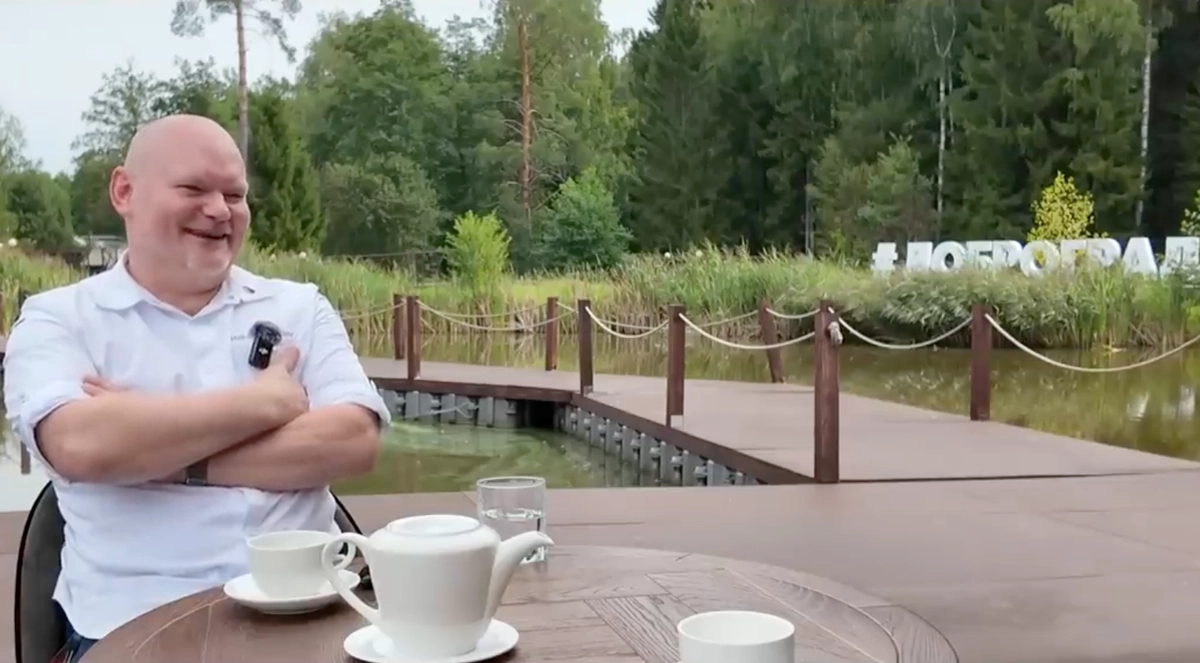
One of the destinations promoted as a place for overseas compatriots to “return to the motherland” is Dobrograd, an entirely private township in the Vladimir Region’s Kovrov District. Galina Guseva, posing among birch trees, explains why she moved to Dobrograd from Israel by saying she never felt at home in the Jewish state, that Israeli homes lack heating and are cold indoors, and that she is very happy now to be living in Russia.
Dobrograd is being built by a local patriotic businessman who made his fortune selling mattresses. As early as 2017, the town’s master plan included a military-patriotic camp, and its residents actively support the war against Ukraine. Maria Butina is now a frequent visitor to the settlement, while advertisements promoting relocation to Dobrograd are shown to Russian-speaking residents of Israel and Europe. The project’s website offers foreign buyers free assistance in obtaining Russian citizenship.
Newly naturalized Russian citizens living in Dobrograd regularly give interviews explaining their reasons for moving. For example, a German man named Maxim, the son of a repatriate from Russia, says on camera: “Russians do not understand how free they are. In Germany now, having an alternative opinion has become bad — an alternative opinion meaning about family, children, God.” What follows is a lengthy monologue about Europe’s transgender people, high taxes, and expensive utility services.
Still, according to political scientist Krawatzek, the main motive for Germans moving to Russia is not “traditional values,” but economics:
“Despite its real economic problems, Russia has managed to project the image of a successfully developing country, and this works especially well on people who are economically dissatisfied in Germany. The second factor is traditional values — the supposed ‘decline of the West’ and LGBT propaganda. These topics are widely discussed and evoke strong emotions, but I don’t think they are the main argument for people leaving Germany.”
Indeed, if one examines advertisements promoting relocation to Russia, the much-discussed traditional values are always mentioned, but they are rarely placed at the forefront. Instead, the main emphasis is on claims that would seem strange to anyone familiar with Russian reality: for example, that “Russia is a country of stability and growth,” that it offers “a high level of service and comfort,” and that it offers “safe streets with low crime rates.”
“They treated me like shit”
“I just couldn’t take it anymore, guys. As someone born in Russia, I can tolerate a lot. I have a very high tolerance for a shitty life. But even I couldn’t handle it anymore, because the internet didn’t work, crime was rising, and the police did nothing. I couldn’t even work online properly. Everything in this country is falling apart,” Russian-American Sergei Bronshtein complains in a video recorded on May 6.
By that point, Bronshtein was already in Turkey and was firmly determined never to return to Russia. The journey from saying “This place is practically paradise compared to America” to fleeing the country took less than six years.
Sergei was born in the USSR, but his parents moved him to the United States while he was in high school. During his 25 years in America, he never came to love the country, and in 2019 he relocated to Moscow, recording an enthusiastic video on Pushkin Square in which he said: “I like everything about Russia! …I even like the police here. People who say the police here are supposedly bad don’t understand what American police are like. At least the police here have some logic and sense of justice… This is basically paradise compared to America.”
For his English-language videos about life in Russia, Bronshtein launched a separate channel called “Meet Sergei.” At first, he filmed videos about borscht, pelmeni, and the Moscow metro system (though in these, too, he continued to criticize the United States).
In 2022, Sergei claimed that “Western sanctions are not working.” However, by 2023 his tone had become more restrained: “Despite everything happening, for the most part everything looks normal, people are living their ordinary lives.”
In February 2024, Bronshtein released a Russian-language video titled “Moving to Russia Was a Huge Mistake.” In it, he says that channels promoting relocation to Russia present a distorted picture of the country. He then describes numerous problems he personally encountered in what he calls his historical homeland.
First, he says he was labeled an LGBT person and became the target of harassment. Second, despite his education and American banking experience, he was unable to find work over the course of four years.
The worst problem of all turned out to be housing. “At first I rented an apartment, and the landlord kept showing up and bothering me. There’s a huge amount of real estate fraud. It’s very difficult to buy anything. So if anyone is thinking about returning to Russia, just know: you won’t make much money here, you won’t find work, but there will be ‘human warmth,’” Sergei says, reflecting on his experience.
“If anyone is thinking about returning to Russia, just know: you won’t make much money here, you won’t find work, but there will be ‘human warmth’”
On Nov. 24, 2025, Sergei posted another video with the same title, this time in English:
“I’m making this video for people sitting in the U.S., watching videos about Russia and traditional values and thinking, ‘I’ll move to Russia because I hate LGBT people, gay pride parades, and all that stuff.’ Well, after living in Russia, you’ll start missing even the gay pride parades. Not literally, of course. But you’ll run into so many other problems that you’ll start missing things that existed in the West.”
In the video, Sergei says that “it is impossible to do business in Russia if you do not deal with criminals.” He talks about low salaries, tiny pensions, and extremely high prices. Even his affection for the Russian police completely disappeared over the course of five and a half years: “People treated me like shit. I have a video on my channel about a terrorist neighbor who attacked me. And when I went to the Russian police, they did nothing…they’re even worse than American police, who at least fight criminals.”
This is no paradise
Stories of settlers who became disillusioned after moving to Russia periodically surface in the media. For example, when African American Francine Villa relocated to Moscow in 2019, Russia Today even produced a propaganda film about her in which she explained that she had left the United States because of racism and in search of safety. But in the summer of 2025, Francine posted a video showing her bruised face. She described being beaten and subjected to racist abuse by neighbors in her apartment building.
A British man named Ben married a Russian woman and has lived in Kursk since 2021, documenting his life on the YouTube channel “Ben the Brit.” In December 2025, he decided to debunk some of the more rosy myths about Russia, complaining about prices, bureaucracy, landlords who are unwilling to rent to foreigners, racism, and interrogations by the security services. At the same time, he explained to viewers abroad that his new home was not a conservative paradise: Russia has extremely high abortion rates and large numbers of children growing up without fathers.
Their new home looked nothing like a conservative paradise: Russia has enormous numbers of abortions and children growing up without fathers
Leo and Chantal Heyr moved to Russia from the United States to get away from LGBT culture. Soon afterward, the Americans found themselves without jobs or means of support. Leo handed over all of his savings to the son of a Baptist pastor who had hosted the family on his farm, and the pastor’s son “invested” the money but never returned it. The Heyrs’ children, who did not speak Russian, were not accepted into Russian school. In the end, the older sons returned to the United States while their parents remain in Russia, where they are still trying to build a life.
In short, after moving to Russia many repatriates encounter a reality very different from what they expected, but very few of them speak publicly about it. People do not like talking about their failures, Dr. Krawatzek explains, which is why Russian television and even personal YouTube channels feature only success stories.
Alina Yashina-Schaefer, a postdoctoral researcher in the Department of Cultural Anthropology and European Ethnology at Johannes Gutenberg University Mainz, shared the stories of two repatriate returnees with The Insider.
One of them was a man in his thirties from Petropavl, Kazakhstan, who had earlier relocated to Russia under the Compatriot Resettlement Program. He was motivated not by abstract ideas, but by a sense of hopelessness about his prospects in Kazakhstan. However, the move to Russia completely disillusioned him: “He described his experience in Russia in harsh terms, recalling how he was treated ‘like a pig’ and as a ‘second-class person,’ characterizing the experience as deeply humiliating. Importantly, this disappointment not only changed his perception of Russia but actively reshaped his sense of belonging, leading him to recognize Petropavl as his home — the place where he wanted to be,” Yashina-Schaefer says. In the end, the man returned home.
The second participant in her research was a man from Estonia in his thirties who left the economically depressed city of Narva for Russia. “He moved to Moscow to study, seeking to affirm his sense of self-worth and achieve recognition,” Yashina-Schaefer explains. “However, paradoxically, he recalled that during his studies he began to grow increasingly distant from Russia. Instead of finding a sense of belonging there, he ultimately arrived at a new understanding — that his real sense of home was in Estonia.”
Many settlers note that the social realities of life in Russia are far different from what they had been promised. “Immediate integration into society did not occur. Instead, some settlers encountered indifference, humiliation, or even exclusion from local residents, who perceived them as outsiders,” the researcher says. “A shared language and historical ties did not automatically lead to acceptance into civic or ethnic communities.”
Portrait of a compatriot
In an interview with The Insider, Felix Krawatzek sketches a portrait of the average Russian-speaking German who wants to move to Russia: low economic status, low educational attainment voting for the far-right or far-left, and deeply skeptical of Germany’s traditional media outlets, relying instead on information from social networks. Such individuals either believe that objective truth does not exist at all, or that German media conceal it in the interests of the government and big business.
At the end of 2025, Dr. Krawatzek and his colleagues studied the attitudes of German citizens with Russian or Kazakhstani backgrounds. “There are two key differences,” he explains. When asked whether Russia is “the country that most strongly supports traditional values,” 75% of German citizens answer that it is not; however, among immigrants from Russia, only 50% disagree, while among repatriates and descendants of repatriates from Kazakhstan the figure falls to 44%.
The second question concerned whether Russia and Germany could be partners. Only 6% of overall respondents agreed with that proposition, while among people with Russian or Kazakhstani backgrounds the figure was over 20%.
Interestingly, the views of Russian-speaking Germans who obtained citizenship through Jewish ancestry differ from the broader pattern. For this group, the desire to move to Russia is rare.
There are also people who want to relocate to a more “traditional” place centered on “spiritual values,” but they are unwilling to move to Russia because they do not want to lose the ability to travel regularly to Europe, Dr. Krawatzek notes. Such people instead relocate to countries friendly to Russia — Serbia, North Macedonia, and, until the recent elections, Hungary.
Of course, emigration is always accompanied by return migration. Some people fail to find their place, some get divorced, and many simply miss their homeland, notes Yannis Panayiotidis, a historian and migration researcher at the University of Vienna. However, the repatriation program in Germany, launched in 1987, was designed from the outset to reduce the number of people returning. As Dr. Panayiotidis explains:
“People moved as entire families, sometimes even entire collective farms. In many cases, they no longer have a social network left in Russia or Kazakhstan. Often, the collective farm where they once lived no longer even exists. That means there is nowhere to return to. It is one thing to talk about how much you dislike Germany, and quite another to actually leave. People may be politically unhappy — and many genuinely are. But economically their lives are fairly successful, and in many cases, their children no longer speak Russian, so most simply choose to stay here and vote for pro-Russian parties.”
Before 2022, some people moved for practical reasons. They understood that knowledge of the Russian language was not especially valuable in Germany, while in Russia, knowledge of German could help them secure a good job, Panayiotidis notes. But with the war in Ukraine, everything has changed: “Under the current circumstances, moving to Russia may be more of a political statement. A person has to be very committed to actually do it. This propaganda is not aimed only at Russian speakers — Russia has recently introduced a ‘values visa.’”
A belated decision
The “values visa” is indeed a new phenomenon. Since August 2024, it has been issued to foreigners who “share Russian spiritual and moral values.” It is through this visa that Europeans, Americans, and Canadians without Russian roots are able to relocate to the country. Such people are frequently featured on Russian television, even though their actual numbers remain small. During the first eight months of the program, Russia managed to attract only 800 applicants.
From a demographic standpoint, that figure is negligible, notes Salavat Abylkalikov of the NEST Centre. In general, he is skeptical about the Russian state’s entire policy in this area.
Before the war, professional demographers frequently proposed migration policy measures, but after passing through ministries and government agencies, the proposals would emerge almost unrecognizable, the expert explains:
“The security services tried to ban and restrict things. Economists wanted to attract more young people. Everyone was pulling in their own direction. The previous Migration Policy Concept expired in 2025. Now a new one has been adopted through 2035. Its primary focus is no longer demographics or economic resources, but security and keeping unwanted people out.”
Migration from Central Asia is being deliberately restricted, the Abylkalikov argues. At the same time, Central Asians themselves are increasingly reluctant to move because of rising xenophobic and anti-migrant sentiment in Russia:
“Against the backdrop of war, society needs a scapegoat. Liberals have left, LGBT people have kept their heads down, and people with distinctly Central Asian features became a convenient target. After the Crocus terrorist attack, the situation became even more acute. At the same time, it is completely unclear what can be done about the demographic situation. You can try to raise the birth rate, but so far no one has really succeeded. France and the Scandinavian countries spend 2.5–3.5% of GDP on family policy, and even there the effect is limited. So what can Russia expect, given its tiny spending in this area?”
As the demographer explains, compatriots abroad are subject to the same demographic cycles as Russia itself, and nd those cycles stretch back to World War II. After the war, millions of people were never born because their would-have-been parents died at the front. As a result, the post-war generation was significantly smaller and had fewer children in the 1970s, creating another demographic trough. The cycle repeated itself among their grandchildren in the 1990s. Now yet another generation has turned over, and there simply are not enough young and working-age compatriots abroad to fill Russia’s current gap, no matter how aggressively they are lured back.