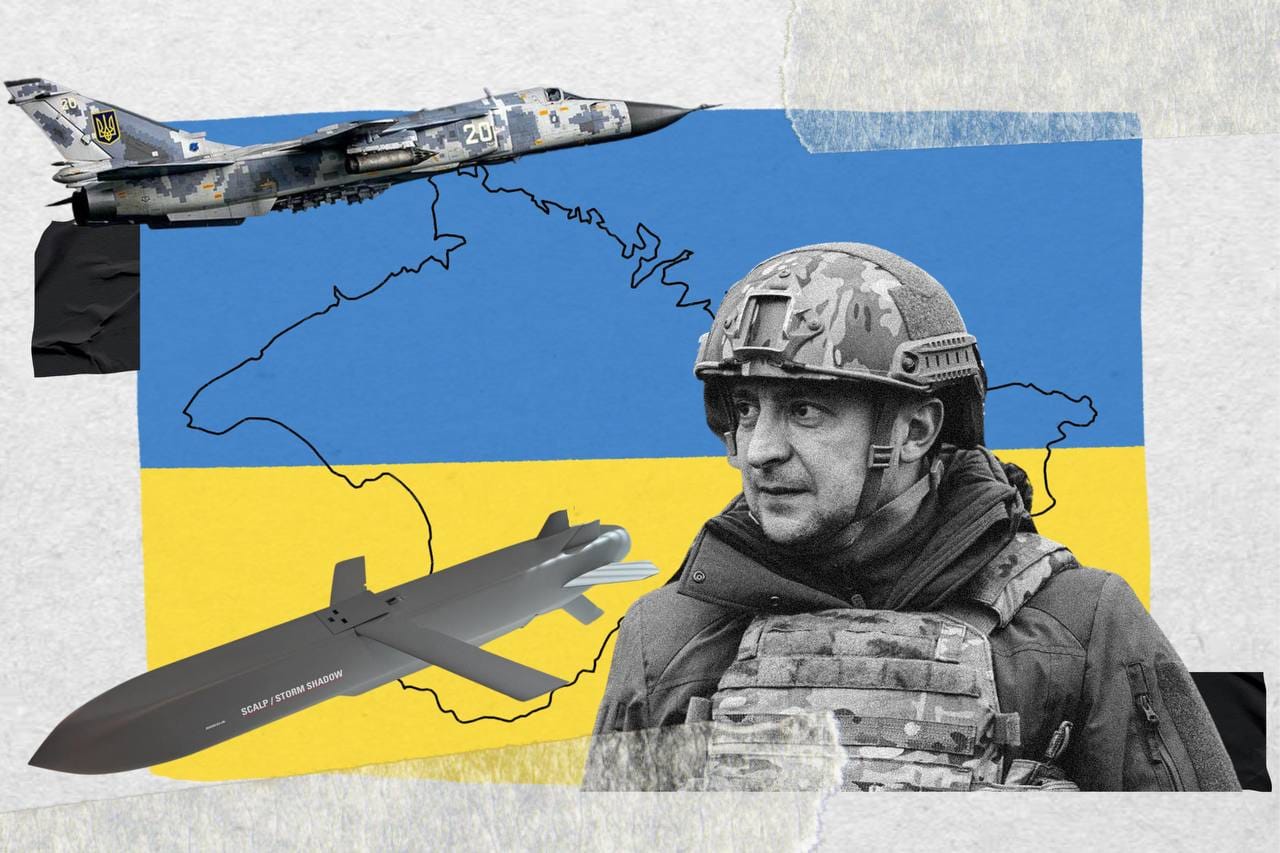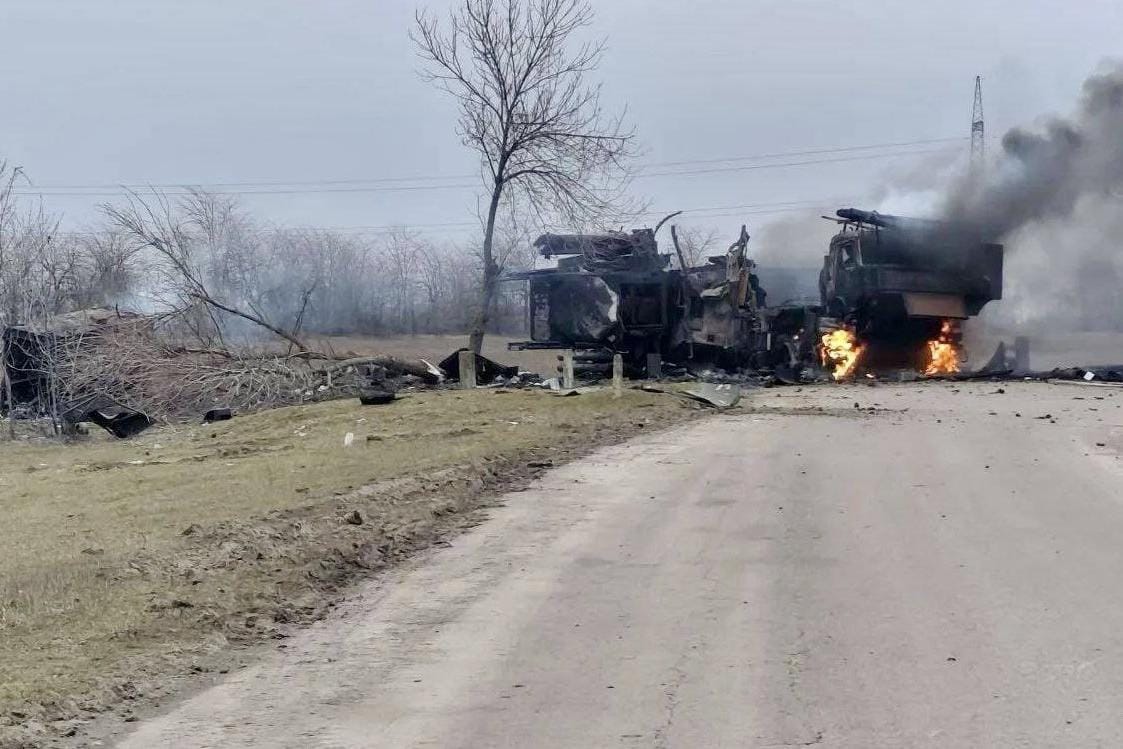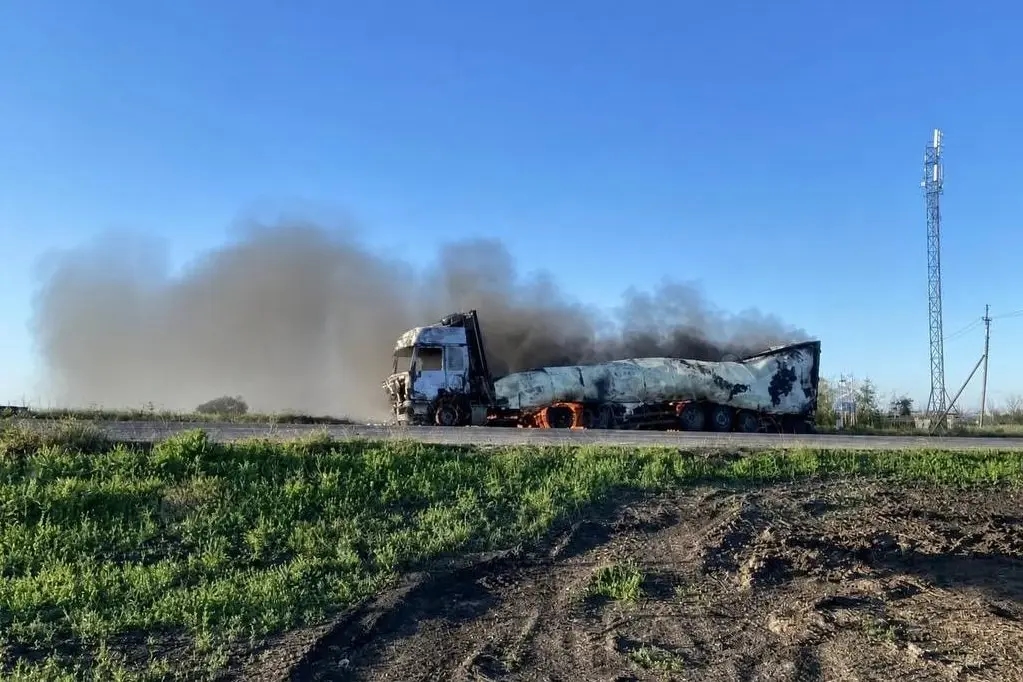
The most important recent development in Russia’s war against Ukraine is taking place not along the front line, but 100–200 kilometers deep in the Russian rear along major transportation routes in the occupied parts of the Kherson, Zaporizhzhia, and Donetsk regions. On May 27, Ukrainian Defense Minister Mykhailo Fedorov announced the launch of strategic “Logistics Lockdown” program in which Kyiv’s forces will scale up “middle-strike” attacks against Russia’s operational rear in order to limit Moscow’s ability to conduct active offensive operations. Since the beginning of May, 500 strikes against trucks in the occupied territories have been recorded, and since the start of June there have been 12 strikes on bridges connecting the Crimean Peninsula with Kherson Region.
Middle-strike: new priorities
Any army remains effective only as long as ammunition, fuel, food, and reinforcements continue to reach the front without interruption. That is why, in recent months, Ukrainian forces have increasingly targeted not trenches and fortifications, but roads, bridges, railway junctions, depots, and trucks in Russia’s rear areas.
Since late spring these attacks have evolved into a distinct campaign that Ukraine’s Ministry of Defense dubbed a “Logistics Lockdown.” Its objective is the systematic disruption of supplies to Russian forces in the occupied territories.
“Over the past several months, we have quadrupled the destruction of enemy logistics, depots, equipment, command posts, and supply routes at operational depth. A clear pattern is already emerging: the more Russian logistics are destroyed, the fewer assault operations take place along the line of contact,” Ukrainian Defense Minister Mykhailo Fedorov said.
An additional 5 billion hryvnias ($113 million) is being allocated directly to military units for the purchase of modern middle-strike systems through the e-points program, and according to Fedorov, direct procurement has already begun. At the same time, the Ministry of Defense is launching centralized tenders to acquire a large batch of such strike systems.
For strikes against Russian logistics, Ukraine employs FP-2, Bulava, RAM-2X, Darts, and, since the spring of 2026, the Behemoth, Baton, and Hornet drones. According to estimates by the OSINT team Tochnyi, the Ukrainian Defense Forces use at least 14 different types of middle-strike UAVs. Within the framework of the current campaign, their primary mission is not one-off attacks against individual targets but the systematic hunting of trucks, fuel tankers, trains, and other supply assets on which the Russian military directly depends.
The logic is straightforward: the farther a logistics facility is located from the front line, the more cargo is concentrated there and the larger the area Russia must protect with countermeasures such as electronic warfare systems, anti-drone nets, observation posts, interceptor drones, and mobile air defense teams. Near the line of contact, the destruction of a vehicle carrying fuel canisters may mean the loss of roughly 40 liters of fuel, whereas the destruction of a tanker truck deep in the rear can result in the loss of several tons.
This is why strikes on routes passing through Rostov-on-Don, Mariupol, and Donetsk, as well as along the roads leading into the partially occupied Zaporizhzhia Region and annexed Crimea, are already causing fuel shortages and may be reducing the overall tempo of Russian operations.
Particular attention should be paid to the Hornet drone, which entered service with the Ukrainian Defense Forces in the spring of 2026. It is produced by Swift Beat LLC (formerly Perennial Autonomy), a company founded by former Google CEO Eric Schmidt. In its basic configuration, the Hornet is a tactical UAV with a flight range of around 50 kilometers. However, Ukrainian units are modifying the communications systems and overall configuration of the drones, turning them into operational-level strike assets, according to an officer of the unmanned systems unit of the 1st Corps of Ukraine’s National Guard “Azov,” who spoke to The War Zone.
A U.S.-made Hornet drone plays a particularly important role in the campaign of strikes against Russian rear areas
With a total weight of 15 kilograms, the Hornet carries a 4–5 kilogram warhead. Communications are handled through Starlink terminals and other undisclosed systems, while artificial intelligence is used during the terminal phase of flight, assisting with targeting, navigation, orientation, and target recognition.
The drone’s built-in AI module with machine vision increases the probability of hitting a target even if communications are lost. Technically, the entire engagement process can be carried out without human involvement, but the developer states that the final decision to strike remains with the operator.
The pro-Russian Telegram channel Voyennyy Osvedomitel claims that in May 2026 alone, anti-aircraft drones operated by the Rubikon Center shot down a combined total of approximately 150 Hornet, RAM-2X, and Baton UAVs. The overwhelming majority of those downed — approximately 70% — were American-made Hornets.
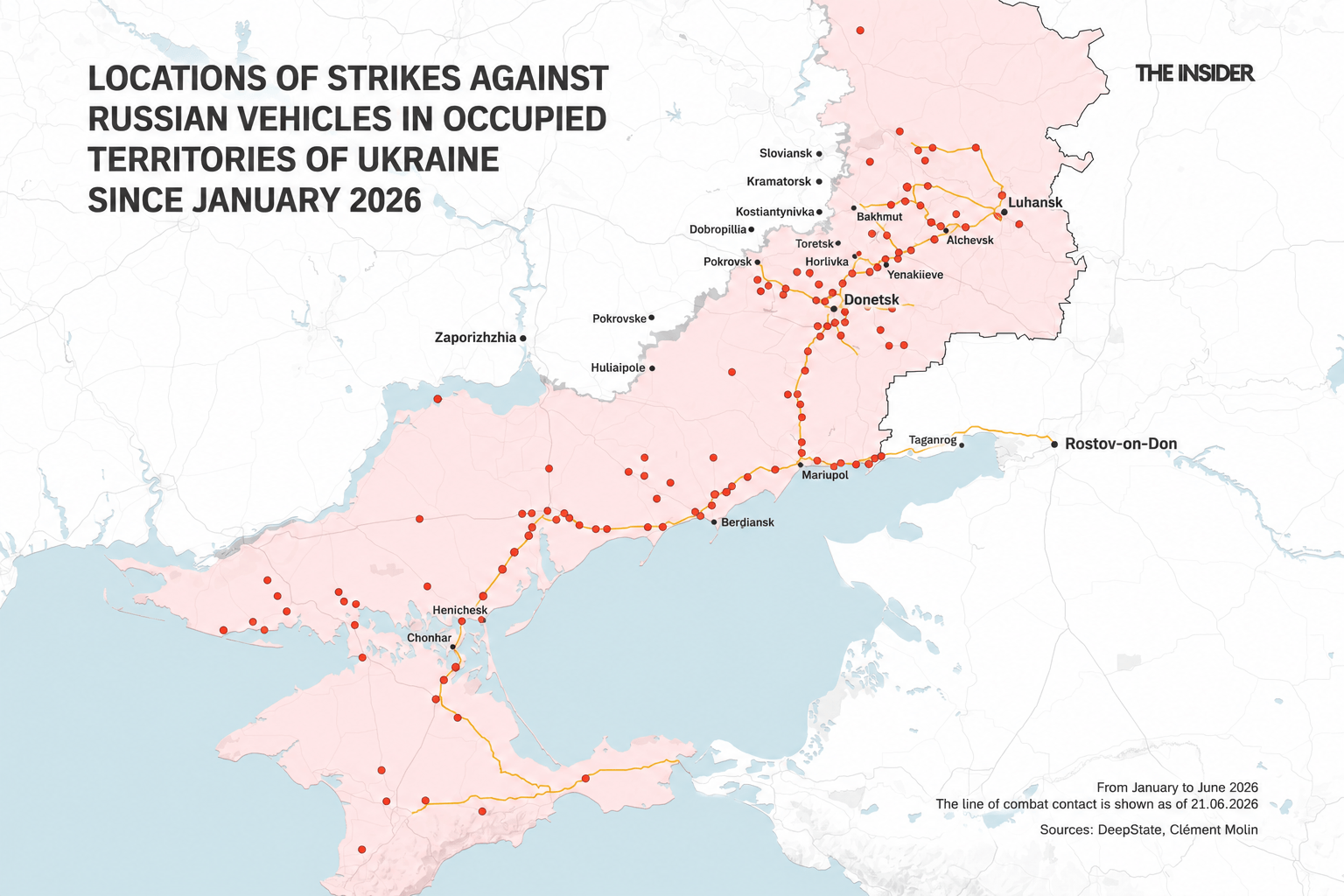
The scale of the current campaign extends far beyond strikes on logistics. Since January 2026, the OSINT researcher known as Clément Molin has geolocated more than 1,000 strikes against Russian targets. According to the researcher’s calculations, about 7% of the strikes targeted air defense systems, 20% targeted vehicles, and 35% targeted warehouses, (1, 2), and fuel and energy infrastructure facilities (1, 2, 3).
Earlier this year, Ukrainian strikes on air defense systems, radar installations, and electronic warfare complexes in the occupied territories forced Russia to relocate these assets deeper in the rear. Moreover, fearing they could become the next target of a Ukrainian drone, Russian crews reportedly expended anti-aircraft missiles liberally, further depleting their already limited stocks.
By May, however, the focus had shifted. Whereas Ukrainian drone operators had previously concentrated primarily on air defense assets, they are now conducting large-scale hunts for military vehicles and fuel tankers.
Statistics from the past several months confirm this shift. From the beginning of May 2026 through June 20, Ukrainian forces carried out more than 500 strikes against Russian trucks and other vehicles, according to calculations by Clément Molin, destroying 90 Russian trucks and other vehicles on June 19, 20, and 21 alone.
One of the first routes to come under attack was the R-280 “Novorossiya” highway running from Rostov-on-Don to Crimea via occupied Mariupol, Berdiansk, and Melitopol. The main objective of Ukrainian forces in this operation is to disrupt military logistics, effectively severing overland supply routes to Crimea.
The Ukrainian Defense Forces first attempted to cut the “land corridor” to the occupied peninsula during their counteroffensive of summer 2023 by focusing their main thrust near Robotyne in the Zaporizhzhia Region. According to a report by the Royal United Services Institute, the original concept of the counteroffensive envisioned breaking through Russian defenses along a 30-kilometer section of the front, isolating Tokmak within a week, and then exploiting the breakthrough by advancing south toward Melitopol. However, those objectives were not achieved due to a combination of strategic, operational, and tactical factors.
Ukrainian forces first attempted to sever the “land corridor” to Crimea in the summer of 2023
First, Western military aid arrived more slowly and in smaller quantities than required to implement the original plan, and many Ukrainian units did not have sufficient time to fully master the newly supplied equipment. Second, the Ukrainian command distributed its forces across several directions rather than concentrating them on the main axis of attack, thereby reducing the pace of the offensive. Third, Russian forces had a good understanding of the likely direction of the offensive and were therefore able to prepare a deeply layered defense in advance.
The large-scale use of Russian FPV drones also played a significant role. Following a trip to the front in 2023, military analysts Michael Kofman, Rob Lee, Konrad Muzyka, and Franz-Stefan Gady described the impact of these systems. After the initial Ukrainian attack plan fell behind schedule, Kyiv’s forces lost operational momentum, allowing the Russian side to redeploy reserves and thwart the attempt to break through to the Sea of Azov.
Ukraine’s Defense Forces are now systematically pursuing a very different approach: cutting Crimea off from its supply routes. According to Robert “Madyar” Brovdi, commander of Ukraine’s Unmanned Systems Forces, before the start of the current campaign average daily traffic on the R-280 highway amounted to 11,000 vehicles, including 3,800 trucks. However, by early June, those figures had fallen to 6,500 and 1,100 respectively.
The geography of the campaign is gradually expanding. In addition to occupied Zaporizhzhia Region and Crimea, roads in the Donetsk, Luhansk, and Kherson Regions have come under attack, along with the bridges and railway lines that Russian forces regularly use to transport military supplies. According to an analysis by the Ukrainian OSINT project KiberBoroshno, since the start of the campaign in mid-May chats and monitoring groups in occupied territories have shown a tenfold increase in posts about drones activity near roads.
Ukrainian UAVs are not only attacking Russian transport but are also being used to lay mines on roads remotely. Baba Yaga and FP-2 drones drop motion-activated mines onto roadways and along highways. As a result, on May 29 occupation authorities were forced to close a section of the Novorossiya highway near the border between Kherson Region and Zaporizhzhia Region for nearly an entire day. “The widespread use of mines on roads is far more likely to cause a transportation collapse and highway closures than simply targeted kamikaze-drone strikes against vehicles,” the pro-Russian Telegram channel Voyennyy Osvedomitel commented following the incident.
The high intensity of middle-strike operations has also been made possible by the growing number of units involved. Whereas such missions were previously conducted only by specialized organizations such as Ukraine’s Unmanned Systems Forces and Military Intelligence Directorate, now there are at least 26 such units, according to Tochnyi’s estimate (1, 2, 3, 4).
A video published in early June by the 475th Separate Assault Regiment of the Ukrainian Armed Forces, Code 9.2, documented 40 strikes against multiple targets in Russia’s operational rear. Most of the vehicles shown are not trucks but unarmored vehicles used for frontline logistics. The footage also appears to show approximately 34 Russian soldiers being hit.
Clément Molin concludes that the campaign is targeting not only cargo trucks but also vehicles used by units deployed closer to the front line. The researcher notes that unarmored vehicles are often more consequential targets than MRAPs, as they play a critical role in sustaining frontline operations. The intensity of the attacks continues to increase and, in his assessment, is already complicating Russian logistics to the point that the effects may soon begin to affect the offensive capabilities of Russian forces.
Roads of war
Russian supply operations in the occupied territories rely on several key logistics corridors linking the front line with rear bases and the territory of Russia. These routes are used to deliver ammunition, fuel, equipment, and reinforcements to frontline units.
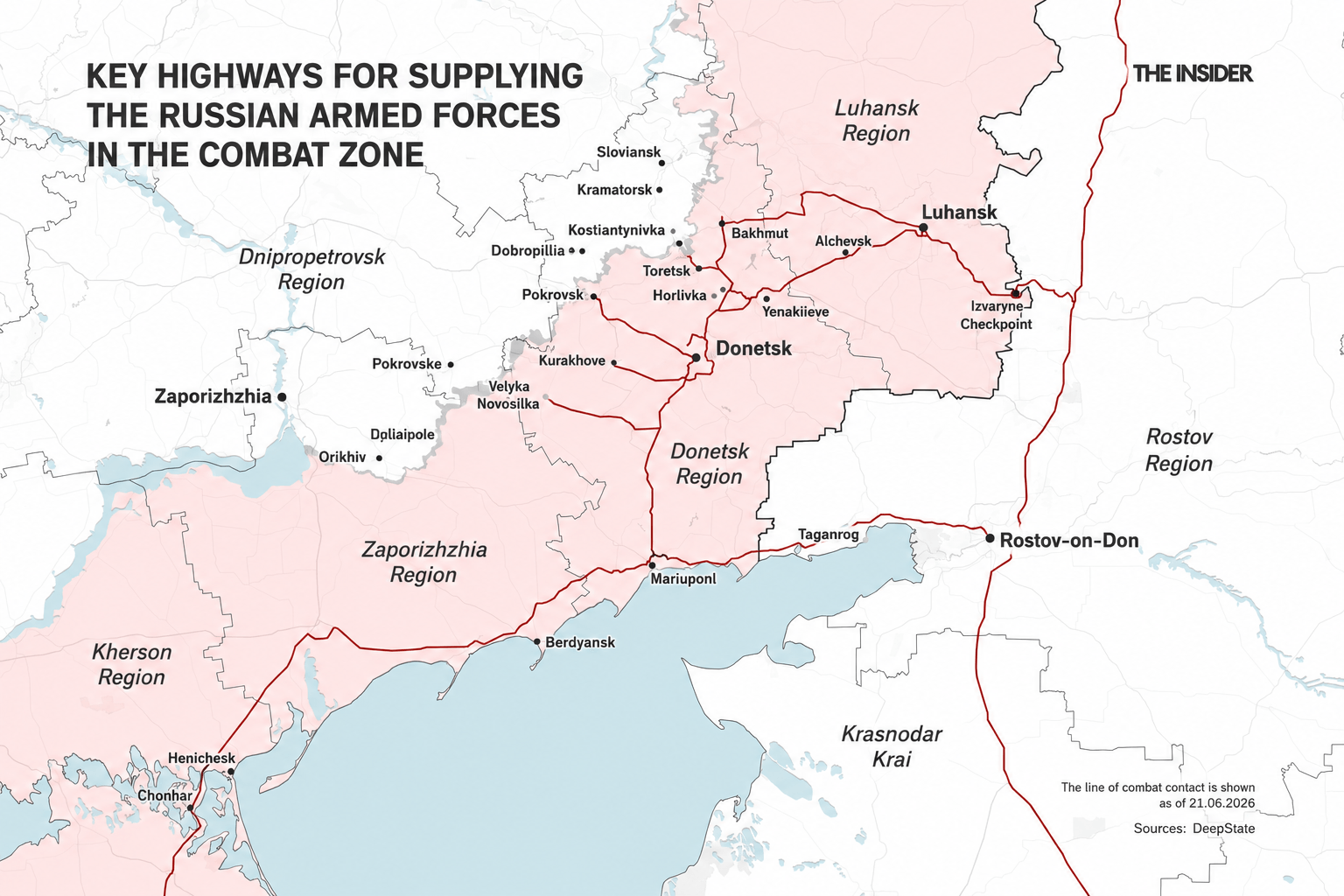
Luhansk remains one of Russian forces’ most important logistics hubs, with a significant portion of supplies for the units operating around Sloviansk, Kramatorsk, and Kostiantynivka passing through the city. For this reason, Ukrainian strikes on targets near the Izvaryne checkpoint, a border crossing located on the road from mainland Russia to the occupied city of Luhansk, have had a notable impact on the fight along the Lyman axis.
Equally important is the railway running parallel to the highway and the nearby road and rail bridges across the Siverskyi Donets River in Kamensk-Shakhtinsky. One of the main supply routes supporting the Russian offensive against Kostiantynivka runs through Yenakiieve, Horlivka, and onward to Toretsk. The logistics hub in Horlivka is of particular importance in this regard, according to analysis by Clément Molin.
Ukraine’s 20th Unmanned Systems Brigade K-2 released footage of strikes along the Yenakiieve–Horlivka highway and reported that during the first ten days of June, the unit hit 216 pieces of light and heavy vehicle equipment, compared with 344 during the entire month of May. Cutting the road from Horlivka would reduce Russian pressure on Kostiantynivka from the south and allow Ukrainian forces to concentrate on repelling attacks from other directions.
An alternative route supplying the Russian forces advancing on Kostiantynivka runs from Donetsk, and the same hub also supports operations in the Pokrovsk direction. In addition, a route from Donetsk through Kurakhove leads to the front-line sector at the junction of the Donetsk Region and the Dnipropetrovsk Region, where Ukrainian forces are conducting counterattacks. In May, according to DeepState, Kyiv’s forces recaptured 46 square kilometers in this area, and strikes against the Donetsk ring road are intended to support further advances.
There is also another route from Russia to Kurakhove, ruining from the border to Mariupol, where drones operated by the 1st Corps of Ukraine’s National Guard “Azov” reportedly appeared in the skies in May 2026. From there, the route turns onto the Mariupol–Donetsk highway, where Clément Molin also identified several strikes against Russian trucks. The situation on this highway was highlighted by military correspondent Vladimir Romanov, who recorded a video address from behind the wheel.
The same route can also be used to reach the area around Pokrovsk, where Ukrainian forces continue to conduct counterattacks around Huliaipole, where one of Russia’s main offensive operations is being conducted. It is here that Russian forces are attempting to advance northeast of Orikhiv in order to bypass Mala Tokmachka, capture Orikhiv, and then continue their advance toward Zaporizhzhia.
Because Russia’s Dnepr Group of Forces has been bogged down near Orikhiv — and is reportedly even retreating near Stepnohirsk — Russian commanders are placing their main hopes on the Vostok Group of Forces, which is pushing forward from the direction of Huliaipole while simultaneously repelling Ukrainian counterattacks farther north. The entire logistics network supporting this grouping is centered on Velyka Novosilka, and part of the route leading there runs along the Donetsk–Mariupol highway. The closer the route comes to the front line, the easier it becomes for unmanned systems units to strike vehicles moving along it.
According to Clément Molin, if attacks on these highways continue at their current pace, then by the end of summer Russian forces on the front line could face a serious shortage of ammunition, fuel, food, medical supplies, and communications equipment, directly affecting the combat effectiveness of units.
In response to the intensified attacks on logistics, Russian forces are employing both traditional countermeasures (interceptor drones, jammers, additional mobile fire groups, fuel tanker escorts) and more unconventional methods such as: painting trucks in black-and-white “zebra” stripes in an attempt to deceive drone machine-vision systems, covering fuel tankers with wooden planks, disguising military Ural trucks as civilian vehicles while forgetting to replace their military license plates, and using civilian transport to deliver fuel to military units (1, 2).
Russian forces have also shifted to moving at night and searching for alternate routes that drones have not yet covered. The effectiveness of such measures, however, appears limited. At night, vehicles remain clearly visible through thermal-imaging cameras mounted on drones, while the painted “zebra” camouflage intended to fool AI systems reportedly does not work, especially when the UAV is being controlled by a human operator. Meanwhile, “safe” alternate routes often increase transport distances by a factor of 1.7 to 2.1 and are typically discovered by Ukrainian intelligence within “3 to 5 days,” according to the Telegram channel Dark Forest Outcome.
Current consequences of the strikes on logistics
Strikes on logistics will eventually affect the combat effectiveness of the Russian military. Reduced deliveries of fuel and equipment lower the intensity of transportation in the near rear, while fuel shortages affect even systems that at first glance appear unrelated to transport.
For example, charging the batteries of FPV drones requires generators, which in turn require fuel. Disruptions to logistics therefore gradually reduce the number of drones operating in the air and diminish the ability of Russian units to conduct reconnaissance and carry out strikes.
According to the Institute for the Study of War (ISW), which analyzed materials published by the Atesh occupation-resistance movement, Russian troops from the 337th Air Assault Regiment of the Dnepr Group of Forces are being withdrawn from the Kinburn Spit because Ukrainian strikes on logistics routes have disrupted supplies. Ukrainian Southern Defense Forces spokesman Vladyslav Voloshyn neither confirmed nor denied the report in comments cited by UNIAN, but he did concur that Russian forces on the spit are experiencing disruptions in the delivery of fuel and generators.
Still, the consequences of Ukraine’s strike campaign have been most visible in rear areas. Restrictions (1, 2, 3) and fuel ration coupons for civilians have already been introduced in occupied territories, as well as in Russia’s Belgorod Region and Kursk Region. In Krasnodar Krai, fuel sales were temporarily suspended at 15 gas stations, and on June 14, military correspondent Vladimir Romanov reported gasoline shortages at filling stations in the Donetsk “People’s Republic.”
So far, the consequences of Ukrainian strikes on logistics have been most visible in rear areas
The situation is most acute in Crimea, where Ukrainian strikes have reportedly created a fuel shortage. There are two principal ways of delivering fuel to Crimea: by ferry or overland via the Novorossiya highway route (which includes a railway). As Alexander Talipov, an advisor to the head of Crimea, explained: “For security reasons, fuel tankers do not travel across the Crimean Bridge.”
Since the start of the full-scale invasion, the Kerch Strait Bridge has been one of the Ukrainian military’s primary targets, coming under attack from mining operations and strikes by missiles, surface uncrewed boats, underwater drones, and one truck bomb, which set fire to fuel tank cars on a passing train and caused the partial collapse of two roadway spans.
The bridge has withstood all of these attacks, but its structure may have sustained damage that could limit the permissible load on its supports. At present, according to the Russian Ministry of Transport, only passenger vehicles and trucks weighing no more than 1.5 tons are permitted to use the crossing. The Crimean authorities claim that these restrictions are intended to “ensure safe passage for people and preserve the transport crossing itself.” Rail traffic also continues to operate under limitations.
The only significant regular maritime logistics route is the Kerch ferry crossing, which continues to operate primarily during daylight hours and remains dependent on weather conditions and the absence of security-related limitations. The first Ukrainian attempts to disrupt its operation were undertaken in 2024, when missile strikes damaged the cargo ferries Avangard and Slavyanin and sank the cargo ferry Conro Trader RORO, which was transporting 30 fuel tank cars.
The attacks resumed this past March, when Ukrainian drones again damaged the Avangard and Slavyanin. In April another strike followed against the Slavyanin, which by that time was the only operational cargo ferry on the route.
Following strikes in the early morning hours of June 21, the authorities announced a temporary suspension of all ferry traffic across the Kerch crossing and advised freight drivers to use an alternative route running overland into Crimea through the occupied territories.
Ukrainian forces have also carried out strikes against port infrastructure on the Sea of Azov (1, 2, 3). Although maritime transport cannot fully replace rail or road transit through the “land corridor,” it provides an important backup logistics option. Strikes on ferries and ports therefore represent a systematic effort to reduce the number of alternative supply routes available to Russian forces in southern Ukraine.
On the night of June 10, Ukraine’s Defense Forces reportedly struck a convoy of 50 Russian trucks carrying fuel and ammunition near Armyansk. Because the Chonhar Bridge and the bridge connecting Henichesk to the Arabat Spit had previously been damaged (1, 2), Russian forces had concentrated a large number of trucks along the highway section running through Armyansk. According to the report, this made them an easy target for drone operators from the 1st Separate Assault Regiment.
“This operation would not have been possible if other units had not been striking Mariupol and the road to Berdiansk. It was precisely this pressure that forced the units operating on the Huliaipole axis to switch from supply routes through Mariupol to routes through Crimea,” emphasized regiment commander Dmytro Filatov.
Since the beginning of June, bridges linking Crimea and Kherson Region have come under regular attack. Some have been heavily damaged, while others have sustained numerous smaller perforations that prevent the transport of heavy cargo across them.
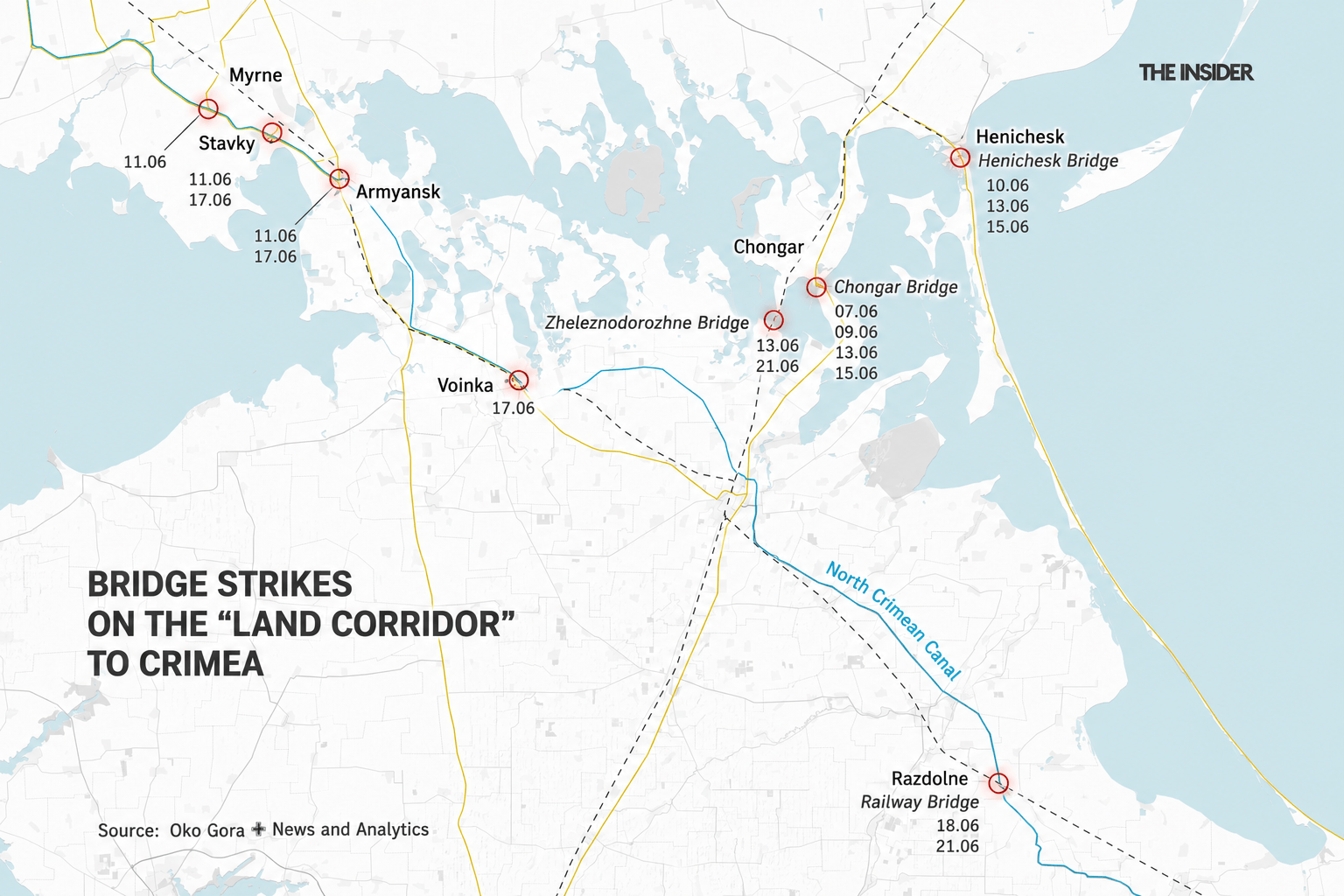
The pro-war Telegram channel ZAPISKI VETERANA 🇷🇺writes that the targeted bridges are used by Russia’s southern grouping for military logistics. Meanwhile, the pro-Russian Telegram channel Osvedomitel complains about how, “In practice, the enemy’s systematic strikes against bridges on the Crimean isthmus have made the overland route to the peninsula at the very least severely constrained and, at worst, temporarily unusable,”
Clément Molin notes that pontoon crossings have been erected near the damaged bridges in Armyansk and Chonhar, pointing out that traffic moves much more slowly over pontoons than over conventional bridges. As a result, bottlenecks form, making it easier to conduct further attacks, including strikes targeting the pontoon crossings themselves.
As of mid-June 2026, the three principal routes linking Crimea with the occupied part of Kherson Region — via Armyansk, Henichesk, and Chonhar — had been seriously damaged. The bridge over the North Crimean Canal near Armyansk, which reportedly sustained four penetrations, is now bypassed by a temporary embankment crossing that has been constructed nearby. Traffic on the bridges at Henichesk and Chonhar is restricted, with most heavy freight traffic being redirected onto pontoon crossings. At the same time, additional embankment routes are being built near these bridges.
In short, the “land corridor” to Crimea has not been completely severed, but its carrying capacity is gradually declining. Supply traffic continues to move via temporary infrastructure that increases delivery times and makes logistics more vulnerable to future attacks.
The “land corridor” to Crimea has not been completely severed, but its carrying capacity is gradually declining.
Ukrainian strikes have also targeted the railway lines linking Crimea with Russia. After the attack on a locomotive hauling the Moscow–Simferopol train on June 8, the Crimean authorities introduced a ban on passenger train operations during nighttime hours. The occupation authorities in the Donetsk and Luhansk “People’s Republics” later did the same.
Overall, from March through the end of May 2026, 28 strikes against locomotives and freight trains were recorded in occupied territories, according to calculations by the Tochnyi project. These included eight strikes in Crimea, 11 in the occupied part of Luhansk Region, six in the occupied part of Donetsk Region, five in occupied Zaporizhzhia Region, and five in Russia’s border areas (three in Bryansk Region and two in Kursk Region).
As a result of the attacks in May, rail traffic was temporarily suspended between Donetsk and Yasynuvata, causing disruptions on routes serving Debaltseve, Ilovaisk, and Mariupol.
The fuel shortage, along with strikes on infrastructure and military facilities in Crimea, is already affecting the tourism sector, which supports a significant portion of the local economy. According to booking platforms, the number of new hotel reservations in Crimea fell by roughly one-third between late May and early June, while up to 80% of previously paid bookings were canceled.
As Kommersant reports, data from the hotel booking management system Travelline show that hotel reservations from May 24 to June 6 declined by 31% year-on-year in Crimea and by 40% in Sevastopol. During the same period, 79% of bookings in Crimea and 71% in Sevastopol were canceled. In an apparent effort not to discourage the remaining tourists, the authorities in Sevastopol changed the procedure for issuing air-raid alerts, which are now signaled by three short sounds.
Since the beginning of June, strict limits on gasoline sales have been repeatedly imposed in Crimea. At most gas stations, customers could already purchase no more than 20 liters per visit, and the most recent strikes reportedly led to a complete suspension of gasoline sales to civilians.
Fuel is not the only commodity in short supply. In grocery chains, products including sugar, flour, grains, and cooking oil, were sold under restrictions. According to officials (1, 2), however, these measures were merely a response to unfounded panic buying.
In any case, Crimea’s “minister of industry and trade,” Anushavan Agadzhanyan, acknowledged that after attacks on the Novorossiya highway, authorities had to take special measures to ensure that companies delivering food and medicines received fuel supplies. A special coordination mechanism was established under which distributors submitted information about their vehicles and fuel requirements, while officials coordinated refueling arrangements with gas stations. According to Agadzhanyan, these measures prevented disruptions in food deliveries to the peninsula.
What comes next?
At the current rate of Ukrainian strikes, Clément Molin expects that Russian units on the front line could begin facing shortages of food, ammunition, and reinforcements by the end of the summer. In an interview with Reuters, Ukraine’s unmanned systems forces commander Brovdi outlined ambitious plans: “We will isolate Crimea. We will create conditions that make it extremely difficult for any serviceman or defense-industry worker to remain in Crimea, in the temporarily occupied territories, or to use the access routes leading to them.”
An expert from the Conflict Intelligence Team (CIT), who requested anonymity, believes it is still too early to speak of a noticeable impact in the situation at the front as a result of these strikes on the routes supplying Crimea. The expert notes that the most intense fighting is currently taking place in more northern sectors of the front, where supplies move through Donetsk and Horlivka. In addition, the Russian military has been confronting a broad range of challenges since the beginning of the year, meaning that even if strikes against rear-area infrastructure begin producing tangible effects, it may be difficult to distinguish their impact from that of other contributing factors.
The expert added that significant effects are likely to emerge only if the intensity of the attacks increases severalfold, particularly against roads and logistics hubs that support Russian offensive groupings on the Siversk salient and the Pokrovsk axis. In its current form, the campaign remains insufficient to produce such results.
The CIT expert emphasizes that the current campaign to isolate Crimea is aimed primarily at political rather than purely military objectives, and that a blockade of the peninsula is unlikely to have a major impact on the position of Russian forces at the front. More important, in this context, is demonstrating Crimea’s vulnerability by disrupting the tourist season and increasing public dissatisfaction.
However, military analyst Kirill Mikhailov disagrees with that assessment. He argues that strikes against the logistics corridor to Crimea have direct military significance, as they constrain alternative supply routes for the Dnepr Group of Forces on the Orikhiv sector of the Zaporizhzhia front, which remains one of the key areas of the war, particularly in light of Ukrainian counterattacks near Stepnohirsk. Russian units continue offensive operations south of Orikhiv, including in the area of Mala Tokmachka. As a result, the reliability of logistics in this sector takes on particular importance.