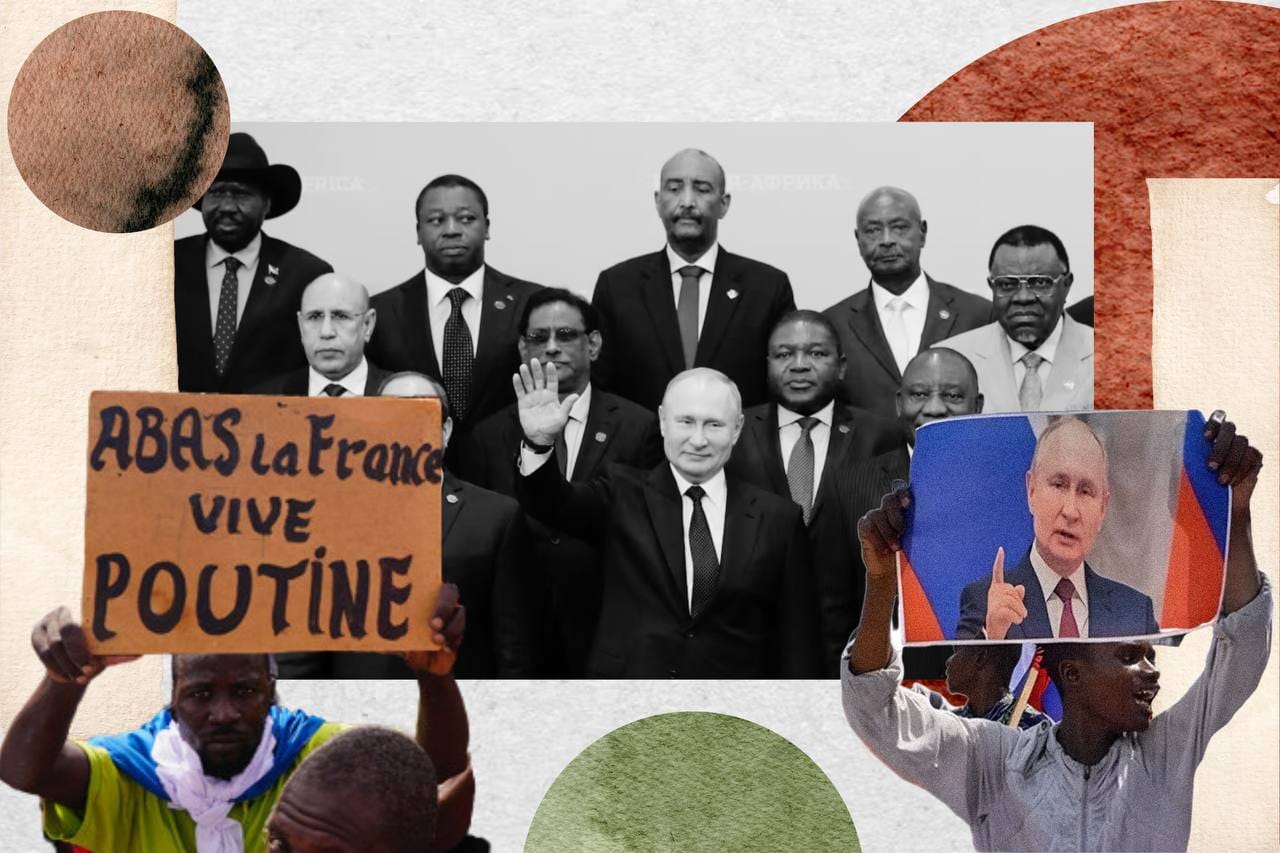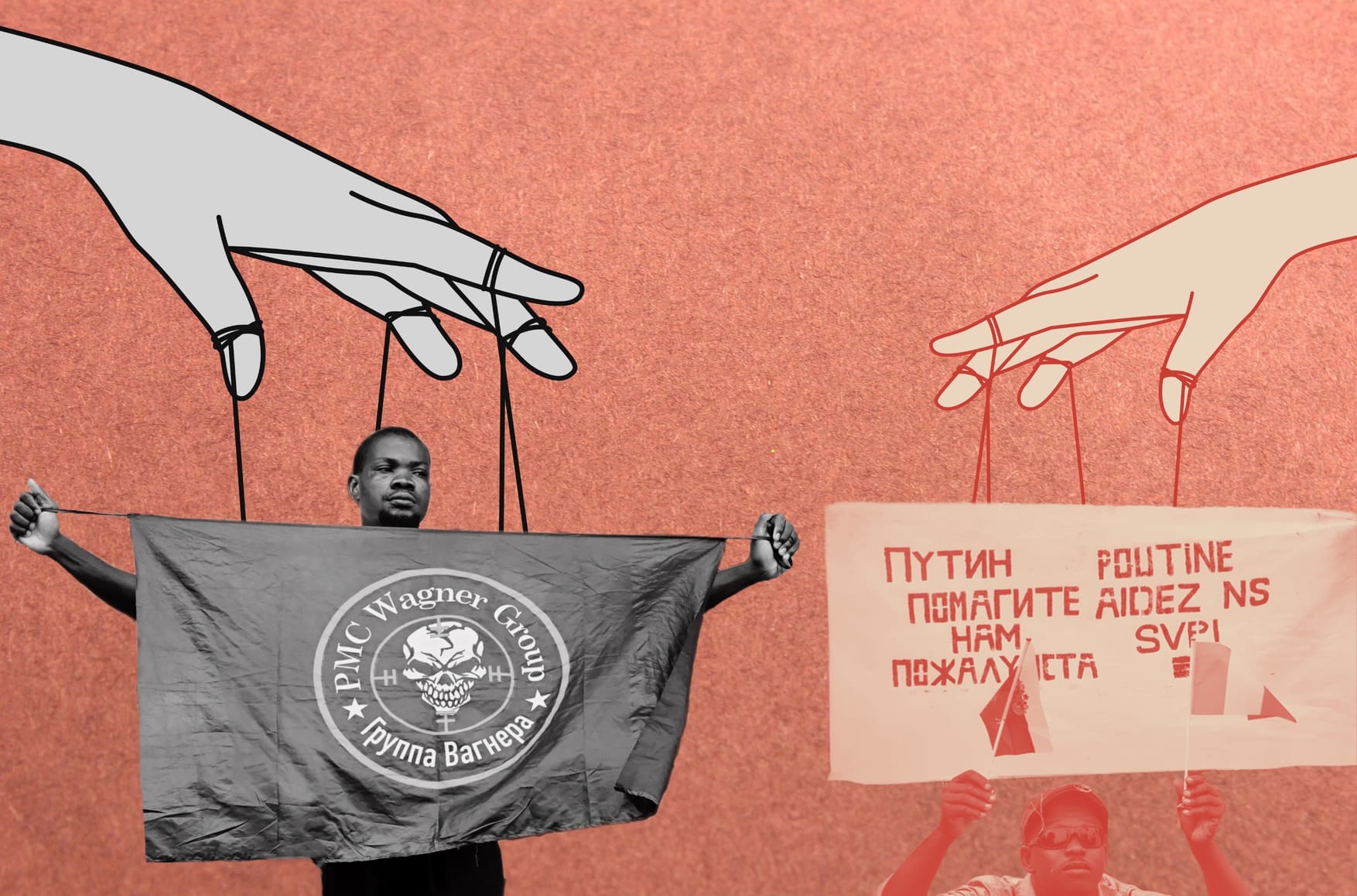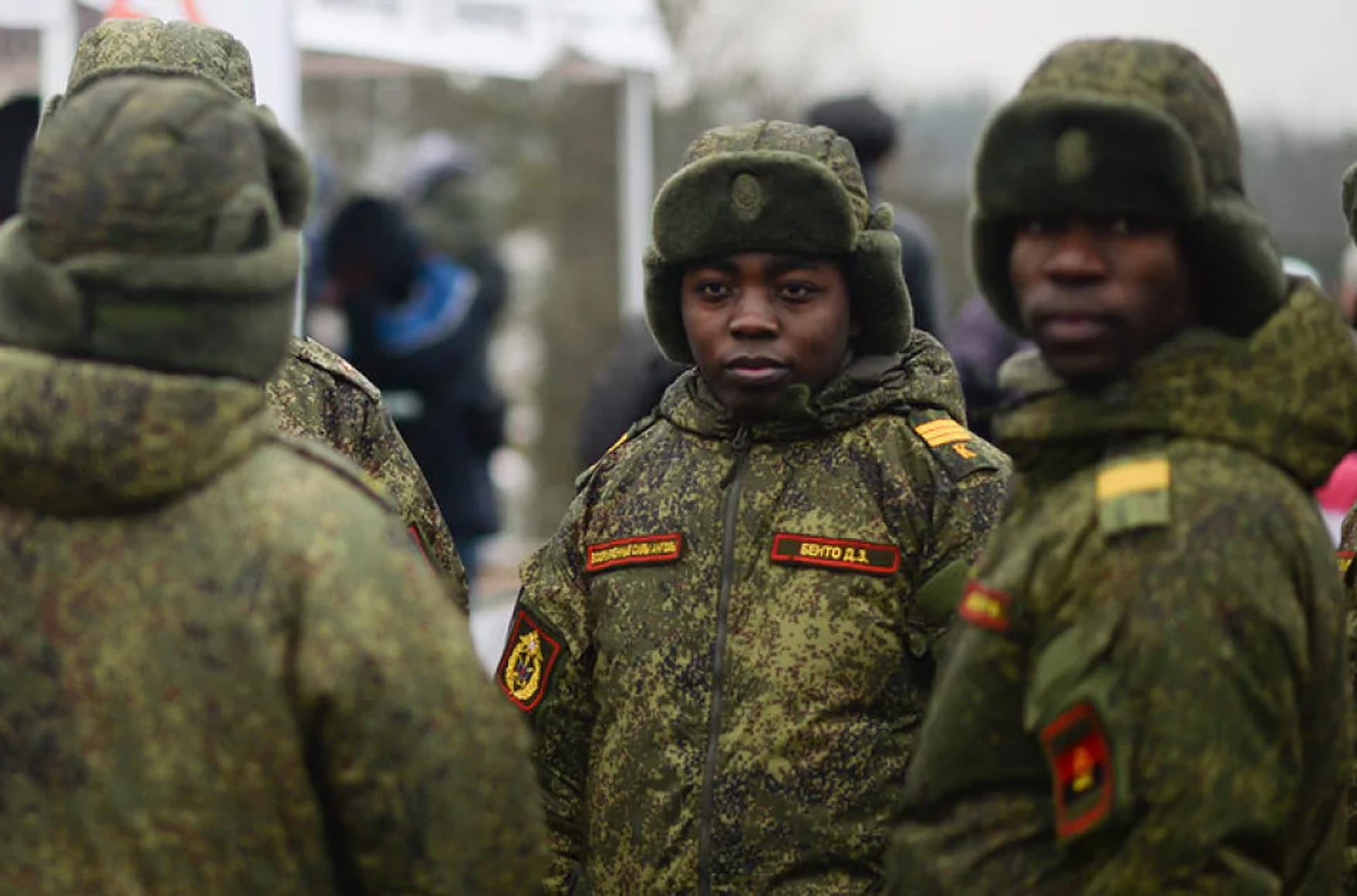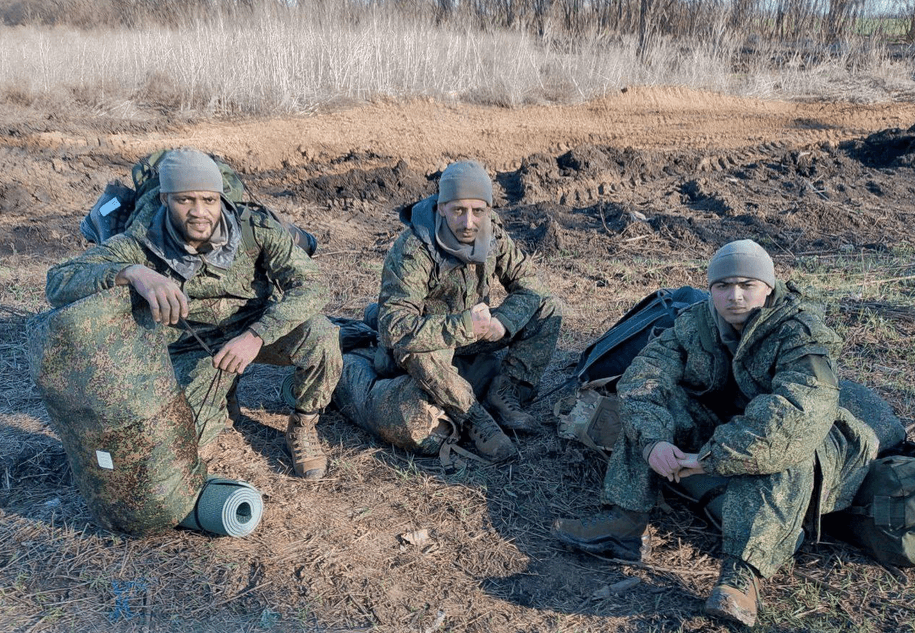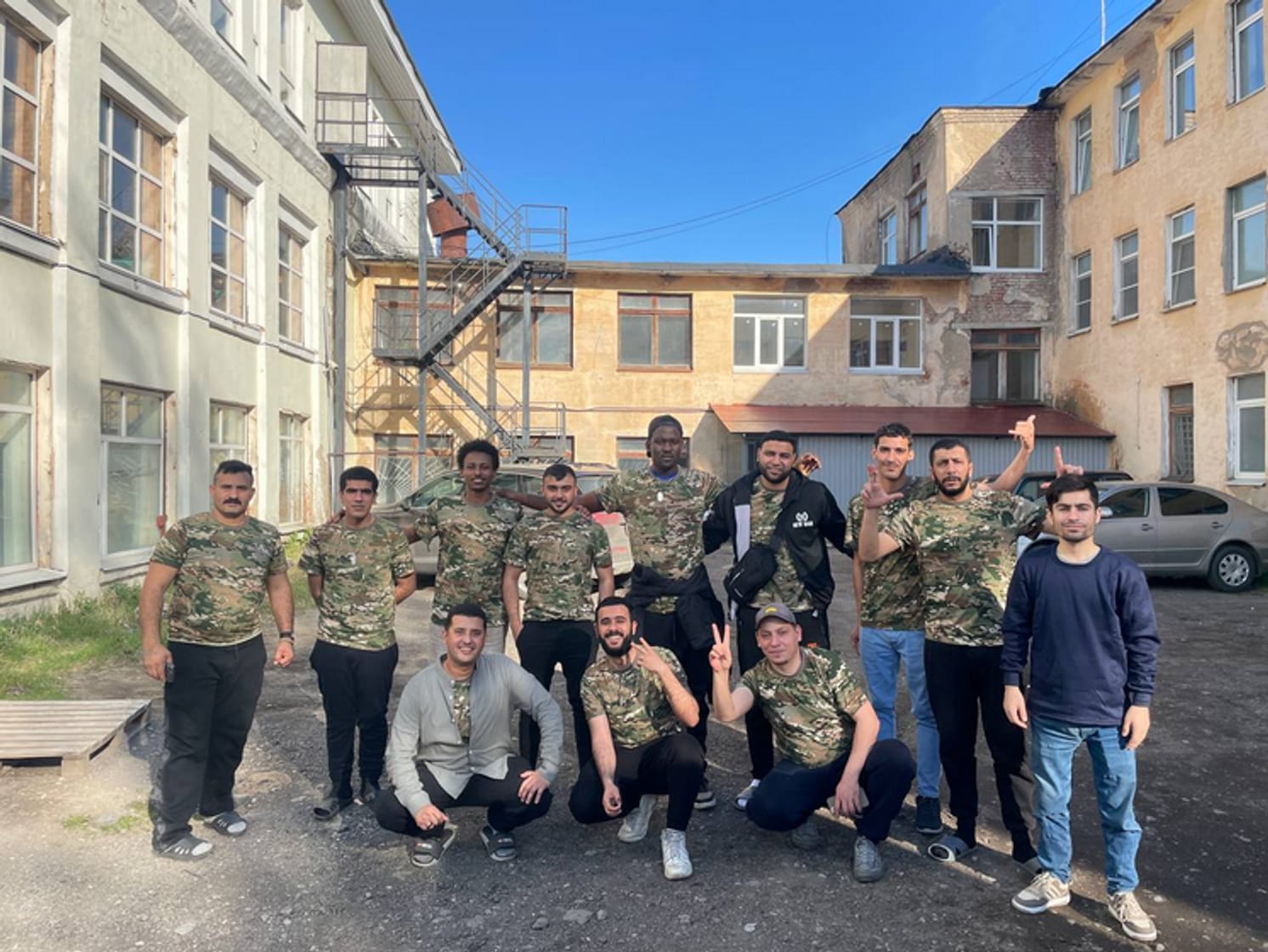
Russia’s information operations in Africa expanded significantly since 2022, even if those efforts remain largely unnoticed against the much more visible backdrop of Russia’s military presence on the continent — via private military companies, the MoD-controlled Africa Corps, and the construction of military bases and dual-use facilities. The Kremlin is acting aggressively through the specially created “African Initiative,” even attempting to introduce its own social network, Afree. One of the propaganda campaign’s main objectives is the recruitment of contract soldiers for the war against Ukraine. Exploiting the catastrophic levels of poverty in parts of the continent, the Kremlin is imitating a “struggle against neocolonialism” the defense of traditional values in order to lure Africans to Russia before they are deployed as cannon fodder on the battlefield.
Gone after leaving “for work”
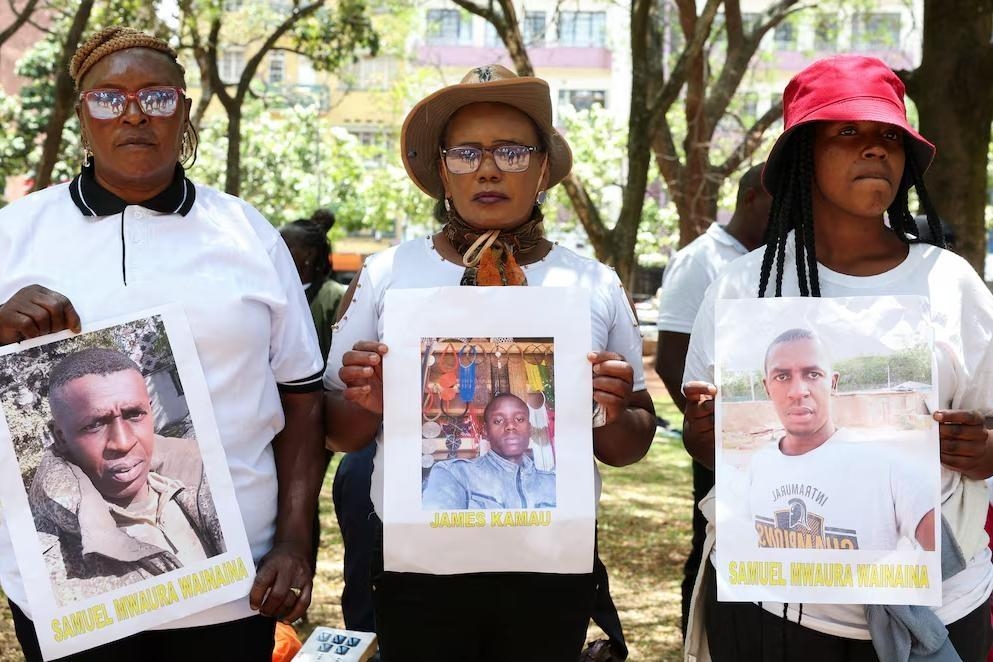
In Kenya, the cases of men who supposedly left for jobs in Russia only to end up in the ranks of the Russian army were discussed for months. On Feb. 18, the country’s parliamentary majority leader Kimani Ichung’wah stated during debates that his fellow citizens were being deceived through promises of civilian employment into serving as cannon fodder in a foreign war.
Later, in comments to local media, he stressed that recruits were being sent into combat with virtually no training: “Some were trained for only nine days. They are simply handed weapons and sent off to die.” The remarks came after the release of a report by Kenya’s National Intelligence Service (NIS), excerpts of which were published by Reuters. According to the document, more than 1,000 Kenyan men had been recruited — at the time, at least 39 had been hospitalized with injuries, 28 were missing in action, and 89 were still on the front line.
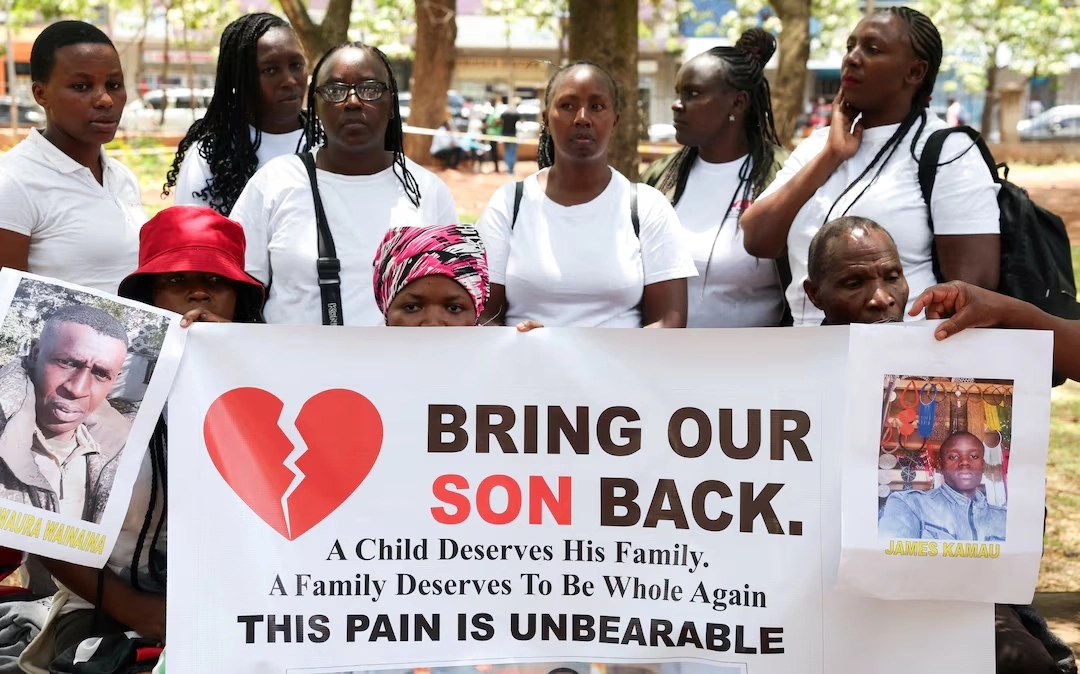
On the day the information became public – Feb. 19, 2026 – dozens of relatives of recruited Kenyans staged their first organized protest in Nairobi. As reported by Al Jazeera, one of the demonstrators, Winnie Rose Wambui, was trying to obtain information from the authorities about her brother, Samuel Maina, who had told her he was going to Russia to work as a security guard. The last time he contacted her was in October 2025, when he sent a distressing voice message “from the forest” asking her to pray for him.
According to Wambui, Kenya’s Foreign Ministry has provided neither assistance nor any information about her brother. The Russian Embassy either failed to respond to inquiries or denied the allegations of illegal recruitment, albeit while acknowledging that foreigners may voluntarily join the Russian armed forces.
Kenyan men were not the only victims of fraudulent recruitment schemes. This past February, Ukraine’s Foreign Ministry stated that at least 1,700 Africans from dozens of countries were fighting on the Russian side. South African authorities managed to repatriate several illegally recruited citizens, though their investigation remains ongoing. Ghana’s foreign minister confirmed the deaths of 55 Ghanaian citizens who had also been lured to Russia with promises of employment, only to be sent to the front lines. Reports of recruitment carried out through the same deceptive scheme also emerged from Uganda.
In February 2026, the Geneva-based investigative group IMPACT, which tracks Russian recruitment networks, reported that it had obtained several files containing lists of recruited Africans, including a more comprehensive database with information on 1,417 citizens from 35 countries. Journalists verified the file through the digital footprints of the alleged recruits and concluded that, despite containing some inaccuracies in categories such as citizenship data, the list was authentic. The largest number of recruits came from Egypt (361 people), Cameroon (335), and Ghana (234).
A separate IMPACT list contains the names of 316 African recruits who were killed in combat. The highest number of deaths was recorded among citizens of Cameroon, Ghana, and Egypt. In Gambia, Nigeria, Somalia, Uganda, Tanzania, and Zimbabwe, dozens of cases of recruited individuals returning home have also been documented.
Details have also emerged of how the recruitment network in Kenya actually operated. A report by the NIS alleged that the scheme involved Kenyan intermediaries connected to recruitment agencies and human traffickers, as well as employees of diplomatic missions.
Kenyans traveled on tourist visas using routes passing through Turkey and the United Arab Emirates. However, after security checks were tightened at Jomo Kenyatta International Airport in Nairobi, recruiters began rerouting people through neighboring countries, including Uganda, South Africa, and other states in the region, in order to avoid heightened scrutiny from Kenyan border authorities.
Mercenaries wanted
Any African using social media can come across direct appeals to join the Armed Forces of the Russian Federation. Such ads are presented without references to “security companies,” “civilian jobs,” or other euphemisms. The Insider found one such advertisement in the comments under a post about 22-year-old Kenyan David Kuloba. According to the post, the young man was deceived, recruited, and likely killed in combat.
Kuloba’s mother says that David believed he was traveling to Russia to work as a security guard – that was what the “recruitment agency” had told him. Among comments asking “how to join” and “where recruitment is taking place,” there was also an advertisement presented as an official offer to serve in the Russian army. It featured a prominent English-language headline that read: “Join the Russian Armed Forces – now open to foreign citizens.”
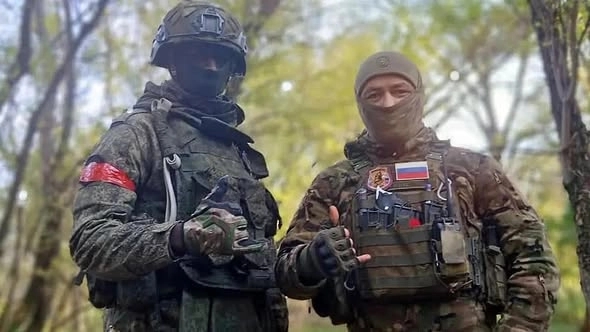
Potential recruits are required to be between the ages of 18 and 55. They are promised access to an “official state program” offering financial and social support. Recruiters assist them with visa applications and arrange and pay for flights to Russia, often to the city of Ufa.
The training period before deployment is said to last between seven and 10 days. The advertisement also guarantees Russian-language courses. However, it does not specify when exactly Kenyan recruits are expected to study the language – before, during, or after combat assaults.
Recruiters also promise free uniforms, housing, food, and medical care. The financial terms are written in small print at the bottom: a one-time payment of 1.4–1.7 million rubles ($19,000-$23,000) upon signing a contract, plus a recruitment bonus of up to $2,600 for bringing in a friend. The advertisement appeared twice in the discussion thread under the news post, published by two different users.
Contact information was also listed at the bottom, including a Telegram account and a phone number. The Insider identified the owners of the listed contact details. The Telegram account, @Za_SVOih102, was displayed under the name “Contract Service, CIS Countries Iran Turkey South Africa,” with the description “We accept foreign citizens.”
No additional information was found about the Telegram username itself, but the phone number +7-962-539-40-21 was saved by different users under the names “Matveeva Olga,” “Bikkuzina Gyuzel,” “LLC Peshkom,” “Bashkir Telecommunications Systems,” as well as “Contract Service” and “Russian Army.”
In the profile of a 2GIS account registered to the number, the “Company” section read: “Central Headquarters for the Formation of Volunteer Battalions of the Republic of Bashkortostan, company for the recruitment of foreign citizens into military service, center for Russian-language instruction and combat training.” According to a CRM database export, the contact was labeled: “GCC CONTACT FOR PROJECT BTEL WEBSITE CONTRACT MOD.”
The recruitment of foreigners into the ranks of the Russian Armed Forces was also carried out through the website workinrussia2025.ru. The domain was registered in August 2025 to a private individual and was paid for one year. Indexed references to the site are relatively scarce, but it does appear on social media.
For example, on Threads, users posted links to the site in the comments section under a post by a young woman who said she was tired of being an Indonesian citizen and wanted to move to Russia. On X, a user named Stepan shared the link to the site, writing in English that it was a contract service for foreign citizens in Russia.
Even AI chatbots appear to know how foreigners can join the Russian army. Grok quoted the recruiters’ website while responding to a user named SirMoyi18480. The potential recruit asked about salary levels and, apparently satisfied with the information, replied: “Good money, I wanna join!” – only to receive another link to the recruitment website.
A potential recruit asked about salary levels in Kenyan shillings and, apparently satisfied with the answer, replied: “Good money, I wanna join!”
SirMoyi18480 posed the question to the chatbot directly in a thread discussing Kenyan officer Peter Kimani, who had sent his mother 1 million Kenyan shillings ($7,700) before being killed in the war against Ukraine. News of his death appeared in the Kenyan press in late February 2026. Kimani had been serving in the military in Embu and decided to travel to Russia during his leave in order to fight. After arriving, he did indeed send money to his mother “to buy land for him.”
He remained in contact with his family online for three months before disappearing. On Jan. 28, the family learned that Peter had been shot dead. His mother is now seeking assistance in repatriating her son’s body.
It remains unclear how this story may have motivated the user SirMoyi18480 to consider joining the Russian Armed Forces or whether he ever contacted recruiters. He did not respond to questions for comment from The Insider.
References to the recruitment website also appear on Facebook, often posted by the same user. Jimmy Åkerlund, whose profile picture features a Russian flag, shared the advertisement in the community “The Knights Templar UK,” which is dedicated to a pseudo-Templar “brotherhood” featuring Christian and militarized symbolism. It also appeared in the group “The People’s Resistance Ireland.”
There are also recommendations from identifiable “real accounts.” For example, a user named Kingscouncil01 – who describes himself as a web designer, a brand influencer, and the CEO of The King Council perfume – advises those interested in joining the Russian Armed Forces to visit the recruitment website. In a follow-up comment, he laments that Nigerians are unable to take part.
The website workinrussia2025 does not resemble an official government resource but rather a landing page – a one-page site designed for a single purpose: to entice potential recruits with financial and social promises and motivate them to contact recruiters. On the homepage, military service is described as “contract work” that does not require knowledge of Russian. Foreign recruits are promised a one-time payment of up to 3.1 million rubles ($43,000) and a monthly salary of 260,000 rubles ($3,500).
The site has six versions: in Russian, English, Arabic, Indonesian, and Burmese, as well as a separate version for citizens of Russia and CIS countries. The terms are identical across all language versions — except that recruits from post-Soviet countries are offered a lower one-time payment of 2.1 million rubles ($28,500), along with assistance in “assignment placement.”
According to information published on the website, the recruitment of foreign citizens for contract military service is handled by the already mentioned Central Headquarters for the Formation of Volunteer Battalions of the Republic of Bashkortostan. The site’s authors specifically address citizens of several countries and regions: “We accept citizens from Africa, Zimbabwe, Iraq, Indonesia, Panama, Colombia, the Philippines, Myanmar, and CIS countries.”
The contract-signing process is described step by step, with recruiters promising support “at every stage, 24/7.” Nothing is said about health requirements, physical fitness, or even the age of prospective “applicants.” For communication, recruits are primarily encouraged to use messaging apps: a WhatsApp account under the name “Work RF” and a Telegram account called workinrussia2025ru, which bears the description “Contract service in Russian Army.”
The phone number listed at the bottom of the website differs from the one used to register the messaging accounts. In various contact directories, it appears under the names “Russian Army,” as well as “Russia” in Arabic and “Peace Throughout the World” and “Russian Army” in Bengali. Addresses linked to the number are located in Ufa.
The recruiters’ contact details also lead to an advertisement posted on the VKontakte page of a woman identified as Darya Artyomovna. Her profile description states: “Information support and coordination center for the volunteer movement of the Republic of Bashkortostan. Current programs, guarantees, payments.”
In August 2025, her page featured a post showing a photograph of dark-skinned men with suitcases alongside the message: “We invite you to sign a contract with the Russian Ministry of Defense in the city of Ufa! We also accept citizens from countries beyond the near abroad: China, Colombia, Africa, Iraq, Iran, Egypt, the CIS, etc. Foreign military personnel WITHOUT knowledge of the Russian language!” The post promises tickets and visas, although the payments offered are more modest: a one-time payment of 1.4–1.7 million rubles ($19,000-$23,000) and a monthly salary of 230,000–260,000 rubles ($3,100-3,500)
In one of her posts, Darya explains why foreigners choose to serve in what Russia calls the “special military operation.” One of the factors she cites is “historical memory,” writing that “People from the countries of the former Yugoslavia, Latin America, and Africa believe that Russia has always helped in the fight against external aggression.”
According to her, citizens of 30 countries are currently serving in the Russian Armed Forces: “These are not mercenaries, not random people. These are contract servicemen who made a conscious decision.” The style and formatting resemble AI-generated text. The post concludes with the slogan: “Your country is not always geography. Sometimes it is a choice of the heart. Russia awaits the strong. Russia awaits the honest. Russia awaits you.”
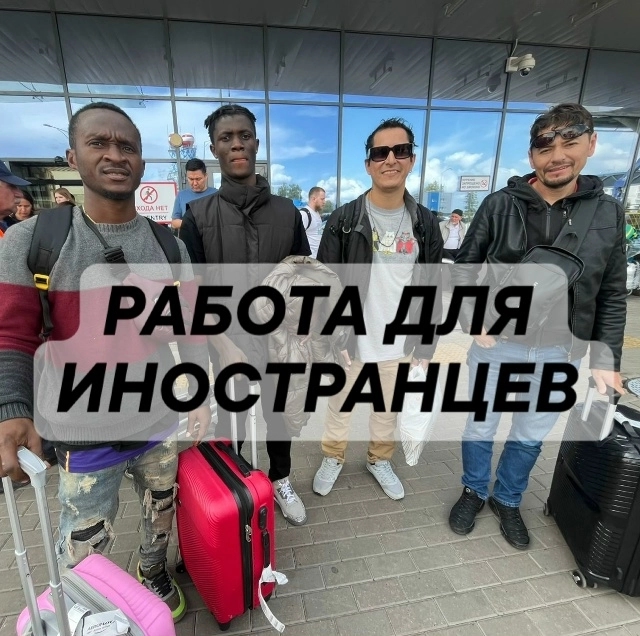
Darya Artyomovna is also listed among the contacts for the community “Volunteer Headquarters of the Republic of Bashkortostan,” which is dedicated to service in the Russian Armed Forces. The headquarters has an official address in Ufa, and its photo albums feature images of servicemen. A post pinned to the top of the community page calls on foreigners to sign contracts with the Ministry of Defense, and the list of regions from which recruits are being sought includes Africa.
The last publication in the community appeared in January 2025, but the recruitment website is clearly still active. It now has a “twin” site, “workinrussia2026.ru,” that was created on Feb. 9. It has nine language versions: Russian, English, Kazakh, Uzbek, Indonesian, Burmese, Filipino, and Arabic.
The promises have expanded as well, with the one-time payment now said to reach up to 4 million rubles ($54,500), the monthly salary listed at 250,000 rubles ($3,400), and total annual earnings advertised at up to 14 million rubles ($19,000). Recruits are also offered the possibility of obtaining Russian citizenship through a fast-track procedure.
The 2026 version also introduces basic eligibility requirements for candidates — only men between the ages of 18 and 60 with a valid passport, general education, and no serious illnesses or disabilities. Knowledge of Russian and prior military experience remain unnecessary, although the site states that professional skills can increase monthly payments.
Candidates are promised “preparatory courses,” though no duration is specified. Recruits are also assigned a “personal supervisor at every stage.” The terms and contact details are identical across all language versions of the website. No references to the new site have been found on social media or other online resources, suggesting that its active promotion may not yet have begun.
Through deception, willingly, or out of necessity
Africa is experiencing economic growth, but it has not been accompanied by a reduction in poverty or an increase in employment opportunities. According to the International Labour Organization, while the average unemployment rate stands at 6.3%, the measure of inadequate access to decent work reaches 17.4%. Youth unemployment in sub-Saharan Africa remains at 8.9%, and the region accounts for 71% of the world’s population living in extreme poverty.
Nominal economic growth has not resolved the problem. In Kenya, for example, GDP per capita grew by 43% between 2005 and 2022, while the share of the population living below the national poverty line declined from 46.8% to 39.8% over. Nevertheless, according to World Bank forecasts, more than 43% of Kenyans will still be living in poverty in 2026.
Kenyan human rights activist Otieno N. told The Insider that poverty is the main factor driving Africans to fight for the Russian army:
“I don’t think young Kenyans would voluntarily fight for Russia. There are no ideological ties that could encourage this. But I would not rule out that someone, desperate to find work or hoping to escape poverty at home, might take the risk of signing a contract.”
Otieno says that before the start of the full-scale war against Ukraine, former Kenyan servicemen sometimes found work in Russia in spheres connected to the private security industry. However, after 2022, numerous agencies luring young, unemployed Kenyans with promises of jobs abroad emerged. According to Otieno, corrupt local officials may have received payments from agencies that profited from the “fees” charged to men seeking employment opportunities.
In the comments under a Facebook post about Kenyan men recruited into the Russian army, users write that they, too, would like to contact recruiters and go to war. Many of these users, according to their profiles, live in Kenya and other African countries.
In one of the first comments, a woman from Zimbabwe expresses the view that participation in the war is a conscious choice, while another woman from Ghana asked, “Why would you fight in someone else’s conflict? Don’t they have their own citizens in that country? If they cannot get all their own citizens to fight, why should you risk your life?” However, the comment that received the most likes came from an empty profile claiming that Kenyans needed combat experience in order to “become a superpower nation in the future.”
Other comments include statements such as: “the unemployment situation in Kenya is deadly,” “better to die in battle than die poor, drowning in poverty, I need a job, help me,” and “better to die for a purpose in life than to live uselessly with empty hope here in Kenya… I wish West Africans dying in deserts and at sea trying to reach Europe would also take advantage of this opportunity.”
The Insider contacted several Facebook users who had commented on the issue, and one of them, a Nigerian man named Nwosu, said that he himself had “almost given in to the temptation” to go to the front. However, after thinking it over, he decided against it, seeing no reason to “go and die for the glory of another country.” Nwosu believes that Black men, after only three weeks of firearms training, are being asked to risk their lives in a war in which even well-trained Russian soldiers have been unable to secure victory for several years.
“These people do not love us,” Nwosu says. “Otherwise, why has participation in a deadly war become the only way to come to Russia?” The Nigerian describes the recruitment of African men in financial hardship as fundamentally unjust. “Why not open schools for us with affordable tuition so that we could study and assimilate into their way of life and culture? Then we would come to love them and, guided by love rather than poverty, desperation, or hopelessness, decide to leave our mothers behind in another country in search of a better life.”
His compatriot Ib was more radical in comments to The Insider: “We believe it is better to die earning money than to sit at home and be killed for nothing. Everyone knows that the offer from Russia is a golden opportunity to build a better life back home in the future.”
Ib is convinced that “80% of young people” in Nigeria — and across the continent — would embrace such an opportunity “with open arms.” Among his friends are several Nigerian soldiers who want to defect to the Russian army.
As an example, Ib points to Nigerian serviceman Obiora Okechukwu, who fought alongside Russia against Ukraine and said in his videos that Africans were going to the front voluntarily. According to Ib, their signing bonus amounted to $5,000 – an enormous sum in Nigeria, where the average monthly salary ranged from $60 to $130. According to Ib, Obiora had helped Africans join the Russian Armed Forces but later stopped because they “started twisting their stories once things went bad.”
Ukrainian-American journalist and political analyst Peter Zalmayev, who regularly visits African countries, questioned whether soldiers in Africa are recruited solely through deception. As he told The Insider, “It’s like a conveyor belt: one person goes, then your friend from the village or the neighborhood hears something, then your cousin follows, then you go after your brother, and so on.”
Some Kenyans interviewed by The Insider are convinced that “security work” is simply the explanation recruits themselves invent “so as not to worry their mothers, wives, and children.” Zalmayev considers that possibility plausible: “Perhaps this formula helps them save face with their families and gives the fighters a chance to legalize their status later and avoid prosecution. People can come up with different explanations to justify their choices.”
“Security work” may simply be the explanation recruits themselves invent “so as not to worry their mothers, wives, and children”
Speaking to The Insider, political scientist and African studies specialist Irina Filatova recalled how, in South Africa, Duduzile Zuma-Sambudla, one of the daughters of former President Jacob Zuma, was accused of recruiting men to participate in Russia’s war against Ukraine: “They thought they were going to security training courses, but instead ended up at the front. The government did everything it could to get them out because the situation became public. But some had already been killed or maimed.” Following the accusations, Zuma-Sambudla voluntarily resigned her parliamentary seat.
Filatova also notes that in South Africa and in some West African countries where Wagner mercenaries previously trained local armed forces, some people may indeed travel to Russia voluntarily, including to the front line, out of political sympathy alone: “Several factors come together here: Russia is popular, I’m going to do a good thing, and I’ll also be well paid – so everything seems wonderful.”
The propaganda of nostalgia and hope
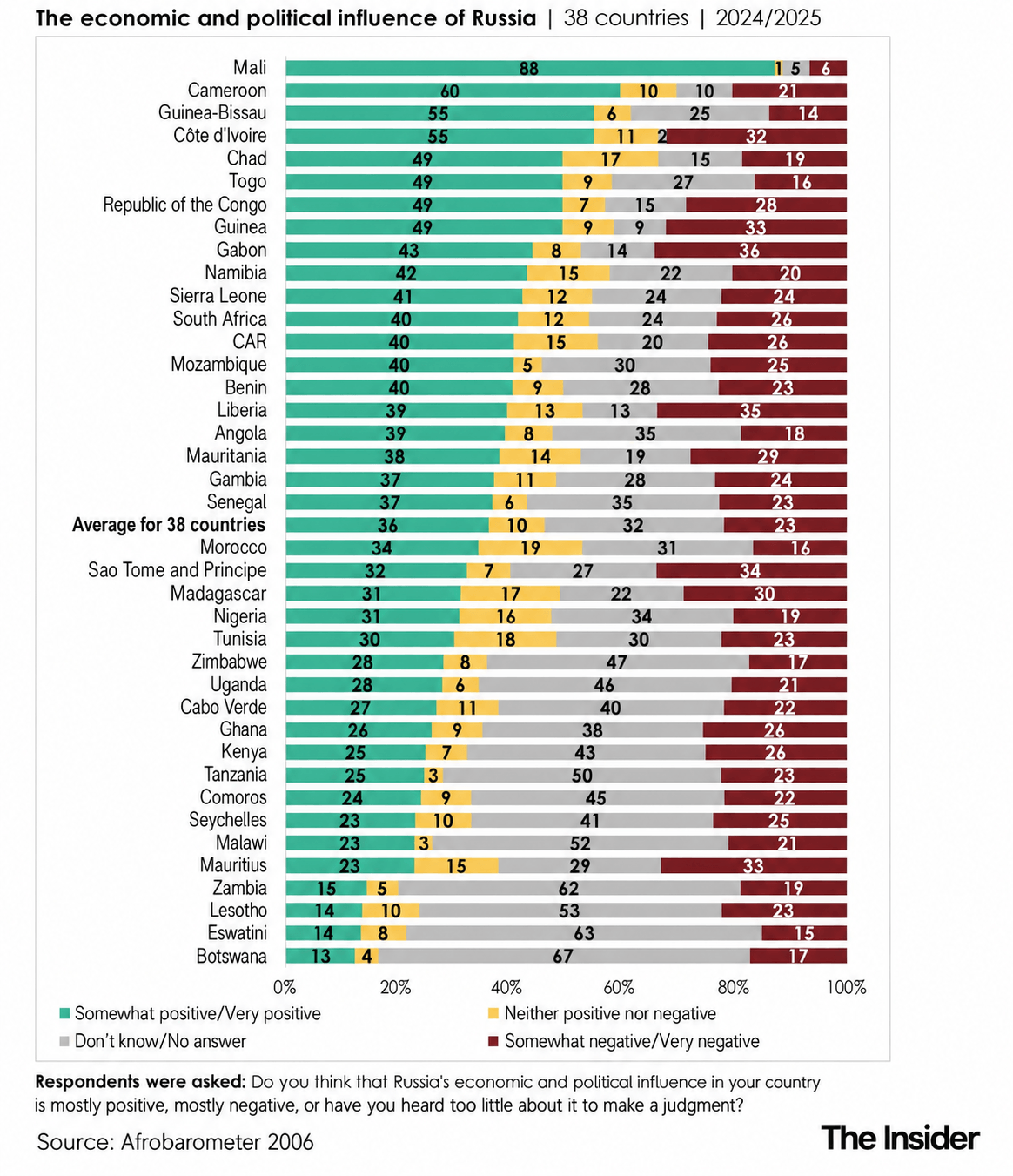
Attitudes toward Russia across the African continent vary significantly from country to country. In 2024–2025, the research service Afrobarometer conducted a survey involving more than 50,000 respondents from 38 African countries. Participants were asked to assess Russia’s political and economic influence.
The results showed that 36% of respondents viewed Russia’s influence as “somewhat/very positive,” while 23% described it as “somewhat/very negative.” Around 42% were unable to give a definite answer. In Central Africa, roughly half of respondents expressed sympathy toward Russia, with 43% in West Africa, 27% in Southern Africa, and 26% in East Africa expressing similar sentiments.
At the country level, the most positive attitudes toward Russia were recorded in Mali (80% of respondents) and Cameroon (60%). The war in Ukraine did not significantly worsen perceptions of Russia: in 24 countries, researchers recorded an increase of around three percentage points in positive assessments compared with the 2019–2021 period.
Code for Africa (CfA), the continent’s largest network of civic technology laboratories and data centers, confirmed in comments to The Insider that Russian influence in African countries is built through different models taking into account the local context.
In Mali, for example, the central narrative is security: pro-Russian campaigns emphasize military cooperation with Moscow and the effectiveness of Russian forces while simultaneously downplaying the achievements of the Western presence. In Kenya, emphasis is placed primarily on soft-power tools, including the network of Russian Orthodox Church parishes – 37 in total across the country – which researchers describe as one of the channels of Russian influence. In Nigeria, the Russian Orthodox Church also operates several parishes that CfA suspects of cooperating with influencers. There, the operation also includes planting material in local newspapers and countering anti-government protests. According to the researchers, the overall effect of these activities has been to protect the interests of coup leaders in the Sahel, fuel anti-Western sentiment, and increase sympathy for Russia’s military actions in Ukraine.
Irina Filatova notes that after the start of the full-scale war in Ukraine, Russian propaganda activity on the continent intensified sharply, diplomatic engagement increased, official visits became more frequent, and cooperation expanded across multiple sectors. She describes West Africa – particularly the Central African Republic – as the region most friendly toward Russia, while South Africa also remains relatively close. Kenya, in her view, is more distant: “At the UN, it did not always vote with Russia, and it did not even always abstain.”
Ukrainian-American political analyst Peter Zalmayev believes that Russia currently exerts its strongest influence in Francophone Africa – including Niger, Burkina Faso, Côte d’Ivoire, the Central African Republic, and parts of Libya. He says that Africans are increasingly being presented with the image of Burkina Faso’s military leader Ibrahim Traoré as a role model:
“It’s the image of the kind of personalist, authoritarian power that now exists in Russia. On both the western and eastern coasts of Africa, I’ve seen these kinds of iconostases displayed in the rear windows of buses – for example, in Burundi there was one with the local president, Putin, and Gaddafi. Gaddafi, as we know, also promoted a pan-African vision and wanted to unite the continent. In other countries, if it’s not Gaddafi, then it’s the local president, Putin, and Traoré. I’ve seen this in Zimbabwe, Tanzania, and elsewhere.”
Zalmayev’s observations are echoed by investigators at Code for Africa, who say that propaganda campaigns supporting Burkina Faso’s leader Ibrahim Traoré are aimed in part at audiences in Nigeria, Ghana, South Africa, and Kenya. They also note that some of this content consists of AI-generated videos designed to project an image of economic growth and overall stability.
In this way, propaganda attempts to capitalize on young people’s frustration – their anger over unemployment, corruption, and weak democratic institutions. More importantly, it seeks to normalize the idea that military regimes can serve as an acceptable alternative. Assessing which groups are most vulnerable to recruitment, CfAresearchers point to several target demographics: soldiers in Cameroon, taxi drivers in South Africa, and craftsmen in Nigeria.
According to Zalmayev, even countries that were not previously known for pro-Russian positions have shifted in recent years because of worsening attitudes toward the United States: “With Donald Trump returning to power, with aid to Africa being cut – including through USAID – a vacuum has emerged, and nature abhors a vacuum. Many countries understand that they need to attach themselves to some kind of harbor.”
Against the backdrop of China’s growing appetite – Beijing has long since strengthened its presence on the continent – the number of countries sympathetic to Russia is also increasing. On March 16, 2026, for example, Namibia began considering prospects for cooperation with Rosatom.
“Russia is also expanding its influence through propaganda built around a continent-wide narrative: ‘This is about the Soviet Union’s assistance in anti-colonial struggles, in the fight against apartheid and imperialism. Russia presents itself as the defender of the Global South, fighting oppression and advocating for a multipolar world,’” Irina Filatova explains.
The continent-wide narrative promoted by Russian propaganda centers on the Soviet Union’s support for anti-colonial struggles and the fight against apartheid and imperialism
Filatova believes the specific reasons for sympathy toward Russia vary from country to country. In South Africa, narratives of Soviet assistance remain especially influential: the USSR is still regarded as a friend of both South Africa and the ruling African National Congress, as well as “those who are still in power or only recently left office.” When it comes to West Africa, Filatova agrees with Zalmayev that there is a strong anti-French element in Russian propaganda and that Moscow’s influence is particularly strong in former French colonies.
Another narrative, more widespread in Southern and Central Africa, revolves around the promotion of traditional values, which many on the continent perceive as being similar to Russia’s own: “There is an emphasis on the religious values of Africans, resistance to the dominance of Western mentality, and opposition to the imposition of Western norms and rules. And in all of this, Russia presents itself as helping Africa.”
Peter Zalmayev also points to strong nostalgia across the continent for Soviet-African ties, especially in South Africa. According to him, that past is associated primarily with Russia, even though Ukraine, in his words, “played second fiddle in this alliance.” As he explains it: “More than half of the doctors, engineers, and other members of the intelligentsia in Mozambique during the 1970s were from Ukraine.” He argues that this history needs to be discussed more openly in order to counter anti-Ukrainian narratives promoted by Russian propaganda and Moscow’s attempts to appropriate the Soviet legacy.
For many pro-Russian Africans, the image of Russia as a defender against colonialism coexists with support for the invasion of Ukraine – something Zalmayev also attributes to propaganda. Having spoken repeatedly in countries across the continent, he says he has developed his own approach to promoting the Ukrainian narrative: “For Africans, it can be difficult to understand the difference between Russians and Ukrainians – to them, we all ‘look the same,’ just as they sometimes do to us. You have to explain to them that just as they fought against their colonial rulers, Ukraine is now fighting what is, in a sense, a colonial relationship with Russia.”
Zalmayev notes that Ukraine faces greater difficulty promoting its narratives because Kyiv’s diplomatic presence on the continent is objectively much weaker than Moscow’s: Ukraine has only 17 embassies in Africa, while Russia has 54, having inherited the Soviet diplomatic network.
According to his observations, in nearly every country the Russian Embassy resembles “a small city with a skyscraper, shops, and a cultural center.” He adds that “after the start of the full-scale war, Russia seriously stepped up its brainwashing efforts, including against Ukraine.”
In Mali, Zalmayev says, anti-Western sentiment is particularly intense: “Even for someone arriving from the West, it would be unsafe there.” Tanzania, meanwhile, has an authoritarian regime that maintains close ties with both Russia and China. Kenya, by contrast, remains “an island of democracy” with a large and active media landscape.
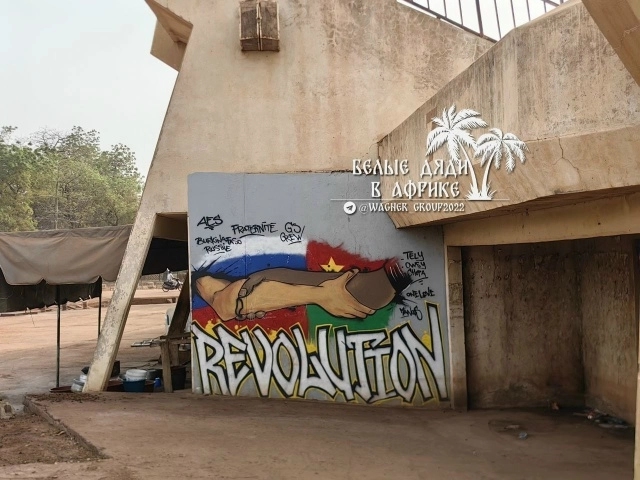
Irina Filatova describes the situation in many of the countries where Russia has expanded its influence and where Wagner forces have operated – a list that includes the Central African Republic, Mali, Chad, and Niger – as catastrophic: “These are extremely underdeveloped and impoverished regions, marked by deep tensions between local populations and Islamist groups that regularly attack villagers, kill those they dislike, and fight governments for control over enormous natural resources. Russian military personnel apparently receive some share of those resources in exchange for protecting these regimes.”
According to Filatova, propaganda in Africa is spread using almost exactly the same language as in Russia itself. It generally consists of narratives about Russia’s “invincible strength” and supposed battlefield “successes,” along with hostile statements about Volodymyr Zelensky and other demonstrably false information. As a result, in countries where Russian influence is strong, many people develop pro-Russian attitudes, especially regarding the causes of the war against Ukraine.
The Insider spoke with Africans who had expressed support for Russia on social media and who said they wanted to help Russia at the front for ideological reasons. Joe Sergeant, from Namibia, has no military experience, but says he “loves the army with all his heart” and wants “to fight evil and the deceivers in NATO.” He believes that Russia, North Korea, China, and Iran are fighting for truth and justice.
A Nigerian man named Wilfred Father said that all countries except Ethiopia had been colonized, but that Russia had never been among the colonial powers: “Fighting for Russia would mean fighting for freedom from neocolonialism. Why should Africans today depend on Western aid in order to develop? Why is Africa a dumping ground for Western goods? Why do they take our mineral resources and give us pieces of paper in the form of dollars, which they print in enormous quantities?” Wilfred says he knows many people who share these views.
Notably, his comments about Ukraine closely mirror Russian propaganda narratives: “The war was not started by Russia, but by America through Ukraine. Russia will not lose – it has the military power to continue fighting for the right cause.” He describes opposing views as the result either of ignorance or of an unwillingness to seek out “reliable information.”
A Kenyan man named David shared with The Insider his dream of fighting for Russia:
“I want to fight the terrorists from the United States, but my health does not allow it. The people who joined the Russian army have been given a great honor – to stand against true evil, depravity, and slavery. Two of my friends are still there. They call and write to their families and do not want to return until victory. Long live Putin!”
David refused to provide any further details about his friends serving in the Russian military, adding only that the work is well paid and that “nobody mistreats them because Russians are like brothers.”
Russians living in Kenya have noticed the effects of the Kremlin’s efforts. An entrepreneur named Alexander told The Insider that Kenyans are aware of the presence of “recruiters urging people to join the special military operation,” but that speaking openly about those who have been recruited is uncommon. He believes that the people who appear in the news are “the ones who ran into problems,” while those serving without incident prefer not to publicize their experience. According to Alexander’s observations, local media coverage tends to revolve around “what can be gained from Russia.” In particular, there was extensive coverage of the Russia–Africa summit and Russian wheat imports to Kenya.
Empire of propaganda: media, culture, and the African MAX
After the death of Yevgeny Prigozhin and the dismantling of his media structures, Russia began rebuilding its system of informational influence in Africa. A key element of this new propaganda architecture is the “African Initiative” (AI), a media project established in Moscow in September 2023.
According to a joint investigation by the European anti-disinformation bodies VIGINUM, the EEAS, and the FCDO, the organization presents itself as “an information bridge between Russia and Africa.” In practice, however, it functions as part of Russia’s public diplomacy strategy, serving as a major instrument of informational influence on the continent.
The report’s authors suspect that the activities of AI are directed by the Russian state, particularly its intelligence services. The organization allegedly exploits existing instability and anti-Western sentiment across Africa in order “to shape the information environment in favor of pro-Kremlin ideology” using both online and offline tools.
According to the investigators, manipulative schemes are concealed behind the façade of public diplomacy. An investigation by the French media outlet Forbidden Stories states directly: “African Initiative is a new springboard for Russian interference in African affairs.”
According to findings published by investigators in May 2025, the organization also promotes the “Africa Corps,” the successor to Wagner, and several figures involved in African Initiative’s operations were affiliated with Prigozhin’s “Lakhta Center.” Among them are editor-in-chief Artyom Kureyev (accused of participating in disinformation campaigns in Europe and Africa and linked to the FSB), liaison officer and contributor Viktor Lukovenko (a.k.a. Vasilyev, who is linked to the GRU and was convicted in Russia of racially motivated murder before later being arrested in Kyrgyzstan on suspicion of recruiting mercenaries), and deputy editor-in-chief Anna Zamaraeva (the former head of the press service for the Wagner Center PMC).
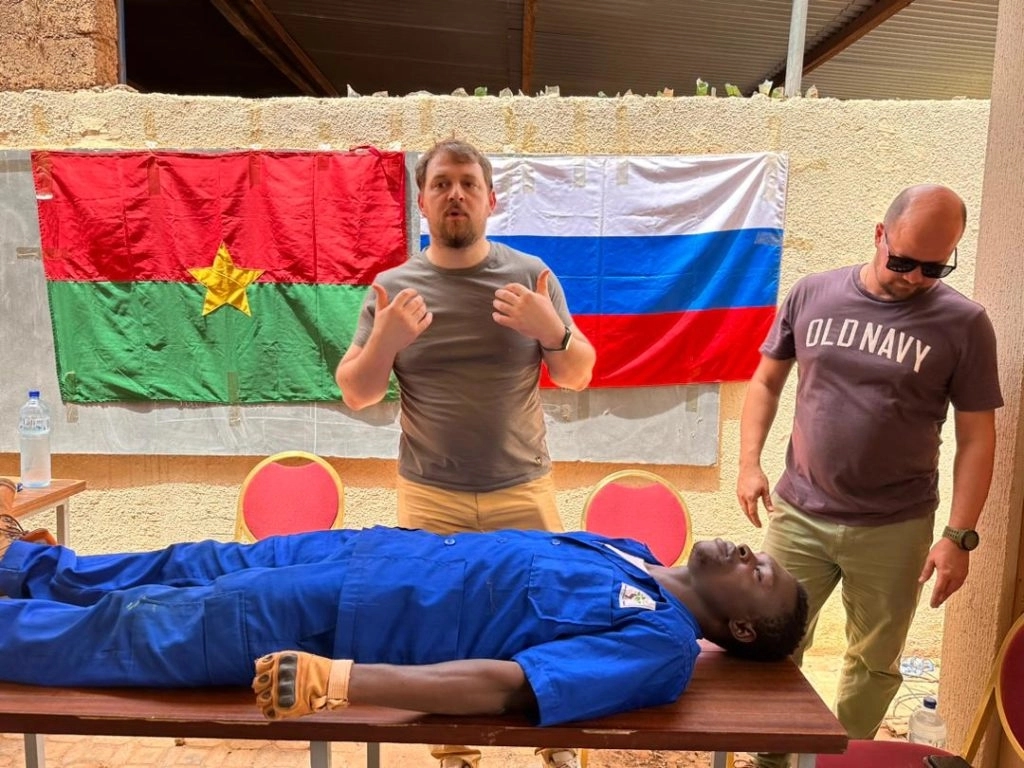
The deputy editor-in-chief of the African Initiative news agency is Maxim Solopov, formerly a special correspondent for Meduza and a reporter for RBC. He became widely known after publishing, together with Kristina Safonova, an article about a double murder that suggested possible involvement by defendants in the Penza “Network” case.
Following the publication, Solopov was granted witness status and testified during the trial. Within the Russian journalistic community, the article was described as “raw and unverified” and “resembling a leak,” while The Insider pointed out a number of inconsistencies and other questionable aspects of the investigation.
African Initiative operates as a full-fledged media outlet, with versions in English, French, Spanish, and Arabic, as well as a Telegram channel. Articles published on the website are reposted to the Telegram channel and then distributed across dozens of affiliated groups and communities.
One of the outlet’s most widely circulated posts, published on Jan. 24, 2023, concerned the arrival of one hundred Russian servicemen in Burkina Faso, along with military equipment and weapons. According to an investigation by DisinfoAfrica, the post was shared across 87 public groups and channels, generating approximately 1.5 million views and 537 interactions. The outlet’s content ranges from neutral topics such as culture and sports to political material promoting anti-European and anti-Western narratives.
The Insider found similar material on Russian social media platforms. For example, the VKontakte community “Empire News” posted a “news item” claiming that “Africans burned an effigy of Zelensky.” Attached to the post was a video in which a rag doll bearing a photograph of Zelensky was first hanged from a gallows and then set on fire. One of the children in the video repeatedly struck the burning “body” in the head with a stone. According to information published on a pro-Russian website, the “event” took place in Mali in October 2024.
However, the role of African Initiative extends beyond publishing propaganda materials – the organization is also preparing potential future collaborators. In July 2026, a content school titled “From Kilimanjaro to the Desna” opened in Bryansk. African Initiative organized the project in cooperation with the “African Bloggers Union,” the “Union of Bloggers of Russia,” and Bryansk State Engineering and Technology University.
Thirty African bloggers with “professional experience” have already been selected to participate. The educational program includes “lectures on the traditional values of Russia and Africa,” a “discussion on interfaith dialogue,” master classes on “fact-checking” and video production, as well as a “seminar on viral marketing.”
Another increasingly popular avenue of influence is video games. In comments to The Insider, the organization Code for Africa pointed to the propagandistic influence of the online video game Africa Dawn, which portrays the September 2022 coup in Burkina Faso. The game was created by African Initiative and is aimed directly at young people in the country. An information report by the French National Defense and Armed Forces Committee states that the game contributes to distrust of France in the Sahel while portraying Russia as a savior and ally.
In the game, a pro-Western imperialist bloc confronts a pro-Russian pan-African bloc. Missions on the “Russian side” revolve around Yevgeny Prigozhin and culminate in the “liberation of the African people” and the “death of Western imperialism.” The final mission, French television channel TF1 describes it, is “a Russian veni vidi vici glorifying the former Wagner leader as an emperor crowned with a laurel wreath.”
African Initiative also placed considerable hopes in its mobile application Afree – a messaging platform developed specifically for the African market and intended to “unite everyone in Africa and free them from total censorship by giving everyone a voice.”
The launch of the app was announced in Kenya in September 2024. CEO Bakhtibek Batyrkanov stated that “the platform was designed to function in regions with limited internet access, features an intuitive interface for people with low literacy levels, and offers numerous functions for internet-savvy youth.”
The application’s official website is itself an example of crude propaganda. Its developers claim that Chinese and American social media platforms “often have a negative impact on national cultural values,” while Afree’s “mission” is “to protect the African population from the harmful influence of foreign cultures.”
Afree declares its mission to be the protection of African populations from the harmful influence of foreign cultures
Afree is also promoted as “an excellent source of income and a business with high capitalization potential.” Its creators say they plan to build an ecosystem around the platform that will include a payment system, marketplaces for goods and services, hotel-booking tools, and “much more.” Among the technical features highlighted are the ability to watch “long-form videos” similar to Netflix and short videos similar toTikTok, to create and follow channels in the style of Reddit and Telegram, and to use livestreaming functions designed for monetization. The platform also claims it will incorporate features resembling services ranging from PayPal to Alibaba.
The application can only be downloaded through the App Store and third-party services hosting Android installation files. The African messaging app has already been removed from Google Play, although the page remains available in the Yandex cache. According to the listing, the application was uploaded by developer Zhyldyz Moldogaziyeva, was downloaded more than 100,000 times, and held a rating of 3.3 based on 428 reviews. However, only a handful of written comments were left by users. Two were positive, while a third complained about a violation of platform rules: “This application…does not provide the ability to delete my account.” That complaint may have been the reason Afree was removed.
However, another possible factor was information about the app’s links to the Russian Federation, which was explicitly mentioned in the privacy policy published on another website associated with the application. The current version contains no references to Russia and states that users’ facial data is neither downloaded nor stored on servers. However, as can be seen using the Wayback Machine, the version of the page saved on Nov. 14, 2025 contained six references to the Russian Federation. Up until November 13, no edits had been made. But beginning with the version saved on Dec. 15, 2025, the policy instead referred to the laws of the Kyrgyz Republic and stated that personal data was stored on servers located in Kyrgyzstan.
The above-mentioned Moldogaziyeva is listed as the director of LLC Kaganat, according to official records. Investigators also report that Afree head Bakhtibek Batyrkanov studied at the Russian Diplomatic Academy in a field related to international security.
Peter Zalmayev believes Afree is clearly part of an influence operation: “It has a nice façade and a clever name – A-free, not Afri – meaning ‘Africa will be free.’ But it is not a neutral messenger app, because Russian narratives are clearly being pushed through it.” According to him, comments containing false information or pro-Russian opinions on the app and other social media platforms may be written both by bots and by people who are paid to post them.
At the same time, Zalmayev doubts that the application ever gained real popularity or that it is capable of influencing large numbers of people. Kenya alone has a population of roughly 57 million, meaning that even if the figure of more than 100,000 downloads is “organic,” it still represents too small a share of users to be significant for a continent as large as Africa. Residents of African countries interviewed by The Insider said they had never heard of the app.
“I think the whole thing was still in the development stage as an operation, but after the investigation came out, they toned it down. There is not even the slightest chance of Afree replacing WhatsApp. But then again, that was probably the goal they set for themselves. Africa is now highly computerized and smartphone-connected, especially Kenya. But in the end, the money was received, embezzled, and written off in reports,” Zalmayev concludes.
“They’ve got nothing in their heads anyway”
Photographs of African soldiers on the front lines in Ukraine have surfaced not only in foreign media and social networks, but also in pro-Russian VKontakte communities. In February of this year, for example, the “Lyubo-Dorogo” group published a photograph showing three men dressed in military uniforms sitting inside a vehicle. One of the men was Black. His face is uncovered and he is seen smiling at the camera while the other two – apparently Russians – have their appearances concealed. The caption reads: “‘Our Black Russian brothers have already firmly settled into the special military operation zone and are even gradually beginning to speak Russian. They’re kind, cheerful, follow orders, and fight the enemy,’ our servicemen note.”
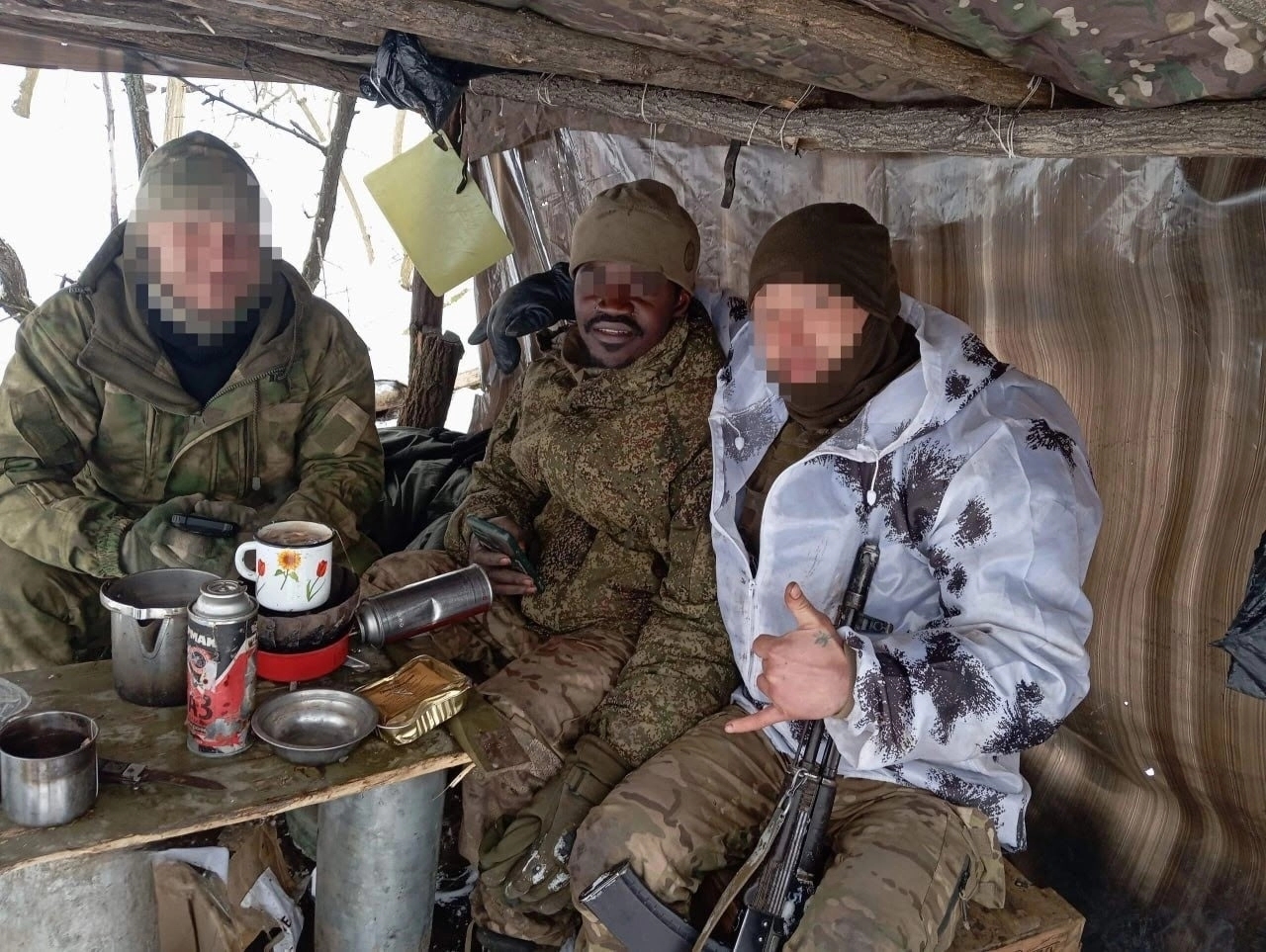
The nickname “Black Russians” has appeared repeatedly in posts published by Russian servicemen. In October 2024, the group “Patriots of Russia” posted a photograph showing 11 Black men seated at a table with several plates of food in front of them. They are looking at the camera and smiling. The caption reads: “African volunteers. Our Black Russians in the special military operation zone.”
In December 2025, African recruits were given yet another nickname. Under a photograph of a short elderly Black man in military uniform smiling at the camera, the caption reads: “More and more of our Black Russian brothers are taking part in the special operation. Our fighters affectionately call them the Donbas ‘miners.’” One commenter appeared to speculate about the possible motivation behind Africans joining the Russian army: “Russia once helped them, and they remember the favor and are now helping in return.”
According to the community, not all African men who signed up for service were sent to the so-called “special military operation zone.” One video posted in “Lyubo-Dorogo” shows a group of Black men in military uniform standing beside tanks. The caption reads: “Black Russians guarding NATO equipment in Krasnodar” (the reference is to an exhibition of “captured military equipment” held in Krasnodar in October 2024).
One of the videos posted in the VKontakte community, “Overheard POW Search SMO,” reveals the psychological atmosphere surrounding recruits’ first encounters with the Russian army. In the footage, men of different nationalities stand at attention while a voice off camera aggressively demands that they state their “name, age, and citizenship.”
According to the accompanying text, the video shows the “combat coordination” of volunteers from China, Kenya, Colombia, Bangladesh, and Iran (the footage also includes one man from Ghana and several from Russia). The post notes that the events are taking place in the “102nd Motorized Rifle Regiment – Slonim-Pomeranian, Red Banner, Order of Suvorov and Kutuzov regiment, granted Guards status by decree of the President of the Russian Federation on April 16, 2025.”
The battalion is reportedly conducting “intensive training and preparations for deployment to the special military operation zone,” with “drills and live-fire exercises from morning until evening” as recruits are prepared for combat.
The volunteers in the video do not appear enthusiastic. The voice behind the camera refers to recruits with Slavic features by saying, “Alright, Orthodox one,” and at the end mocks the posture of a recruit from Novosibirsk: “If you stand like that, your palms are going to smell like ass.”
Not all users appreciated the cameraman’s tone – some commenters responded by insulting him in return. Most of the other messages in the thread, however, were enthusiastic. There were also expressions of resentment toward those unwilling to fight for Russia, including from two women:
“If that’s the case, then they’ll earn it with blood and sweat, unlike those who come here just for benefits and subsidies, but when it’s time to serve or go to the SMO, they hide in the bushes.”
“Say thank you that they fight shoulder to shoulder instead of running away from the country like some of your own do, even your celebrities like Malakhov, Pugacheva and many others... And then you say only Russians are fighting in the war when most there are not Russians. Thank you guys from the bottom of my heart.”
During training, Africans undergo not only intensive military instruction but also the sacrament of baptism into the Orthodox faith. Priest Alexander Gavrik writes that during one of his trips “to the special military operation zone,” he encountered Africans, and that “our Black Russian brothers were slightly confused when they saw a priest at the deployment point.”
During training, Africans undergo not only intensive military instruction but also the sacrament of baptism into the Orthodox faith
The priest communicated with them “through a Serbian brother” who spoke English and French. The Africans apparently came to the idea of baptism rather quickly: “After a brief introduction about myself and the Orthodox faith, with the help of our Serbian brother, they were baptized.” The text is accompanied by photographs showing several Africans among Russian servicemen as they convert to Orthodoxy.
Some Africans reportedly ended up at the front directly from construction sites. “How do you become a true Black Russian? Ask these guys. Men from Nepal, Africa, and India were building a church near Ryazan. Now they are going as volunteers to the SMO. That’s how steel was forged!” the VKontakte community “Russkost” writes, attaching several photographs of Black men standing near a church.
Searching for the term “Black Russian” produces numerous videos featuring African contract soldiers. In one clip, they say in Russian to the camera: “Wagner Group good, fucking awesome!” In another, they dance to the song “Mother Earth,” while in a third they smile demonstratively and nod as a voice off camera proclaims “Russian world! Victory will be ours!” – apparently without fully understanding what is being said. Meanwhile, one commenter complains: “There’s nothing in their heads anyway, they’re useless.”
It is also possible to get a brief glimpse into the recruits’ training process. One video shows the “instruction” of “Black Russians” unfolding amid the foreigners’ complete inability to understand either the Russian language or the mockery directed at them: “Me, helicopter, tu-tu-tu and go to Sri Lanka, jumping and VDV,” says the “instructor.” He then hands a crushed metal can to a Black recruit and repeats: “Guitar, present.” The man smiles awkwardly and does not know how to respond. “Maybe go to assault? Tu-tu-tu,” the instructor suggests, to which the trainee shakes his head: “No, no.” “Go, go, let’s move!” comes the reply – whether it is said as a joke or deadly seriously is impossible to tell.