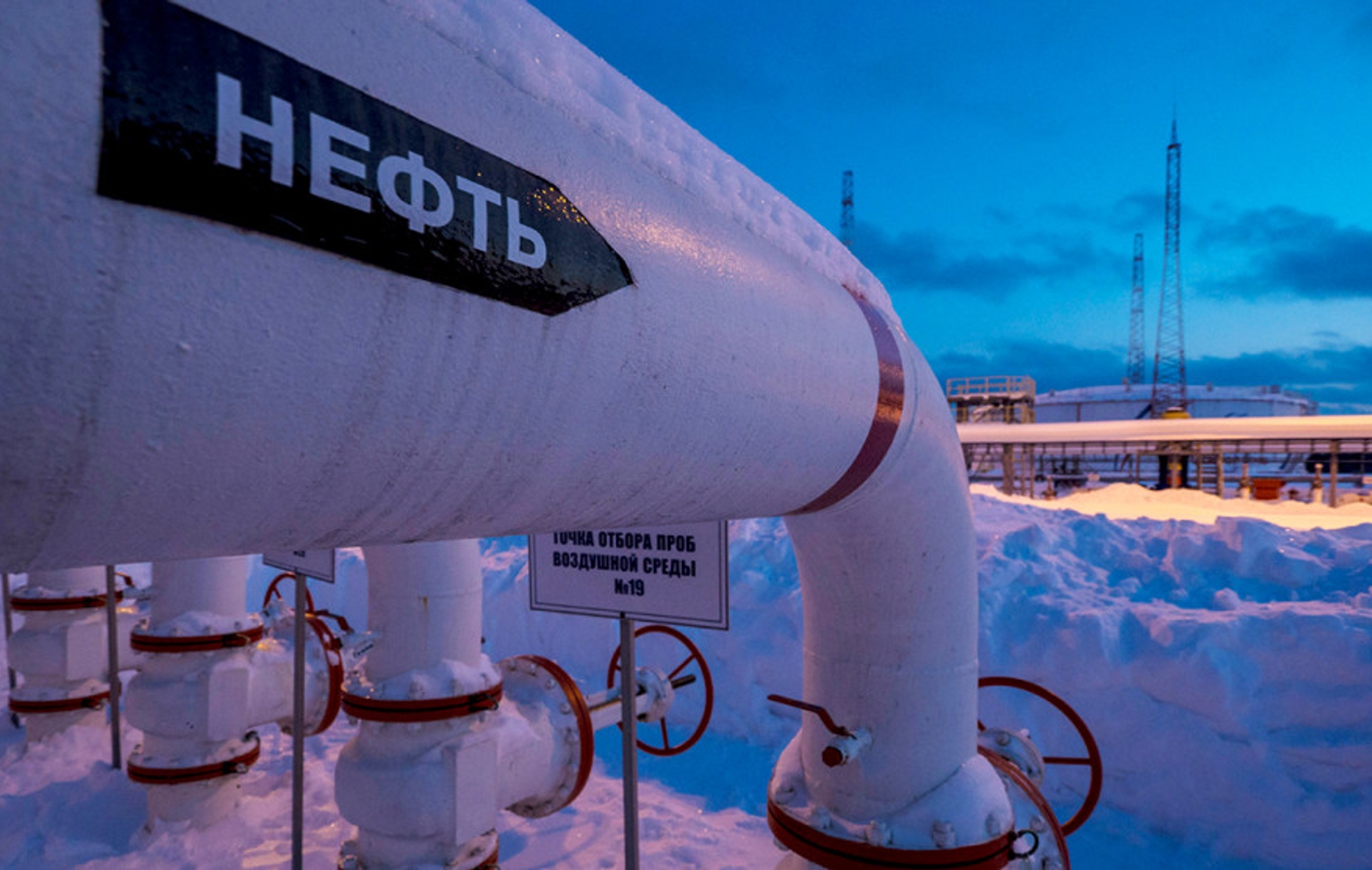

After four years of strict financial and technological sanctions, Russia’s share in global oil production has fallen from 12% to 11% and in overall trade from 13% to 11%. The drop may look small, but it is not the quantity but the quality that has changed most. Russia has completely lost its status as an oil superpower. Whereas Moscow once set the terms, it now plays by rules imposed on it, explains Tatiana Mitrova, an expert on the global energy system. Russia continues to sell oil, but it plays an ever smaller role in shaping its price (which has fallen to its lowest level since before the start of the invasion). Although India and China will not be able to give up Russian oil — not even under pressure from the United States — Western sanctions have still pushed Russia into the shadow market, turning the country from a stabilizer into a “disrupter” of energy markets.
OPEC+: Russia has lost its role
Until 2022, Russia held a special position in the oil market. Its scale of production, well-developed infrastructure, diversified export geography, and close coordination with Saudi Arabia allowed Russia to be not just a supplier but one of the players shaping the global oil balance. Within OPEC+, joint decisions by Moscow and Riyadh to cut or increase output set the market’s benchmarks and shaped expectations.
Today this model formally remains, but in practice it has changed radically. Russia is still an OPEC+ participant, but its influence has markedly weakened. The reason lies not in a decline in production as such, but in a sharp reduction in export alternatives.
Russia is still an OPEC+ participant, but its influence has weakened noticeably
Unlike Saudi Arabia, Russia no longer has free access to the high-margin markets of the democratic world. Not only that, the loss of the European export route deprived Moscow of a key lever: the ability to redirect flows between regions with different price sensitivity.
Saudi Arabia can adjust production by relying on its low costs, substantial spare capacity, and wide range of buyers. Russia, by contrast, is forced to factor in sanctions, leading to a situation in which decisions regarding production cuts are increasingly imposed on Moscow rather than reached with significant Russian input. There is also the fact that Russia’s geology and infrastructure are poorly suited to frequent production shifts: shutting wells is complicated and costly, and restoring output requires time and investment.
Most importantly, the global oil market itself has changed significantly in recent years. Rising production outside OPEC+ has created a persistent buffer of supply that weakens the impact of any single decision. The supply deficit during the post-Covid recovery in 2022 has given way to a surplus, and prices have retreated from $100 a barrel in 2022 down to the $60–$65 range.
In 2025, Saudi Arabia adjusted its strategy, shifting from attempts to maintain a high oil price to an approach focused on defending market share. Voluntary production cuts are used mainly as a signal of available spare capacity rather than as a strict balancing tool.
In a structurally oversupplied market, Riyadh is prepared to weather a period of lower prices while preserving its investment pace and its status as the system’s key stabilizer. Russia has no access to such a strategy, which deepens the asymmetry within OPEC+. As a result, it is Saudi Arabia that sets the strategic tone inside the cartel, while Russia’s role is reduced to supporting decisions that have already been made.
Trade with Asia: supplies remain, influence does not
The pivot of exports to China, India, and Turkey has allowed Russia to preserve almost the same supply volumes, but its quality of market access has deteriorated sharply. Asian buyers are focused above all on the size of the discount they can receive by running the sanctions risk inherent in importing Russian oil.
Russia can no longer freely choose its supply routes and has become dependent on a narrow circle of buyers that are highly sensitive to price. India has already shown its readiness to sharply reduce purchases under sanctions pressure, and while China is not refusing Russian oil, it is using the situation to increase price pressure and widen its own margin.
At present, Russia exports 80% of its oil to China and India. India receives roughly 1.7 million barrels a day from Russia, about 300,000 of which go to the Nayara (49% owned by Rosneft) refinery, already under sanctions. If the United States puts strong pressure on the remaining buyers still wary of sanctions, India will have to replace supplies amounting to 1.4 million barrels a day — and Russia, accordingly, will have to find buyers for that volume. If Donald Trump manages to force China (or at least its state companies) to give up Russian oil, that would mean another 500,000 barrels a day lost. Turkey also buys small seaborne volumes — around 300,000–400,000 barrels a day.
If demand from India and China drops significantly, Russia will continue to look for buyers in Southeast Asia — Indonesia, Malaysia, Vietnam, Cambodia. These are not large countries, but they need cheap oil and may be willing to pay the regulatory price necessary to get it. Over time, sanctions will impose additional transaction costs on Russian oil producers, who will have to offer deeper discounts in order to find customers willing to take on even greater risk.
Over time, sanctions will impose additional transaction costs on Russian oil producers
The key change for Russia is not volume but a shift in role. The country continues to sell oil, but it no longer shapes the terms of trade. Any change in market conditions, logistics, or the sanctions regime directly affects purchase volumes and the size of the discount. This is precisely what has been happening since October 2025, when, after sanctions were imposed on Rosneft and Lukoil, state companies in China and India decided it was safer to suspend imports of Russian oil.
As a result, over the past three months the price of Russian oil has fallen by nearly 30% – to around $40 a barrel, its lowest level since before the start of the war. Accordingly, Russia’s oil and gas revenues for December 2025 will be almost half of what they were in December 2024 — the only time they were lower was in August 2020, during the global collapse in consumption caused by the pandemic.
Sanctions: remove rent, not oil
It is important to remember that sanctions were never meant to drive Russian oil off the market. A sharp drop in supply would have caused a deficit, which would have led to a price spike, which no one wanted. The goal of the restrictions was different: to increase Russia’s logistics costs, widen the discount on its oil, and complicate trade without destabilizing the market through a sudden halt in exports. In practice, the aim was to preserve Russia’s export volumes while sharply reducing their margin.
At first this strategy worked only partially — high prices and limited enforcement allowed Russia to maintain export revenues. However, the latest U.S. sanctions are far more serious than all previous iterations, as they target the heart of Russia’s oil industry. The largest companies — state-owned Rosneft and privately owned Lukoil, which together produce about 6.8 million barrels a day — account for a combined 5% of global oil output.
Still, adopting sanctions is not enough. The key task is to enforce them. After all, in January 2025 similar sanctions were imposed on the smaller Surgutneftegaz and Gazprom Neft. This initially caused supplies to fall, but within a couple of months they had recovered as the companies redirected flows to China. The buyers were not China’s major state companies, but second-tier refiners, the so-called “teapots.” The result: Gazprom Neft recently reported an increase in output and plans to post annual growth.
Adopting sanctions is not enough, the key task is to enforce them
Sanctions against Rosneft and Lukoil will likely follow a similar pattern. For now, finding buyers has undeniably become more difficult — access to insurance and clearing is increasingly problematic, and volumes of oil are “getting stuck” at sea. Most likely though, by early 2026 exports will begin to gradually recover. New shell companies will be created, numerous intermediaries will emerge, and the shadow fleet will be put to work. As always, loopholes will be found for as long as there are people willing to earn money on cheap Russian oil (and such people will always be found).
To a certain extent an understanding of this reality is evident from the architecture of these sanctions, which appear to be less a tool for reducing supplies than an element of negotiation and a symbolic gesture inviting Russia to take part in serious talks about ending its war. For now, the United States is not deploying the full array of its enforcement mechanisms, but in principle, such an option remains available in the event talks reach a complete dead end.
Parallel energy market: oil outside the system
Sanctions do not push Russian oil off the market, but they accelerate its drift into parallel trade operating outside Western financial, logistical, and pricing institutions. Sanctioned oil moves into a gray zone populated by operators of the shadow fleet, specialized traders and insurers, smaller banks handling non-dollar payments, independent refiners willing to take on higher risks for a few extra dollars in margin, and so on. They all operate in a different institutional reality, one where settlements are handled in national currencies or crypto, fleets remain outside G7 jurisdiction, ship-to-ship transfers are frequent, and Western banking and insurance firms play no role.
Sanctioned oil moves into a gray zone populated by the facilitators of a parallel oil trading system
Similar schemes were used before, particularly for exporting Iranian oil, but the current scale is fundamentally different. The combined volume of sanctioned oil supplies (Russia, Iran, Venezuela) already amounts to roughly 10–11% of global seaborne oil trade. This is enough to sustain a separate and entirely opaque market — with its own logistics, intermediaries, and pricing logic.
Talks, pauses, and long-term consequences
The decline in global oil prices at the end of this year is tied not only to the current balance of supply and demand, but also to the fading geopolitical risk premium. The market has begun to factor in the possibility of de-escalation in the conflict between Russia and Ukraine.
At the same time, the market does not expect Russian oil to return to the West quickly: sanctions are always lifted slowly and selectively, the European market will not open instantly, and logistics and trust take years to rebuild. In other words, bearish players are not betting on a future return of Russian oil, but on a present reduction in fears of new shocks. In an oversupplied environment, even a hypothetical normalization puts upward pressure on prices — and paradoxically works against Russia’s oil revenues.
Even in the event of a peace agreement, investment dynamics will determine Russia’s future role in the oil market. Since 2022, the Russian oil industry has effectively entered an investment pause. Major projects are being postponed, exploration is shrinking, and technologically complex segments are no longer developing.
The reason lies not only in sanctions but also in a domestic Russian fiscal policy focused on diverting resources from the energy sector into the budget. As a result, the oil industry can sustain current volumes but is losing its growth potential. The postponement of the Vostok Oil project to 2030 has become emblematic of this trend: long-term initiatives are being pushed back and planning horizons are shrinking. Significant new volumes of production and exports are therefore unlikely to come online anytime soon.
New role: the market’s “disrupter”
Taken together, these factors shape a new reality. Russian oil has not disappeared, but is increasingly detached from the system that shapes the global oil market. Russia’s influence on prices, flows, and strategic decisions has shrunk dramatically. It keeps the volumes, but loses rent, flexibility, and influence. Within OPEC+, the decision-making center has shifted to Saudi Arabia.
Russia is turning from an oil superpower into a major player operating outside the system, one that shapes the market less through institutional mechanisms (OPEC+, benchmarks, long-term contracts) and more through instability and uncertainty.
Russia increasingly acts as a major disruptive force in the global oil market
In the previous configuration, Russia was embedded in the architecture of the market. Its actions were predictable, its interests clear, and its participation institutionally structured. That is why it could serve as a co-architect of OPEC+, take part in balancing supply, and generally shape expectations. Today this function is largely gone. But a no less significant role has emerged in its place: Russia increasingly acts as a major disruptive force in the global oil market.
First, Russian flows increasingly fall outside standard trading channels. The parallel market for sanctioned oil is not integrated into benchmark systems. As such, it is opaque and is difficult to forecast. Its volumes can shift abruptly depending on sanctions pressure, logistical constraints, or political signals. For the global market, this means more “noise”: the oil exists, but it appears and disappears outside the usual logic. Russian oil has become a source of constant uncertainty.
The market is forced to price risks even more attentively than volumes. Secondary sanctions, logistical disruptions, sudden shifts in routes, tankers stuck at sea, opaque deals — even the expectation of de-escalation in Ukraine or peace talks between Moscow and Washington does not stabilize the situation. Instead, it amplifies volatility, because the market has no clear sense of which volumes might return to the “white” zone and on what terms.
Moreover, Russia increasingly acts not according to the logic of optimizing revenue, but according to the logic of survival. Decisions to increase or maintain supplies are made not on the basis of market signals, but on tactical considerations regarding which markets remain accessible under sanctions. This weakens the correlation between price and supply — one of the fundamental pillars of how the market functions.
Historically, the largest oil producers have served as stabilizers: through spare capacity, coordination, or predictable behavior. Russia is gradually leaving this category. It has neither Saudi-scale spare capacity, nor comparable flexibility, nor access to universal markets. But it does have another resource — the ability to disrupt equilibrium. Russia can:
• suddenly appear on the market with dumping-level prices;
• get stuck in logistics chains, creating local surpluses;
• change the direction of flows in ways that do not fit seasonal or pricing patterns;
• retreat into “parallel” gray markets.
In this sense, Russia is turning from a participant that helps the market find equilibrium into a player that systematically shakes that equilibrium.
Such a shift carries long-term consequences. The market can adapt to a smaller Russian share or to a discount provided these factors remain reasonably consistent, but it is far harder to adapt to a constant source of uncertainty that does not follow familiar logic. As a result, the market is forced to treat Russia not as a structural element, but as a risk factor that moves within the system and creates local disruptions.
Even a possible peace agreement would not undo these shifts. Russia’s role in the global oil system has already changed — and this change is not temporary.