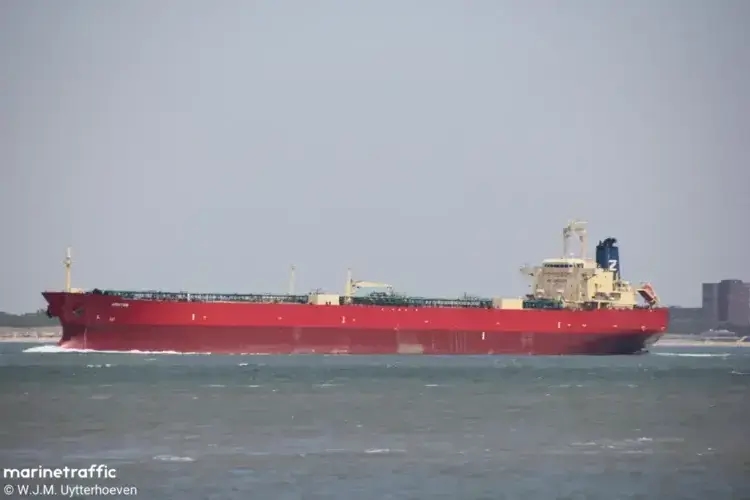
The oil products tanker Myra (IMO 9336490), which is under sanctions from the U.S., EU, UK, and three other jurisdictions, sent a distress signal in the North Atlantic west of Ireland on Oct. 24.
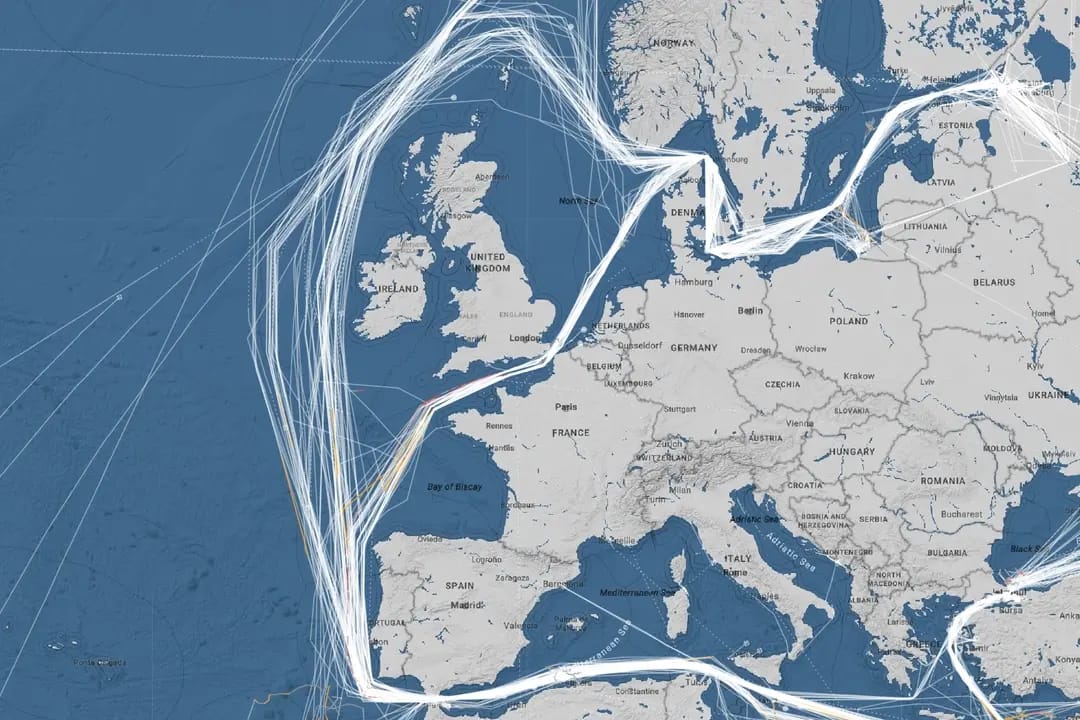
The UK coast guard is coordinating assistance to the vessel, which maritime monitors say departed the Russian port of Ust-Luga and sailed around the northern coast of the United Kingdom, bypassing the English Channel.
According to Ukrainian military intelligence, the tanker is linked to the shipping network of Mohammad Hossein Shamkhani, the son of Ali Shamkhani, a former secretary of Iran’s Supreme National Security Council and an adviser to the country’s supreme leader.
A distress signal and a storm in the Atlantic
Maritime monitoring project SeaNews reported that the distress signal was transmitted through the Inmarsat-C satellite system at 12:38 p.m. UTC, or 3:38 p.m. Moscow time.
The tanker was at 56°18′ north latitude and 15°25′ west longitude. The British coast guard asked nearby vessels to contact authorities if they were able to provide assistance. According to SeaNews, the tanker continued moving at about 9 knots, roughly 17 kilometers per hour, despite extreme weather conditions.
Waves in the area reached 8.8 meters, while wind gusts reached 70 knots (about 130 kilometers per hour). The vessel was approximately 188 nautical miles from the coast.
The Insider reviewed Myra’s route and weather conditions in the area using the Starboard Maritime Intelligence ship tracking system. According to the platform, the tanker traveled from the Baltic Sea through the North Sea, rounded the northern tip of the United Kingdom and entered the Atlantic Ocean without passing through the English Channel.
It is unclear whether the route was chosen in an effort to avoid scrutiny by European countries. Many tankers belonging to Russia’s “shadow fleet” use the same route (1, 2).
Starboard’s weather map showed the ship near a broad area of strong winds in the North Atlantic. A pronounced cyclonic circulation was visible farther west. According to the platform, at 4:20 p.m. on Oct. 24, wind speed in the tanker’s immediate area was 45.6 kilometers per hour, blowing from the southwest. That corresponds to Force 6 on the Beaufort scale, classified as a strong breeze.
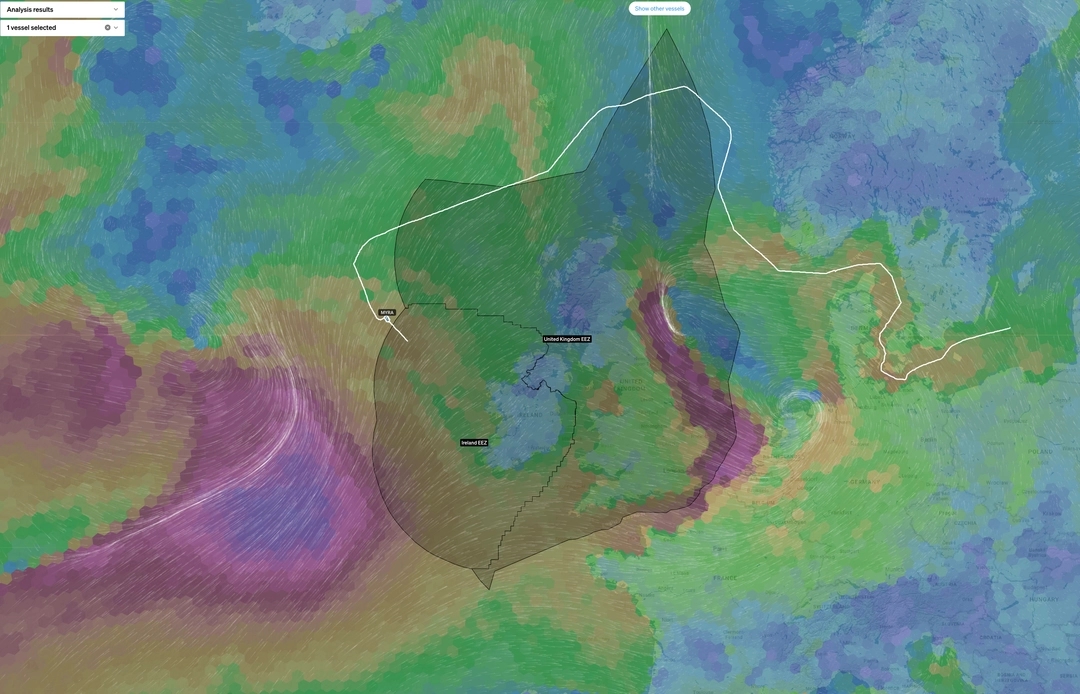
Starboard’s reading was lower than SeaNews’ report of gusts reaching 130 kilometers per hour. The figures are not necessarily contradictory: Starboard may have been showing sustained wind speeds, while SeaNews reported maximum gusts. The readings may also have been taken at different times.
The reason for the distress signal remains unknown. There is also no confirmed information about possible damage to the tanker, the condition of its crew, the nature of its cargo, or any possible leak of petroleum products.
Suspected false flag and sanctions from six jurisdictions
Myra is a 228-meter oil products tanker built in 2006. It has a deadweight capacity of 74,999 metric tons and a gross tonnage of 41,021.
According to the vessel’s records, its registered owner is Fleet Armada Pvt Ltd.
In GISIS, the International Maritime Organization’s shipping information system, its flag is listed as “Cameroon False,” indicating suspected fraudulent use of the Cameroonian flag. In the Ukrainian intelligence database, the vessel’s current flag is listed as unknown.
According to the War & Sanctions database maintained by Ukraine’s Defense Intelligence Directorate (HUR), Myra has been used to export Russian oil and petroleum products to third countries while the G7 and EU oil embargoes and the price cap on Russian crude were in effect.
The tanker is under sanctions from six jurisdictions. The United States sanctioned it on July 30, 2025, followed by the European Union on Oct. 24, 2025, and Switzerland and Ukraine on Dec. 13, 2025. The United Kingdom added the vessel to its sanctions list on Feb. 24, 2026, and Canada followed on March 25.
According to HUR, Myra has repeatedly called at the Russian ports of Ust-Luga and Primorsk and has also visited ports in Turkey, Brazil, Senegal, Estonia, and Denmark.
Ukrainian intelligence has also recorded instances in which the vessel switched off its Automatic Identification System (AIS) which allows ships’ positions and movements to be tracked.
Links to the shipping empire of an Iranian official’s son
Ukrainian intelligence links Myra to Fractal Marine DMCC, a company registered in the United Arab Emirates.
According to HUR, in early 2023 the company was one of the three largest international operators transporting Russian oil and petroleum products, alongside Radiating World Shipping Services and Gatik Ship Management. Britain sanctioned Fractal Marine DMCC in February 2024 for activity in Russia’s energy sector.
Ukrainian intelligence says the company operated a fleet of 28 tankers, acting as an intermediary between shipowners and charterers. After sanctions were imposed, management of the vessels was transferred to other affiliated entities.
HUR says Myra is part of a shipping network controlled by Mohammad Hossein Shamkhani, the son of Ali Shamkhani, a former secretary of Iran’s Supreme National Security Council and an adviser to Iran’s supreme leader.
According to Ukrainian intelligence, the younger Shamkhani controls an extensive network of tankers, shipping operators and shell companies used to transport Russian and Iranian oil, including to buyers in China. HUR says the network generates billions of dollars in revenue from oil trading and takes steps to conceal its links to Russia, Iran, and the Shamkhani family.
Among the companies Ukrainian intelligence links to Myra are BPT Shipping Co LLC, Fractal Marine DMCC, Wanta Shipping LLC-FZ, and The Zulu Ships Management and Operation — Sole Proprietorship LLC. All are registered in the United Arab Emirates.
Despite the sanctions against Myra, the British coast guard is coordinating the response to the tanker’s distress signal. International maritime search-and-rescue rules require assistance to people in danger at sea regardless of a vessel’s sanctions status.