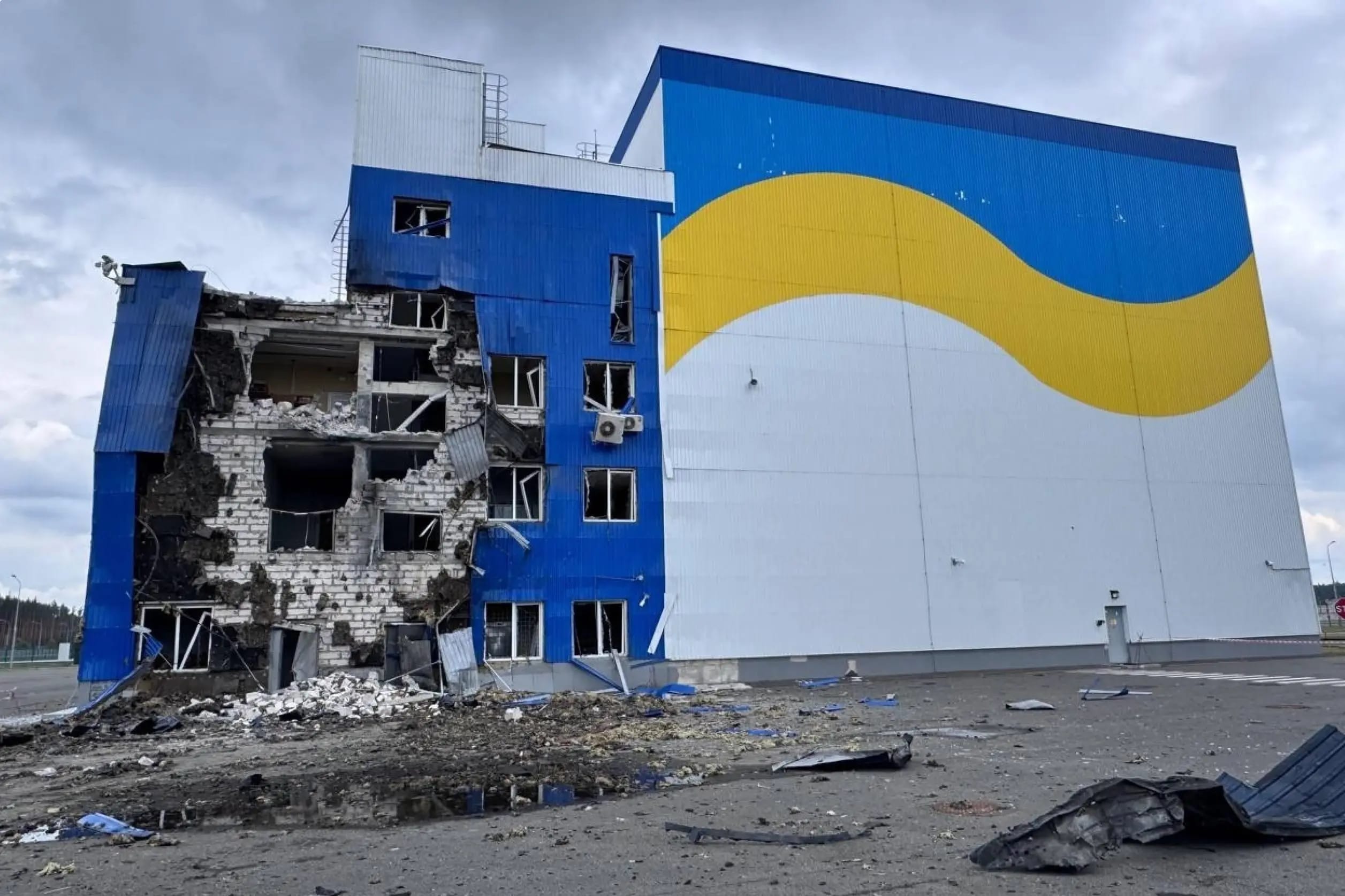
Kyiv’s Institute for Nuclear Research of the National Academy of Sciences of Ukraine, which houses a research reactor, was struck by a Russian drone on Sept. 30 at 18:18 local time, according to a statement from Ukraine’s State Nuclear Regulatory Inspectorate released earlier today. Experts interviewed by The Insider said attacks on nuclear facilities are unacceptable but that the risk of radioactive contamination from this reactor is low. A strike on the spent fuel pool, however, could cause radioactive contamination.
Ukraine’s nuclear regulator described the strike on the institute as “an attack on a peaceful nuclear facility that serves exclusively scientific and research purposes,” adding that the attack itself represented “Russia’s cynical disregard for internationally recognized principles and standards of nuclear and radiation safety.” No one was injured in the attack, the resulting fire was extinguished, and neither the reactor nor its safety systems were damaged, the agency said. Radiation levels also remained unchanged.
Pavel Podvig, an expert on Russian strategic nuclear forces, told The Insider that the research reactor is located in a conventional building without the kind of specialized containment structure typically found around reactors at nuclear power plants. Because of that, he said, a strike by “a sufficiently powerful warhead could cause serious damage to everything inside.” He then added:
“On the other hand, the reactor itself is not very large, and to seriously damage it, you would have to hit it directly, which is fairly difficult. It is probably not accurate to say there is a significant risk of a radiation incident, but it cannot be ruled out entirely. The reactor is not actually operating; the fuel has been removed, so there is almost no radioactivity in the reactor itself. That fuel is stored in some kind of spent fuel pool or other storage facility. You would not only have to hit that facility but also damage it badly, which, again, is fairly difficult.
At the same time, attacks on facilities of this kind should be unacceptable. Civilian facilities should not be attacked in principle, but nuclear facilities carry an additional risk, even if that risk is relatively small.”
Podvig added that the International Atomic Energy Agency (IAEA) has no practical means to ensure the safety of these facilities:
“There are nuclear safety and security principles that the IAEA formulated at the start of the war, but strictly speaking, these issues do not fall within the agency’s mandate. It is trying to establish these principles and urging everyone to follow them, but it does not even have the formal authority to insist on compliance. There has been discussion and an effort within the IAEA to establish a principle that all nuclear facilities under IAEA safeguards should not be attacked. The problem is that some states object to such a broad principle. Facilities in Iran that Israel and the United States attacked were also under IAEA safeguards. The United States has a certain interest in avoiding such a broad commitment.”
Maxim Starchak, a research fellow at the Centre for International and Defence Policy at Queen’s University in Canada, told The Insider that, based on the available information, the drone struck the grounds of the institute without damaging either the reactor or its safety systems. He said:
“After the start of the full-scale invasion, the fuel was removed from the research reactor and placed in the spent fuel pool, after which the reactor ceased operating. In other words, the reactor is shut down. Under these circumstances, a drone strike on the reactor itself would not cause a major disaster. Some risk would arise if the spent fuel pool were destroyed. That could theoretically lead to a loss of radiation shielding and damage to the spent fuel, resulting in radioactive contamination. However, the reactor has been shut down for more than four years, and its fuel produces relatively little residual heat. As a result, a scenario in which the fuel rapidly overheats after a loss of cooling would now be far less severe than if the reactor core had been unloaded only days or weeks ago.”