The decision to remove the anti-war Yabloko party from Russia’s September parliamentary elections may been the result of a conflict between the civilian wing of the presidential administration, which was initially prepared to allow the party into the campaign, and the security services, which favored eliminating any political risks through outright bans and repression, political analyst Mikhail Komin told The Insider.
Komin is director of research at the Center for Advanced Governance, a Russian policy research organization.
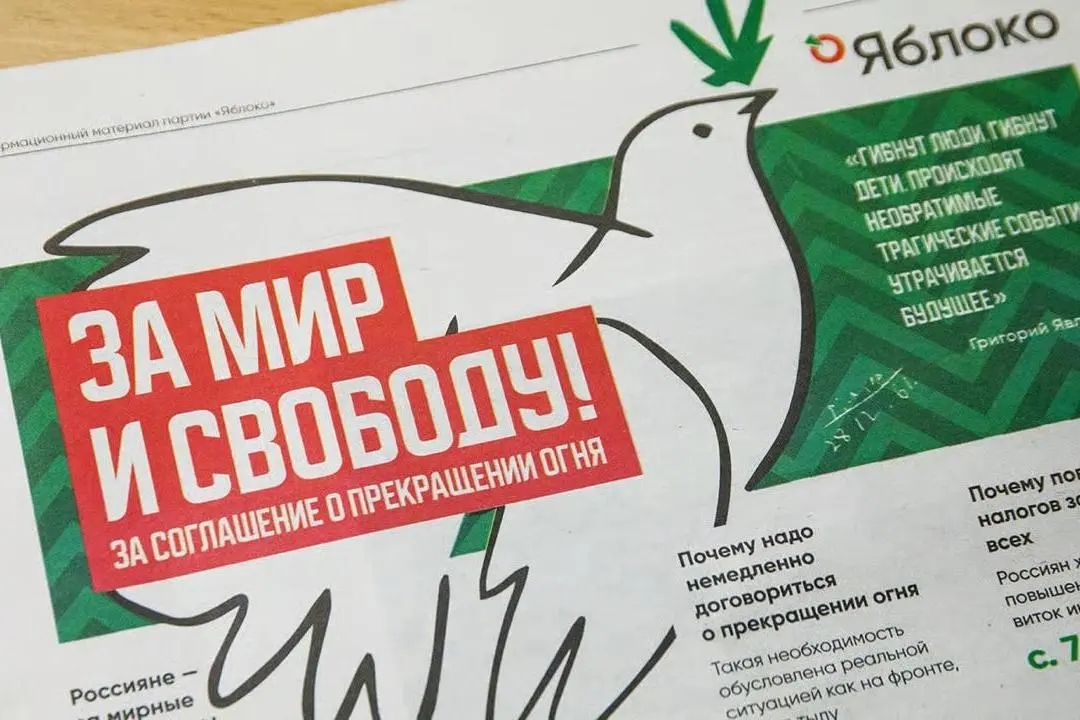
In his view, the initial decision to register Yabloko may have been made by the presidential administration’s domestic policy department, which oversees Russian election campaigns. Komin said the Kremlin may first have studied closed-door polling and focus group results, including reactions to Yabloko’s main campaign slogan, “For Peace and Freedom.”
“I think that [the presidential administration] looked at some polling that they themselves commission and conduct, and that we do not see publicly,” Komin said. “They tested the slogans that Yabloko was planning to use in focus groups — ‘For Peace and Freedom.’ They looked at the results and understood that the polling showed a fairly small number of votes.”
According to Komin, the presidential administration may have assumed that Yabloko’s vote share could be kept below the 5% necessary for representation in the State Duma — and even below the 3% required to qualify for state funding — via a combination of propaganda, administrative mobilization, and vote-rigging. In that scenario, Yabloko’s participation in the election could itself have benefited the Kremlin, as a defeat for the only registered party with an anti-war platform would have allowed the authorities to present the results as evidence that calls for peace had little public support.
“They realized it would be better to let Yabloko in and make an example of it during the campaign, to show that a very limited number of people support the slogan ‘For Peace and Freedom,’ and that this social group is marginal,” Komin said. “It is a safe way to demonstrate that society is in fact consolidated around the idea of war.”
Komin said that, under that scenario, a strong result for the ruling United Russia party would take on additional significance. The authorities could use it as confirmation of public support for continuing the war, thereby giving the Kremlin extra political legitimacy to implement post-election decisions that would more directly affect the public.
Komin cited the possibility of a new wave of mobilization into the Russian army as one possible example.
“We know that the prospect of mobilization in one form or another is now being actively discussed: hidden mobilization, mobilization into [the] drone forces, mobilization in the form of rotation, or some other options,” he said. “Perhaps such broad legitimacy for the idea of the war is needed for other decisions as well — not only mobilization, but decisions that affect the population more directly and influence people’s social well-being.”
Komin said the initial plan may therefore have been to allow Yabloko to run, ensure its defeat, and then present the election results to Vladimir Putin as proof that society was consolidated around the continuation of the war. Such a course of events could have expanded the space for more radical decisions the Kremlin considers necessary to change the trajectory of events on the battlefield in Ukraine.
According to Komin, the civilian wing of the presidential administration, associated with Sergei Kiriyenko and the domestic policy department, initially approved of Yabloko taking part in the election. But the security wing, which Komin links primarily to the FSB’s Second Service and its head, Alexei Sedov, may have viewed the party’s presence on the ballot as too dangerous.
“Russia’s security structures favor cutting off risks through repression and bans,” Komin said. “The civilian administration more often takes the position that risks are better managed by creating a more complex picture and applying more complex solutions. And those protect against risks much better than blunt bans.”
Komin said Yabloko’s registration and then removal suggest that such a competition really did take place behind the scenes, likening it to the Kremlin’s decision to block Telegram. According to Komin, the civilian wing of the presidential administration opposed blocking the messaging service (or at least opposed making such a move before the election), while security officials took a harder line. Komin also attributes Telegram founder Pavel Durov’s addition to Russia’s list of extremists to developments in the internal Russian power struggle.
Komin sees the State Duma campaign of anti-war politician Boris Nadezhdin, who was barred from running in Russia’s 2024 presidential election, as another similar episode. In his view, the civilian administration may have planned simply to deny Nadezhdin’s registration over problems with signatures, while security officials saw that scenario as too risky after lines of people seeking to support his nomination formed across the country.
“They saw those lines for Nadezhdin last time and did not want to create them under any circumstances,” Komin said. “So they opened the relevant cases against him, which prevented him from running and campaigning, and then pushed him out of the country.”
Nadezhin has fled Russia and now lives in France.
Komin stressed that these political developments do not represent a split inside the government so much as they signal the presence of competition between two approaches to controlling the political space. In his assessment, the advantage has increasingly gone to the security services.
“This is actually not a very good signal, because we see that in all these decisions, at least the ones we know about, the security services are winning,” Komin said. “That means repression as a tool will develop and expand.”
Komin said the presidential administration’s policy approach, which involved preserving a more complex and manageable political landscape rather than relying on direct bans, is clearly falling out of favor with the Kremlin as the full-scale war in Ukraine rages well into its fifth year.