
The Kremlin-linked “Matryoshka” bot network is spreading videos and images disguised as content produced by reputable Western media outlets warning readers of a looming hantavirus pandemic after an outbreak aboard the cruise ship MV Hondius. The Antibot4Navalny project, which monitors the network’s activity across social media, shared its findings about Matryoshka’s latest campaign with The Insider. Meanwhile, epidemiologists have assessed the risk of a hantavirus epidemic, let alone a pandemic, as low or very low.
The fake videos and images are being posted on X and TikTok. Bots are placing them in comments under posts by well-known fact-checkers, demanding that the information be verified, and are even sending them to journalists’ personal email addresses. Views, reposts, and likes on X are being artificially inflated.
In one video that uses the logo of the media outlet France 24, Matryoshka paints a truly apocalyptic picture, claiming hantavirus has already been detected in 210 people across 60 French cities. It also claims France’s healthcare system and economy have been so weakened by support for Ukraine that the country will be unable to cope with a new epidemic, which it says could have more severe consequences than the COVID-19 pandemic in 2020.

In reality, as of May 14, French Health Minister Stéphanie Rist said only one hantavirus case had been recorded among French citizens — a female passenger from the affected ship. Another 26 people who had contact with the passenger tested negative, and their health continues to be monitored.
Another video disguised as content from the German outlet Deutsche Welle accuses Ukrainian refugees of phone fraud. They allegedly call residents of Germany and France, offering to sell hantavirus medications. To add credibility, the first part of the video describes the evacuation of passengers from the ship where the outbreak occurred fairly accurately.

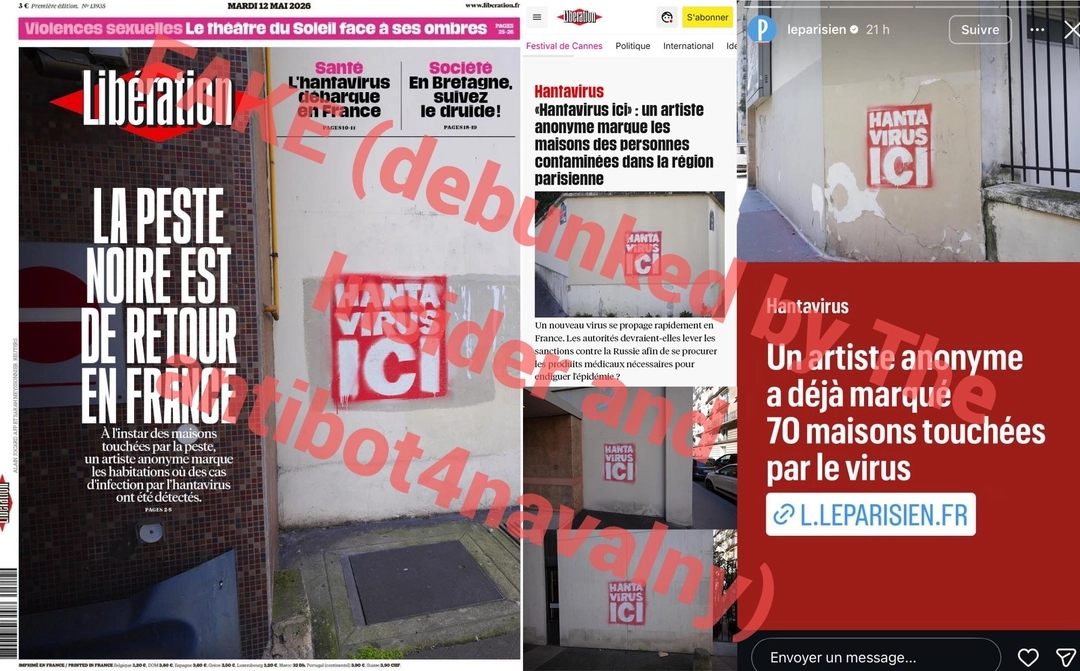
The bots are also spreading images disguised as scans from the French newspaper Libération. The photos show building walls with graffiti in French reading “Hantavirus ici,” or “Hantavirus here.” The posts claim unknown people marked several dozen homes where infected people live.
In a recent video on her YouTube channel, biologist and science journalist Irina Yakutenko said that hantavirus, unlike COVID-19, is not transmitted from person to person through coughing or sneezing. Humans are not its main host, as the virus reproduces in rodents. The specific strain that infected passengers aboard the MV Hondius is carried by the long-tailed rice rat, whose main habitat is in South America.
Human-to-human transmission is possible only through large droplets of saliva and other bodily fluids, for example, among members of the same family or in cramped conditions, such as on a cruise ship. An analysis of the virus genome cited by Yakutenko shows that it “has not adapted and has not even begun to adapt to reproduce more efficiently in humans or to transmit more effectively.” For that reason, epidemiologists consider an epidemic or pandemic on the scale of COVID-19 unlikely in the case of hantavirus.