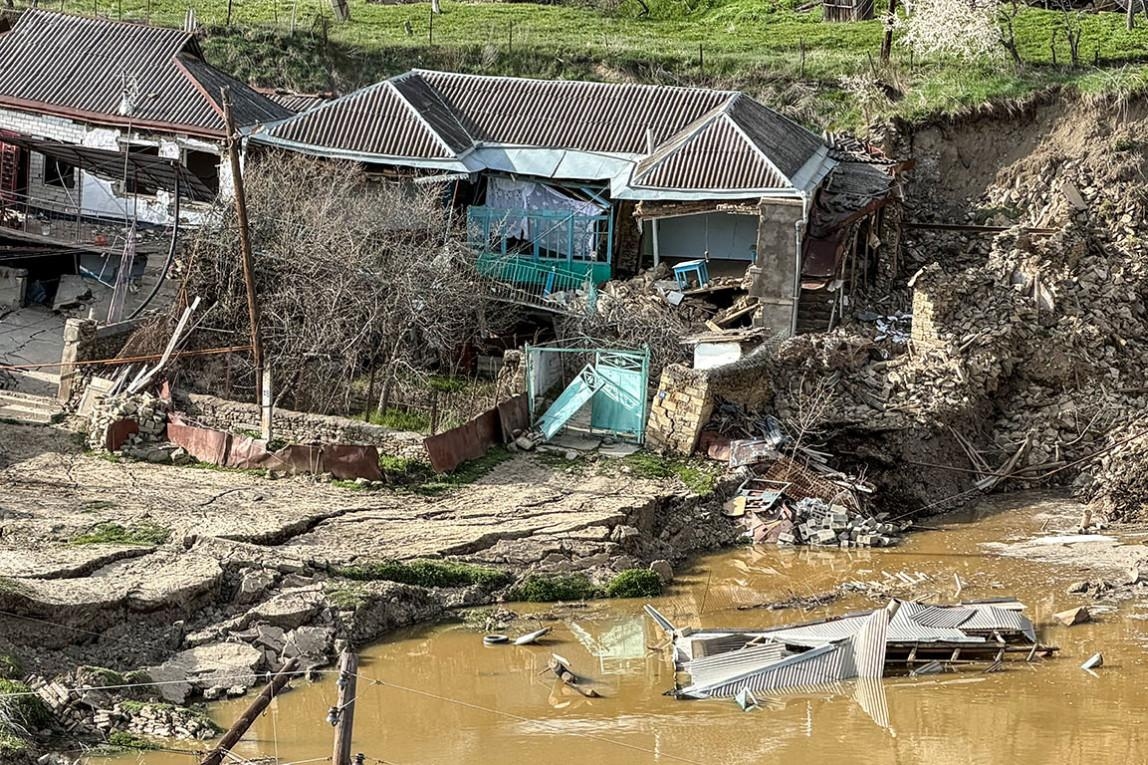
Landslides triggered by repeated heavy rainfall in Russia’s Republic of Dagestan have destroyed several major roads and damaged hundreds of homes. The landslides followed widespread flooding in late March and early April that killed at least seven people and left hundreds homeless. Experts interviewed by the newspaper Argumenty i Fakty said waterlogged mountainsides began giving way after becoming saturated with moisture.
As of April 20, about 2,500 people affected by the flooding had received one-time payments from the state, the regional Labor Ministry said. But more than 100 homes in four localities still remain flooded, and 537 people — including 159 children — are being housed in temporary accommodation centers. In addition, more than 3,000 residents in three villages in the Republic have been left without gas, critical for heating and cooking, the regional branch of Russia’s Emergency Situations Ministry said on April 21.
What happened?
At the end of March, unusually heavy rains began to fall in Dagestan, causing the Cherkes-Ozen and Tarnairka rivers, as well as the October Revolution Canal, to overflow their banks. A state of emergency was declared in Makhachkala and the Khasavyurt District. According to official data from March 29, 760 homes were flooded and more than 3,000 were damaged. A total of 3,338 people had to be evacuated, and hundreds of populated areas were left without electricity. Some 43,000 people filed applications seeking recognition as victims of the flooding.
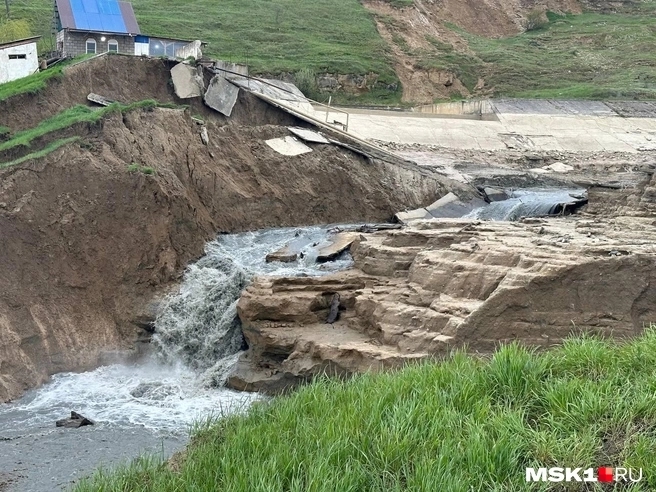
A second wave of flooding came in early April. On April 5, a dam at the Gedzhukh reservoir burst. The reservoir had already been declared hazardous in 2006, and its condition was found to be unsatisfactory, according to a report by independent outlet Agentstvo.
The settlement of Mamedkala, located about 10 kilometers from the dam, was flooded. According to data cited by Russia’s Ministry of Emergency Situations, about 260 homes there were affected, with some of them being completely destroyed.
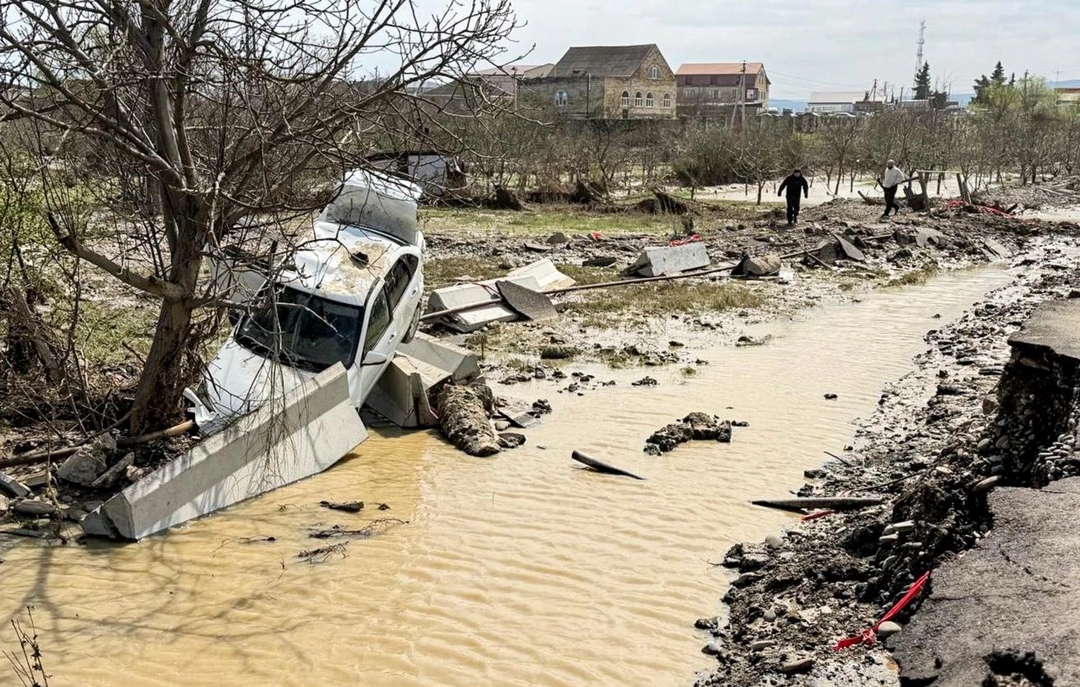
A bridge also collapsed on the federal Caucasus highway, and the water swept away several vehicles. Six people were killed: four children and two women, one of them pregnant.
That same day in Makhachkala, two houses collapsed after their foundations were undermined by flooding. The city of Dagestanskiye Ogni and several villages were inundated. The total number of dead rose to seven when a 78-year-old pensioner died after her house was hit with floodwaters.
After that, a state of emergency was declared across all of Dagestan and in neighboring Chechnya, and Vladimir Putin ordered the creation of a commission to deal with the aftermath of the flooding.
The flooding also led to the deterioration of water quality across the region, leading more than 100 people to seek medical help for acute intestinal infections. Residents also began receiving vaccinations against hepatitis A.
In all, as of April 20, about 11,800 hectares (about 29,000 acres) of farmland had been affected by the flooding, according to a preliminary official estimate from the regional authorities cited by the Interfax news agency. 912 head of cattle had died, along with 3,500 sheep and goats, 43 horses, 64,400 poultry birds, and 385 bee colonies. A total of 39 buildings were damaged or partly destroyed, along with two pumping stations, and one artesian well was affected.
Witness accounts
Journalists from the outlet MSK1.RU spoke with witnesses to the deaths that occurred on the Caucasus highway, and also with the relatives of the deceased. Local residents say they did not know about the danger. According to the outlet, authorities decided not to close the section of the highway that lay in the path of the torrent, even though they knew water was flowing from the dam.
Cars began stalling on a small bridge over the Darvagchay River. One of them was carrying the Balabekov family. There were six people in the vehicle: the head of the family, Albert, his wife, their daughter, a 12-year-old granddaughter, as well as their son and his 17-year-old pregnant wife.
The first wave pinned the stalled cars on the bridge against the guardrail. People climbed out through the windows and stood on the roofs. Then a second wave came. Witnesses said cars were overturned, while road signs, fences, gas pipes and 500-kilogram (1,100-pound) concrete slabs were swept away on the highway. People tried to grab onto trees, barriers, and debris that was being carried off by the water.
The mother of the dead 12-year-old girl, Samira Balabekova, told MSK1.RU:
“My girl was in my arms. I put her on a branch. I myself grabbed onto another tree. Her tree was torn out by the roots, and my girl went with it. I couldn’t save her, I couldn’t even grab her by the leg. My girl was swept away before my eyes. She was crying out, poor thing: ‘Mom, save me!’”
The outlet reported that the child’s lifeless body was later pulled from the mud. Samira’s 17-year-old daughter-in-law also died. She was three months pregnant.
The Khalilov family was traveling on the same highway. In their vehicle were Zeynulla and Kevser Khalilov, together with their 12-year-old son and 5-year-old granddaughter. The bodies of the grandmother and granddaughter were found the next day several kilometers from the bridge.
The survivors were pulled from the water several hours later. According to relatives, fellow villagers and eyewitnesses rescued them. Many had hypothermia.
Meanwhile, an evacuation was already under way in Mamedkala. Some residents underestimated the seriousness of what was happening and left all their valuables at home. Others did not even know that a natural disaster was approaching, as communication in the area was working poorly that day, the outlet reported.
Hundreds of homes in Mamedkala simply collapsed, with only bricks remaining. The outlet quoted an affected pensioner, Sakinat, as saying:
“We were left outside with nothing. I don’t even know what to do. They shouted at us: ‘Run!’ We had only just managed to get up when the wave came, and the house collapsed right away.”
Who is to blame?
On April 10, the Volga interregional environmental prosecutor’s office found that the owner and organizations using the Gedzhukh reservoir complex in Dagestan had failed to ensure the safe operation of the facility, leading to the dam breach.
Authorities opened a criminal case in Dagestan on charges of “violating safety rules during construction and other work resulting through negligence in the deaths of two or more people,” an offense punishable by up to seven years in prison; charges were also brought in connection with “violating environmental protection rules during work,” which carries a penalty of up to five years. On April 11, investigators detained an engineer from the organization responsible for the safe operation of the Gedzhukh reservoir’s hydraulic structures. Investigators believe the organization ignored the dam’s dangerous condition and provided false information about its fitness.
Reports also said the organization’s former CEO had been detained, though MSK1.RU noted that further updates on the man’s legal status were unavailable.
Heavy rains also hit Dagestan’s capital, Makhachkala. MSK1.RU said the main reasons for the extensive damage there involved problems with storm drainage and haphazard development. In recent years, authorities allocated more than 500 million rubles for sewer modernization, but some of the projects were never completed. A 512 million-ruble contract was terminated, and housing and utilities officials were accused of embezzling more than 40 million rubles intended for storm drain repairs.
Residents say that in flooded areas, storm drains had gone unmaintained for years, and during the flooding help arrived late or did not come at all. People have been clearing debris and coping with the aftermath on their own, fearing that without systemic changes similar destruction could happen again.
Public reaction
In the first days after the flooding began, help for those affected was mainly provided by volunteers and local residents, who pumped out water, cleared debris, delivered food and drinking water, and sheltered those who had lost their homes. Later, hundreds of volunteers from other parts of the republic and from other regions of Russia arrived, and victims were able to collect humanitarian aid. Businesses and charitable organizations also joined the relief effort.
Regional authorities said about 2,000 volunteers were involved in dealing with the aftermath. One of them, 19-year-old Artyom Mikhrabov, died from injuries sustained while clearing debris.
A collection of popular Russian bloggers also provided aid to Dagestan residents. They included Viktoria Bonya, Ksenia Borodina, Ida Galich, and Mikhail Litvin. The latter not only donated 2.5 million rubles to those affected, but also traveled to the region to witness the aftermath personally.
State Duma MP Biysultan Khamzaev also traveled to the flood zone, where he openly accused Litvin of using the crisis to promote himself. Social media users, however, sided with the blogger, accusing the lawmaker himself of staging a publicity stunt.
Blogger and former “Dom-2” reality show star Viktoria Bonya donated 1 million rubles to Dagestan residents and urged her followers to provide whatever help they could to those affected. In mid-April, she also recorded a video appeal to Vladimir Putin in which she listed five pressing problems that, in her view, the president did not know about. According to Bonya, people in Dagestan had for a long time received no help from the state. Bonya said she was especially outraged by an episode in which a carpet was laid out for officials visiting an affected village so they would not get their feet dirty.
According to a report by the business outlet RBC, the head of Dagestan, Sergei Melikov, could resign in the coming months. The Insider recently reported that the leading candidate to replace him in post could be Magomed Ramazanov, Vladimir Putin’s deputy envoy in the Far Eastern Federal District, who served in the FSB’s Fourth Service. Ramazanov had until recently remained a nonpublic figure. In April, he took part in a meeting with Putin focused on dealing with the aftermath of the floods in Dagestan, after which the president suggested that Ramazanov return to the region to continue his work.