In 2026, Rosstat stopped publishing statistics on Russia’s progress toward the targets set by Vladimir Putin’s “May decrees,” which were issued in 2012 as part of an effort to raise public-sector wages. However, even without these data, it is clear that the targets were met only briefly. To improve the numbers corresponding to key indicators, the authorities simply cut staff, which led to a heavier workload for the country’s remaining teachers and doctors. Yet even with these reductions, the benchmarks set by the “May decrees” could not be sustained: teachers’ and doctors’ salaries once again either fall short of the stated averages, or else reach them only on paper. After the start of Russia’s full-scale invasion of Ukraine, the ratio of doctors’ salaries to the national average has fallen back to levels prevalent a decade ago, while teachers’ salaries have dropped even below where they stood before the “May decrees” were adopted.
Public-sector workers: a drama in three acts
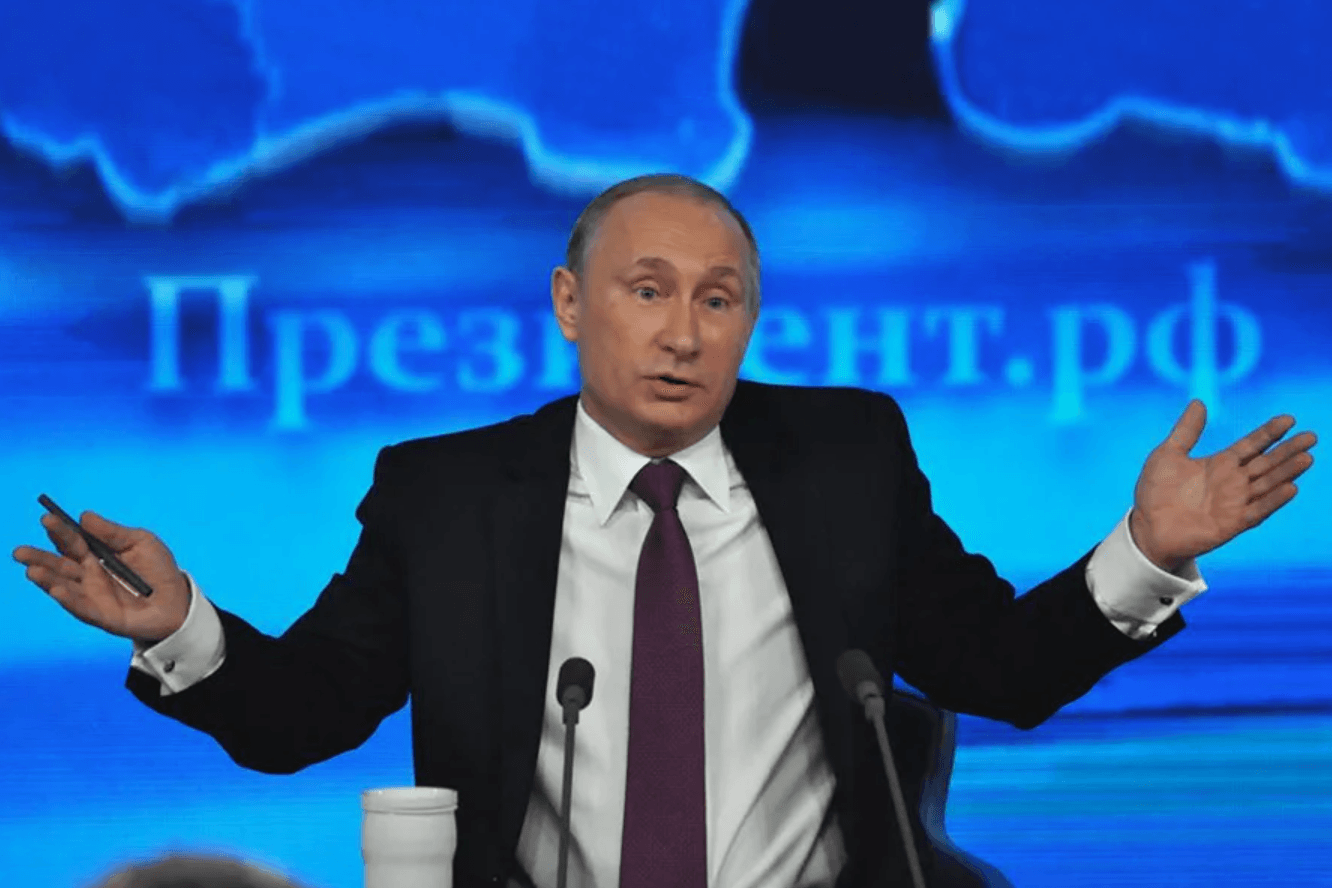
Since 2012, the incomes of Russian doctors and teachers have been determined by Vladimir Putin’s “May decrees” of 2012, in which the president ordered that the average salary of school teachers be brought up to the regional average. For doctors, university lecturers, and researchers, an even higher bar was set — 200% of the regional average salary, to be reached by 2018. As early as 2017, Putin reported that at least 93% of the stated targets had been achieved, and the decrees formally remain in force — even if the authorities now prefer not to mention them publicly.
In the 1990s, doctors and teachers fell victim to an empty treasury and had numerous justifiable grievances with the system, and even in the 2000s, despite rising oil prices, schools and clinics still received negligible funding. After the “May decrees,” public-sector wages finally increased, although this was achieved not only through higher budget allocations, but also thanks to a heavier workload: public-sector workers were compelled to put in overtime and deal with constantly changing rules, all under the guidance of strict top-down oversight.
After the “May decrees,” public-sector wages rose, but workers faced overtime, constantly changing rules, and strict top-down oversight
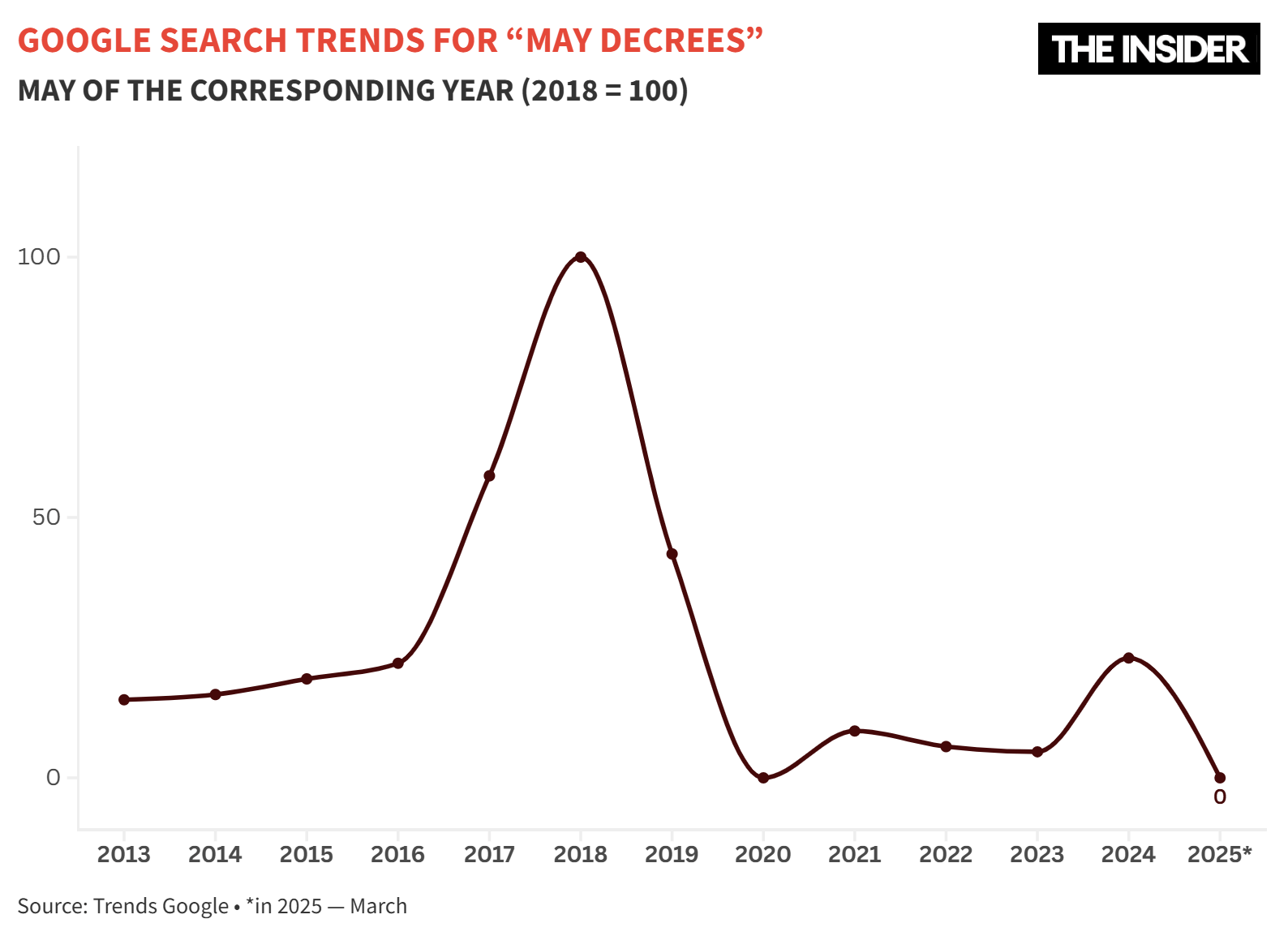
The decrees were part of Vladimir Putin’s 2012 election campaign, and when he sought another presidential term in 2018, he reported that the targets had largely been met, introducing a new set of “May decrees” with different goals. Nevertheless, the previous decrees were never repealed, and official statistical monitoring of their implementation continued. At the same time, both in official rhetoric and in public attention, the “May decrees” lost their former prominence. A chart based on Google Trends data shows that with the onset of the COVID-19 pandemic in 2020, they were largely forgotten. Interest in the topic returned only in 2024, when Putin was again “re-elected” and issued a third series of “May decrees.” Meanwhile, starting in 2020, the ratio of teachers’ and doctors’ salaries to the national average began to slide back toward its previous levels.
After the start of the full-scale invasion of Ukraine, the authorities oscillated between periods characterized by the slogans “everything for the front” and “life as usual,” but in 2025–2026 the motto “macroeconomic stability above all” ultimately took precedence. By adopting a 2026 budget featuring minimal spending growth, the Kremlin seemed to identify inflation as the main economic threat and thus declared a freeze on expenditures — even, nominally at least, when it came to military spending. For the private sector, this has meant higher taxes and fewer government contracts, while for those employed in state institutions, it has meant even greater administrative pressure. In real terms, spending on healthcare and education has declined since the start of the full-scale war, making it clear that the requirements of the “May decrees” have been definitively abandoned.
War is no decree
Formally, from 2015 to 2020, the “May decrees” pertaining to teachers’ pay were largely met from 2015 to 2020, and for doctors the same held true from 2019 through 2022. In specific regions, however, the situation varied widely, with some outliers consistently failing to reach the targets.
During the full-scale invasion, amid labor shortages in the industrial sector and massive resources devoted to the defense sector, the national average salary surged by 75%, crossing the threshold of 100,000 rubles ($1,248) per month in 2025.
In order to formally comply with the May decrees, regional budgets would have had to raise doctors’ and teachers’ salaries by the same 75%. However, regional budgets — which account for 73% of school funding while also financing regional hospitals — proved unable to do so.
What has been happening to doctors’ salaries
According to 2025 data, the average monthly salary of doctors in the mandatory health insurance system amounted to 147,000 rubles ($1,834), an increase of 12%. “The indicators correspond to the targets set by the presidential decrees,” claims Ilya Balanin, Chairman of Russia’s Federal Compulsory Medical Insurance Fund. The problem is, Balanin’s statement is not true. In order to meet the decree, the average salary should have exceeded 200,000 rubles ($2,495).
One method of “meeting” the decrees has been the mass exclusion of orderlies and junior nurses from the category of medical workers by reclassifying them as cleaners or technical staff. Formally, this reduces the number of public-sector employees covered by the decrees, making it possible to redistribute the wage fund in favor of doctors. But in the real world, of course, such measures only serve to reduce the quality of patient care.
Rising prices for imported medical supplies and original-brand medicines further limit hospitals’ ability to index wages. In 2025–2026, the budgets of treatment and preventive care facilities finally slipped into deficit.
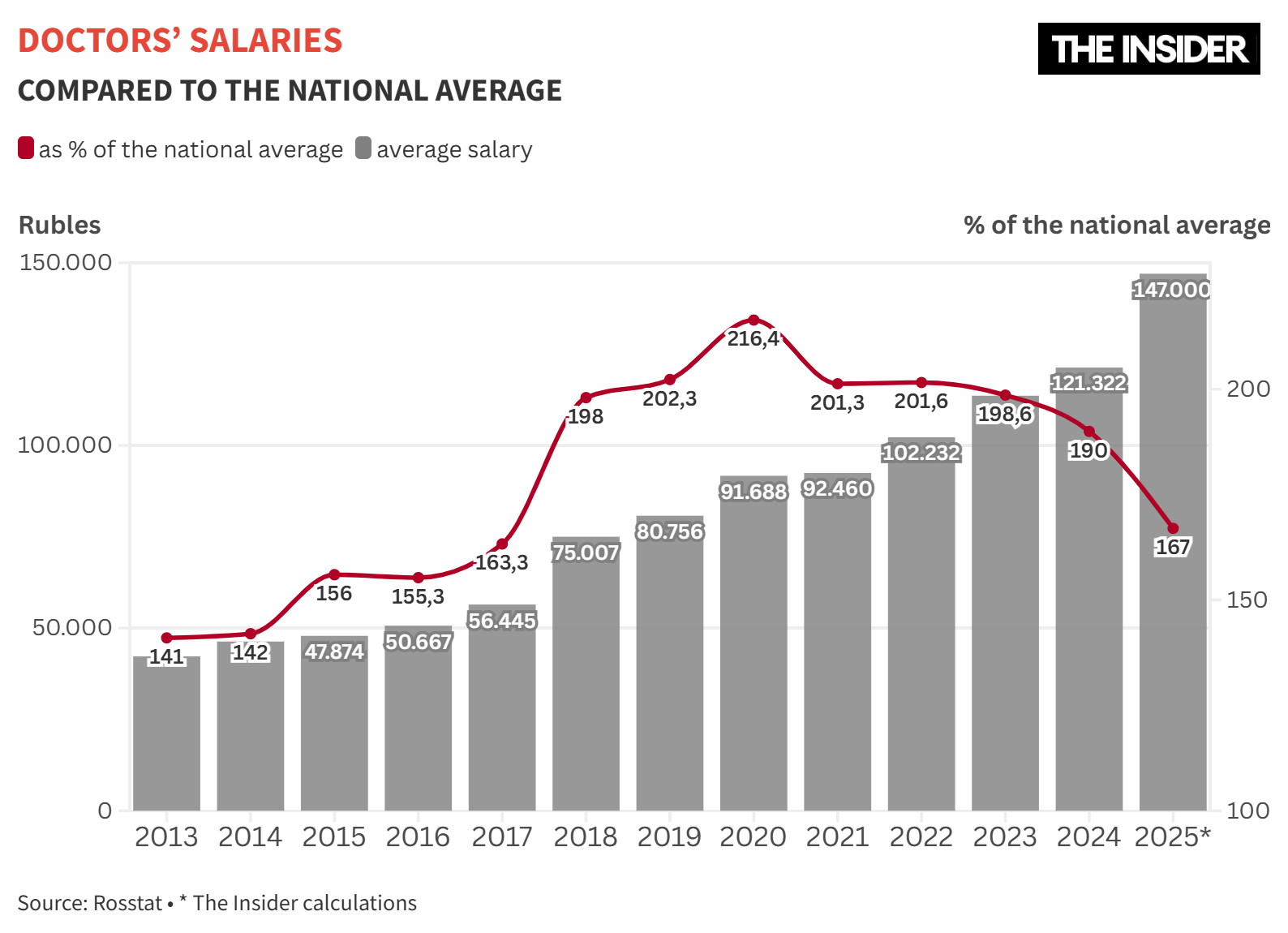
In addition, higher pay is often achieved simply by increasing doctors’ workload. “On average, a district general practitioner works 1.5 full-time equivalents instead of the recommended 1.2. Each is responsible for 2,800 people — 65% more than the established norm of 1,700. These are people assigned to a single general practitioner within their district,” the project “If to Be Precise” noted.
What has been happening to teachers’ salaries
According to a report by Moscow’s Higher School of Economics, titled “Teacher at the Crossroads of the Russian Labor Market 2025,” in recent years the number of teachers in Russia’s public schools has been declining, while the number of students has been growing, the result of both demographic trends and political decisions.
In the 2010-2011 school year, there were 13.57 million schoolchildren in Russia, and by 2024-2025, that figure had reached 17.99 million, in line with predictable demographic waves. Nevertheless, the increase was not taken into account when hiring teachers, and the peak has already passed. By the start of the 2025-2026 school year, the number of children had declined to 17.54 million, and from now until 2038 it is expected to continue decreasing.
The “May decrees” may have set federally directed salary targets for teachers, but schools are funded primarily at the regional level. In the structure of budget financing for general education institutions in 2024, 73% of such funds came from regional budgets, 18% from local governments, and only 9% from the federal center.
In essence, Vladimir Putin’s 2012 decrees imposed new spending obligations on the regions without giving them the means to generate additional revenue — whether from their own tax intake or from federal transfers.
The regions solved this problem in the simplest way available to them, at least from an arithmetic standpoint: if teachers’ average salaries needed to rise even though funding for wages had not increased, then staff would have to be cut. Needless to say, reducing the number of teachers while the number of students grows increases the workload for those who remain, and the heavier the workload, the fewer people are willing to take such jobs. In 2016, the average Russian teacher was working 1.22 full-time equivalents — already excessive — and by the end of 2024, it had reached an average of 1.44. At the start of the 2025-2026 school year, the figure in large cities was as high as 1.5.
The outflow of teachers is uneven across regions and localities. In the country as a whole the number of teachers declined by only 0.5% between 2016 and 2024, but in rural areas it fell by 9.7%, while in cities it actually increased by 5.2%. The fastest decline has been in Mordovia, where the number of teachers dropped by 17.9%, while staffing levels fell by more than 10% in the republics of Bashkortostan and Komi, as well as in the Kirov, Kurgan, Oryol, Pskov, Smolensk, Tambov, and Ulyanovsk regions, and in the Jewish Autonomous Region and the Nenets Autonomous Okrug.
The Ministry of Education and Science continues to place new obligations on teachers. As the authors of the Higher School of Economics report note, requirements for educators have expanded significantly over the past decade. The professional standard “Teacher,” which codifies these requirements, is constantly being updated, especially in the section concerning homeroom teachers. Teachers are expected not only to conduct lessons, but also to supervise breaks, manage classrooms, and participate in state examinations and methodological activities. There are also requirements related to implementing an “individual approach,” working with parents, educational and upbringing activities, and “innovation,” including digitalization. Even if all this is done at a minimum level, merely for reporting purposes, there is catastrophically little time. A school teacher often works more than 46 hours a week, and up to 17 of those are spent filling out plans and reports.
“Exhausted by an unbearable workload, teachers continue to quit; they are replaced by people off the street whose qualifications at least roughly meet the requirements,” the teachers’ union “Uchitel” commented on this trend.
Looking at specific subjects, the fastest decline has been among chemistry teachers (down 10% nationwide over eight years), as well as physics and computer science teachers (down 6%). The outflow is especially pronounced among mid-career specialists. Over eight years, their share has fallen from 66.8% to 60.9%. At the same time, compared with the 2016-2017 school year, the share of teachers under 35 has barely changed (rising from 22.2% to 22.7%). The proportion of teachers over 60, meanwhile, has increased significantly — from 11% to 16.4%. Across the country as a whole, one in six school teachers is now of retirement age or close to it. In three regions — Pskov, Smolensk, and Kalmykia — the share of such teachers exceeds 25%.
One in six teachers in Russia is either of retirement or close to it
Among subject matter areas, mathematics teachers are the most overburdened. By the end of 2024, there were 1.6 full-time equivalents per teacher, and by September 2025, that figure had already risen to 1.75. In total, staffing schedules at state general education schools provide for 1.6 million teaching positions, even though there are only around 1 million teachers. In other words, the personnel shortage exceeds half a million people. Yet the authorities have no intention of eliminating it: officially, only 16,400 positions are recognized as vacant. The rest are expected to be covered by “multi-role” staff.
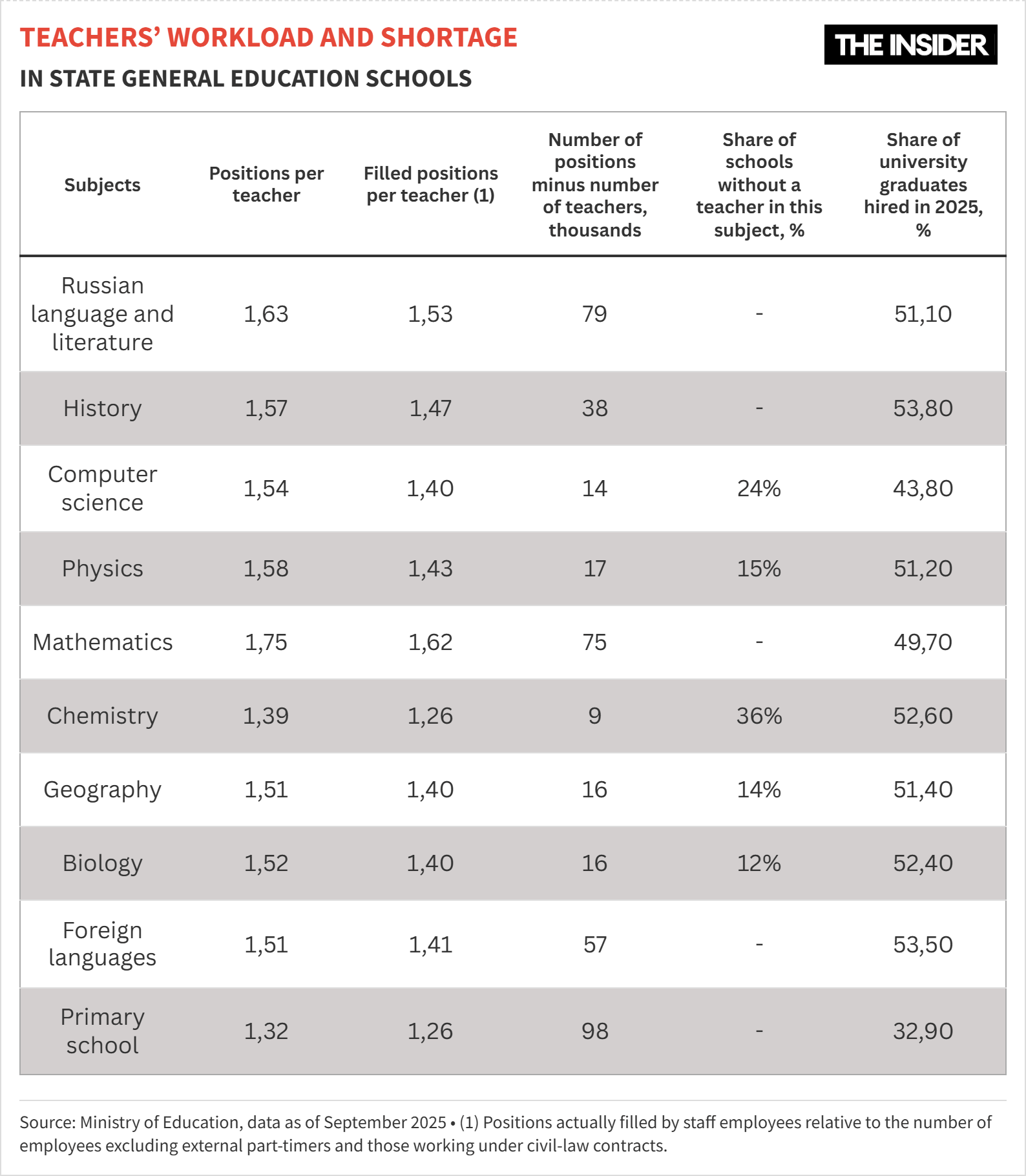
Officially, every school is supposed to have at least one teacher of computer science, physics, geography, and biology, and 90% of institutions should also employ a chemistry teacher. In reality, 24% of schools operate without computer science teachers, 15% without physics teachers, 14% without geography teachers, 12% without biology teachers, and as many as 36% without chemistry teachers. The shortage has been noticed even by the authorities: at the end of 2024, State Duma deputy Oksana Dmitrieva stated that 23% of schools lack physics teachers and 43% lack chemistry teachers.
The increase observed over the past year is linked to the recruitment of university students, who are brought into schools before actually completing their studies. This practice began in 2020, but at the time it applied only to teaching majors who had passed intermediate assessments for three years of study. In July 2025, amendments to the law on education extended the practice to all other fields. Students who have completed three years and studied the basics of teaching can now work in schools.
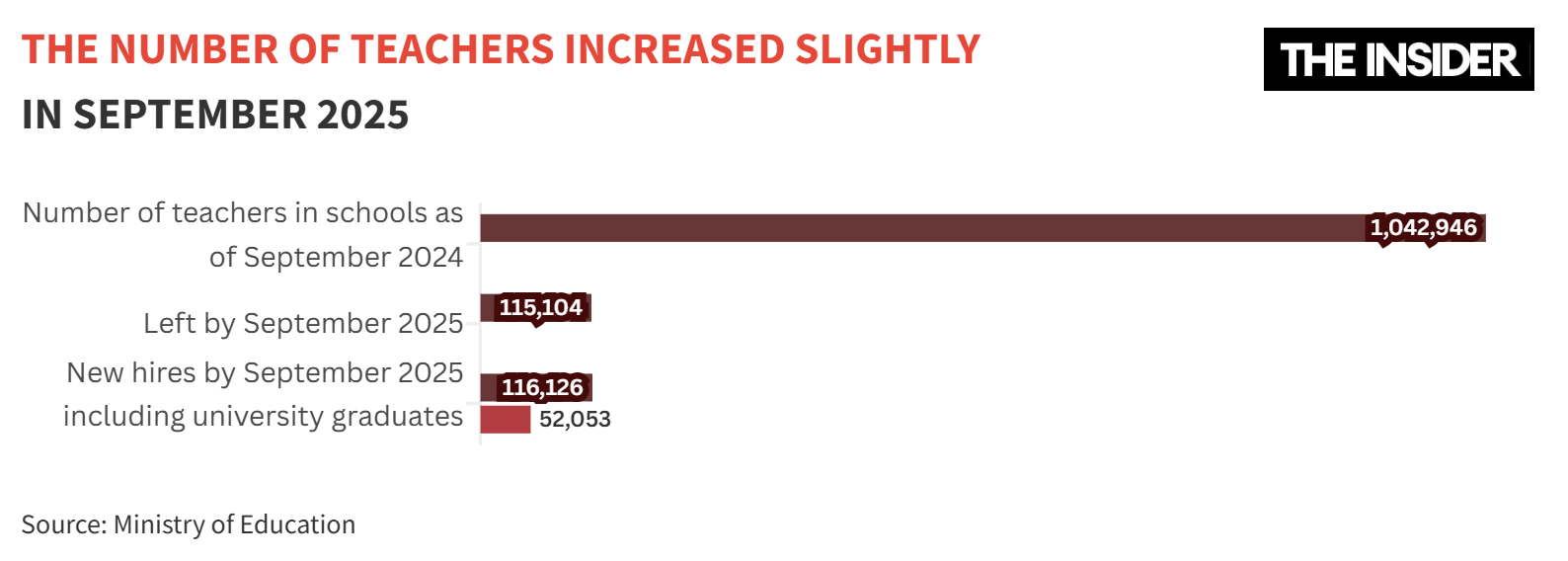
The correspondence between a graduate’s specialty and the subject they teach is determined by the employer — that is, with a school principal’s approval, even a law graduate can be assigned to teach chemistry in the event of a shortage. The amendment entered into force on August 11. The explanatory note to the bill read like a retelling of a Federal Protective Service survey on the shortage of teachers.
Moscow’s largest pedagogical university, Moscow City University, announced that starting from the third year it will introduce a special flexible schedule for students, enabling them to combine their studies with work in schools. In addition, in 2026 around 2,000 university students will, for the first time, be involved in monitoring the Unified State Exam (since 2025, parents of school students have also taken part).
No inconvenient numbers
Since teachers’ workloads likely cannot be increased significantly further, continued growth in their wages is also not possible without an actual increase infunding. Rosstat’s monitoring of the implementation of the “May decrees” on salaries had previously been updated at least four times a year. However, the most recent data available cover only January–June 2024.
This can be explained either by a serious breakdown in statistical data collection or by the authorities’ reluctance to communicate unpleasant news to the public. (Details of this surge in secrecy were compiled by the project “To Be Precise.”)
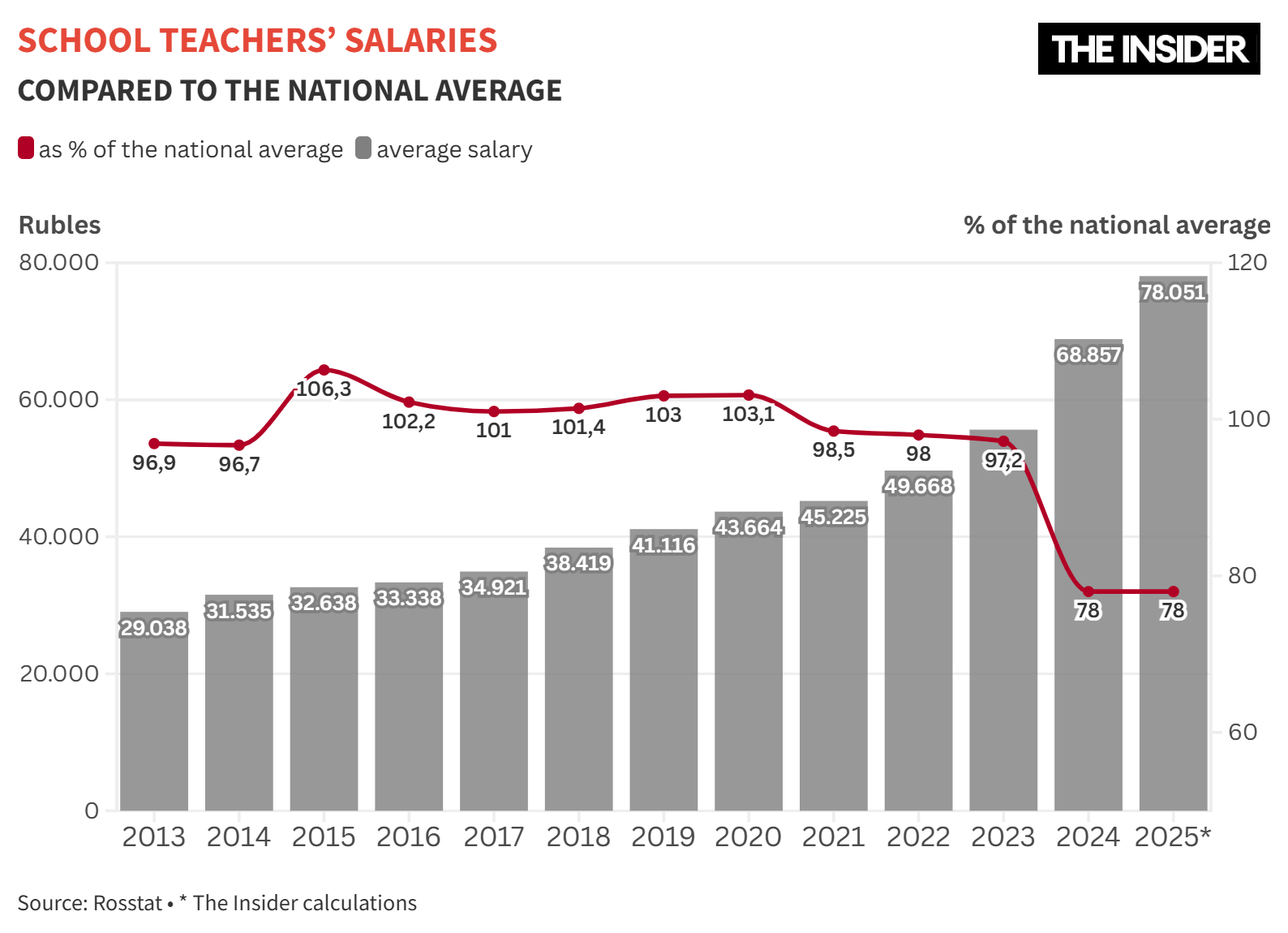
The average salary of Russian teachers in 2025 can only be estimated, based on data for the “Education” sector and an adjustment coefficient. The average monthly nominal wage in the sector was 63,000 rubles ($786) in 2024 and 71,000 rubles ($886) in 2025. Teachers in state general education schools account for less than half of all employees in the sector (which also includes university and college instructors, as well as administrative and technical staff). In 2024, they earned 9.4% more than the sectoral average — 68,900 rubles ($860) per month.
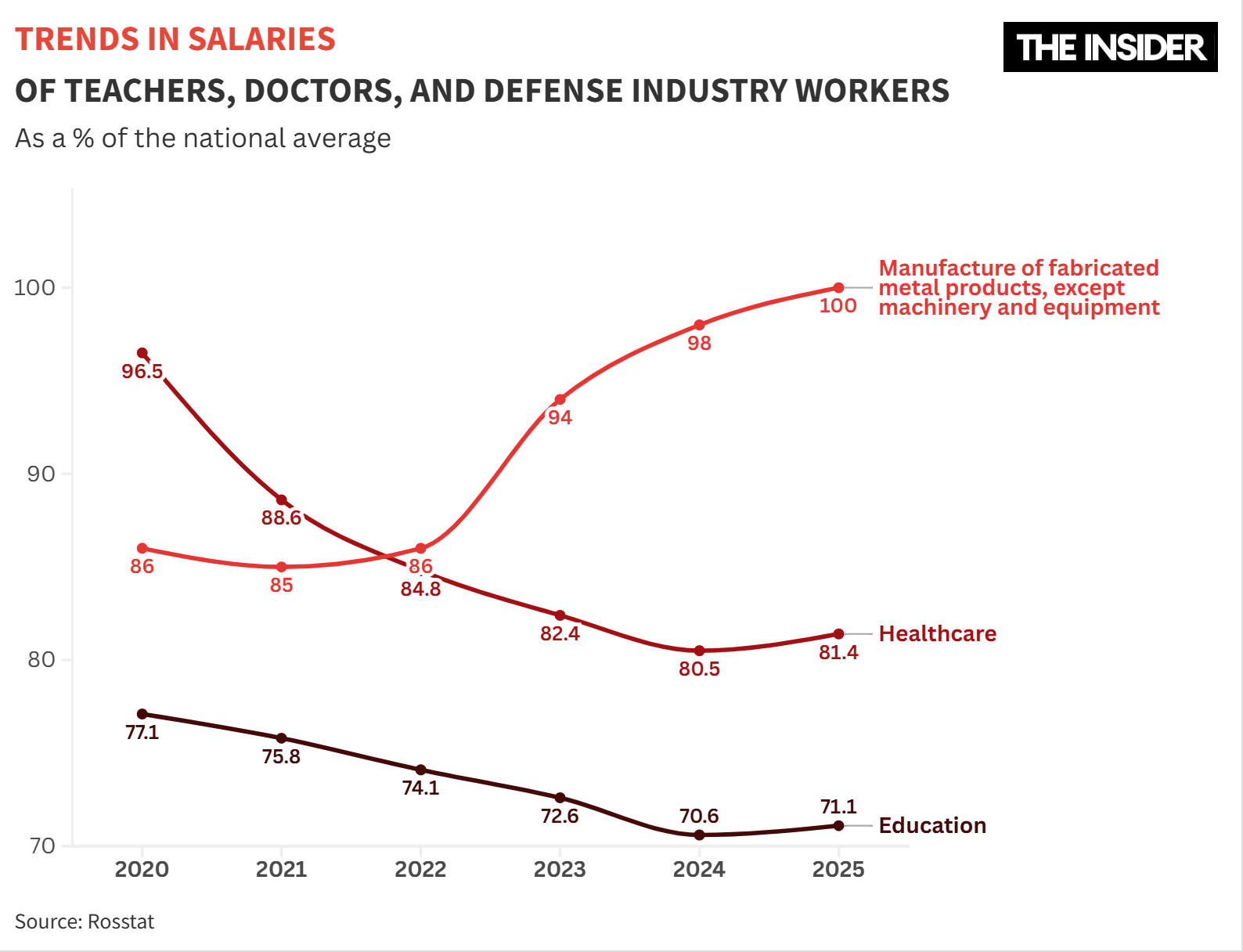
If we assume that in 2025 school teachers also earned 9.4% more than other education sector employees, their average salary would come to 78,000 rubles ($973) — below the national average monthly nominal wage of 100,000 rubles ($1,248), and thus not in line with the 2012 decrees.
Teachers’ salaries are still below the national average
While Rosstat and the Ministry of Education remain silent, the teachers’ union “Uchitel” is publishing complaints from educators about declining incomes. Since the start of the 2025-2026 school year, additional payments for teachers have been reduced or abolished in eight regions. These include rural bonuses, seniority and qualification payments, and extra pay for managing classrooms or grading assignments. Reports have come from the Ryazan, Tula, Oryol, Orenburg, and Irkutsk regions, from Bashkortostan and Karelia, and from the Khabarovsk and Krasnodar territories.
Overall, both education and healthcare have lost out as a result of the invasion of Ukraine. Before February of 2022, teachers’ salaries stood at 76% of the national average; now they are at 71%. In healthcare and social services, the figure has fallen from 89% to 81%. The figure has increased only in agriculture, clothing manufacturing, and the military-industrial sector. Public-sector workers, meanwhile, are becoming unaffordable for a state that refuses to cut military spending. For Vladimir Putin, undermining his own “May decrees” appears to be the lesser evil.